Blog · 3 November 2026 · Jon McLachlan
Saved on Monday. Gone by Friday.
In 2025, the year AI went into the work, the firms SPI Research counts billed the smallest share of their available hours in the nineteen years it has counted them. This post follows the hours: into checking and fixing what the tools produced, into new work nobody priced, into unplanned time, and into time nobody wrote down. It is honest about what else the benchmark found, and ends with what a firm of ten can do this month. With nine recordings, two posts from X, the Hacker News threads, six figures, pictures of the product, four books and five episodes of The Security Podcast of Silicon Valley. None of it is financial advice. Correct as far as we know on 18 October 2026.
Every firm that sells its team’s time lives on one ratio, though few of them say it out loud: of all the hours its people had available, how many it billed. SPI Research has measured that share across professional services firms every year since its first benchmark, and its nineteenth, published on 24 February 2026, counted 509 firms with more than 245,000 employees and $63 billion in professional services revenue between them.
Guess the share of available hours services firms billed in 2025.Show the answer
66.4%
SPI Research, 24 February 2026: “Billable utilization declined to 66.4%, the lowest level recorded in SPI Research’s 19-year history”. Of every three hours the firms had available, roughly two were billed.
That was also the year generative AI went into 27.1% of the projects SPI counted, about 40% more than the year before. SPI does not say that one caused the other, and neither do we. But 2025 was the year the tools were supposed to hand services firms their hours back, and it was the year the smallest share of those hours got billed.
For a firm of ten the gap is easy to price. Ten people working 45 weeks of 40 hours have 18,000 hours available. At SPI’s target of 75% they bill 13,500 of them. At 2025’s 66.4% they bill 11,952. The difference is 1,548 hours a year, about 3.4 hours a week for each person, and at an illustrative $175 an hour it is $270,900.
The arithmetic
Our assumptions, for illustration: ten people, 45 working weeks of 40 hours, a billed rate of $175 an hour. The 75% target and the 66.4% average are SPI’s. The last row uses SPI’s 64.3% for firms under ten people in 2024.
- Available hours, 10 × 45 × 4018,000
- Billed at SPI’s 75% target13,500
- Billed at 2025’s 66.4%11,952
- The gap, a year1,548 h
- A week for each person, 1,548 ÷ 10 ÷ 453.4 h
- The gap at $175 an hour$270,900
- The gap at 64.3%, the share for firms under ten1,926 h · $337,050
The hours did not disappear. Most firms of ten could say where they went, if anyone had written it down. Here is a week we recognize. On Monday an agent drafts a vendor risk assessment in twenty minutes, work that used to take a morning. On Tuesday someone checks it against the contracts and fixes four rows. On Wednesday the client, who has heard the work is faster now, asks for one more thing while you are in there. On Thursday an unplanned call takes the afternoon. On Friday the week is typed in from memory, and the morning saved on Monday is nowhere in it.
Boston Consulting Group put the mechanism in one sentence in June, after surveying close to 12,000 employees, managers and leaders.
“The time that individuals save leaks out of the organization unless it is tracked and deliberately reinvested.”
BCG, “AI at Work: Strategy Matters More Than Tools”, 3 June 2026.
This post reads that sentence from inside a small firm. For a firm of ten, tracked means today, and reinvested means someone decided.
We run a security consultancy, YSecurity, whose delivery playbooks now run on agentic workflows our own people built and answer for, and the record we built to run its money side is Ceed. We know the week above. The numbers that follow are other firms’ averages and our illustrations, and yours will differ.
Sixty-six percent. Lowest in nineteen years.
SPI’s measure is simple: of the hours a firm’s people had available, the share that was billed to a client. From 2018 to 2022 it moved between 69.7% and 73.2%, the recent high, reached in 2021. Then it slid, to 68.9% in 2024 and 66.4% in 2025. Deltek, which publishes summaries of the benchmark, put the last number beside the line every owner knows: “Billable utilization fell to 66.4% in 2025, the lowest in SPI Research’s survey history and well below the 75% target.”

Profit did worse. SPI measures it before interest, taxes, depreciation and amortization, and it has a view about what a services firm should earn: “SPI Research has always set 15% profit as the baseline each year.” From 2018 to 2023 the firms in its sample cleared that line every year, between 15.2% and 18.5%. In 2024 they fell to 9.8%. In 2025 they stayed there, at 9.9%, “essentially unchanged from 9.8% in 2024 and still well below the five-year average of 13.8%,” as Deltek put it. A firm that bills fewer of its hours earns less on the people it pays for all of them.

SPI also found that 40% of firms now sell AI services of their own. Certinia, which sells software to the same firms, read the benchmark in June as a verdict on how firms are run, not on the tools: AI “does not fix a disconnected operating model”, it “exposes it”. Sasha wrote the same thing on the YSecurity blog in September, in The Art and Zen of Adopting AI: “Adding AI to an unchanged operating model reliably makes things worse.”
The benchmark found good news too, and it belongs in the same paragraph as the bad. Project margins rose to 37.7%, from 35.9%. The average project overrun improved, to 10.7% from 11.3%, still just above the 10% that SPI flags as the point where overruns start to damage client relationships, margins and future bookings. Revenue per billable consultant rose 6%, to $210,000. Revenue leakage, the money lost on work already counted as billable, “improved to a five-year low of 4.5%,” as Rocketlane reported it. And Deltek noted that pipeline coverage rose to 175% of the quarterly bookings forecast, “suggesting client demand remains healthy even as firms struggle to convert it into delivered, profitable work.”
Put the two halves together and the picture is specific. The work that reached a project, a budget and an invoice was run better in 2025. What fell was the share of hours that ever reached that stage. Part of the fall is demand and staffing, as SPI itself says, and we come back to it in the case against. The rest sits upstream of the invoice, and that is where this post goes looking. What a billed hour costs a firm at 66.4% is worked through in Markup is not margin, and what the gap does to an agency priced at 85% billable and running at 68% is in Margin this morning.
66.4%
of available hours billed in 2025, the lowest in 19 years. SPI Research.
9.9%
profit before interest, taxes, depreciation and amortization, against a 15% baseline. SPI, via Deltek.
30%
of allocated time unplanned, by Unit4’s rough estimate, at firms of 250 to 10,000 people.
37%
of the time saved with AI lost to fixing what it produced. Workday.
More AI. Fewer hours billed.
Start with the saving itself, because the best evidence says most of it never reaches anyone’s income. Anders Humlum and Emilie Vestergaard studied workers in Denmark in 11 occupations exposed to AI chatbots, and in April 2025 they put a number on what the tools gave back: “Across our 11 occupations and employer policies, the average time savings amount to 2.8% of the total work hours of users.” Then they followed the saving into pay, and found that only 3% to 7% of it showed up in earnings. Their revision of March 2026 found “precise null effects on earnings and recorded hours at both the worker and workplace levels”, and summed it up in one line: “Technological change reshapes work well before it surfaces in earnings or hours.”
On Hacker News, where the first version of the paper drew 144 points, pcwalton read it this way: “That leads to a productivity boost that, while not negative, isn’t anywhere near the wild numbers that are bandied about.”
Executives report the same thing about their own companies. In February 2026 thirteen economists published a survey of “nearly 6,000 senior business executives at US, UK, German, and Australian firms”. 69% of the firms used AI, the executives themselves for an average of 1.5 hours a week, with “nine-in-ten reporting no impact on employment or productivity.” Fortune connected it to Robert Solow’s line from 1987, “You can see the computer age everywhere but in the productivity statistics,” and found the modern version at Apollo, from Torsten Slok: “AI is everywhere except in the incoming macroeconomic data”.
The chief executives of the largest companies have started to say where the gains go. EY’s CEO Outlook, published on 1 October from a survey of 1,200 chief executives in 21 countries, found almost a quarter of them, 23%, saying that “AI-driven gains are often absorbed before they fully translate into bottom-line results.” Andrea Guerzoni, EY-Parthenon’s global vice chair, said the plain thing: “AI is creating real productivity gains, but productivity alone is not a strategy.”
Accenture said it on its earnings call the same day. Julie Sweet, its chair and chief executive, told analysts that Accenture is giving clients more productivity because of AI, and filling the hours another way, with “new kinds of work, more scope”. For Accenture, more scope is a new contract with a price on it. A firm of ten gives clients the productivity too, and the extra scope arrives as requests nobody prices. That is the trap we described in Faster work. Smaller invoice., and what the largest firms have said about it in public is in What the giants did. Out loud.
Ken Houseman put the two halves of this post in a LinkedIn post in May.
“AI is applying pressure from two directions at once. Compressing the value of hours at the front. Exposing everything leaking at the back.”
“Rates up. Write-offs up. Realization declining. Legal. Accounting. Consulting. Same pattern.”
Ken Houseman, on LinkedIn, 16 May 2026.
The front, what a client will pay for an hour that AI has shortened, is a pricing question, and we took it up in Fixed price. Hourly cost. This post is about the back: the hours that leak between the work and the record.
Saved at the desk. Spent on review.
The first place the saving goes is back into the work it saved. Workday surveyed 3,200 employees and leaders at companies with revenue of $100 million or more, with Hanover Research, and released the results on 14 January 2026. Most people did save time: 85% said AI saved them between one and seven hours a week. Then they spent a large part of it fixing what the tools produced. As ERP Today summarized the report, “For every 10 hours of efficiency gained, nearly four hours are absorbed fixing AI-generated work.” Roughly 37% of the time saved went to rework, and only 14% of employees consistently came out ahead once it was counted.

The firms that sell time say the same from the top. Kantata’s survey of 200 professional services leaders, released on 8 January, found that 88% trust AI outputs enough to use them in operational decisions, and that “nearly the same share (89%) say they spend a significant amount of time verifying those outputs.” BCG found the checking spread through whole jobs. “Close to half or more report spending more time reviewing and correcting AI output or managing and directing AI,” its report said, and 41% said AI had increased the time they spend making decisions. Bloomberg’s account of the same survey had nearly half saying they spend more time managing and directing AI than doing the work itself.
Some of what needs checking was never worth sending. In September 2025 researchers at BetterUp Labs and the Stanford Social Media Lab gave it a name in Harvard Business Review. Workslop is “content that appears polished but lacks real substance, offloading cognitive labor onto coworkers.” In their survey of 1,150 full-time US desk workers, 40% had received some in the previous month, each incident took about two hours to resolve, and the cost came to $186 a month for each person who received it, or $9 million a year for a company of 10,000 people. For a firm of ten, the same arithmetic gives about $9,000 a year.
On Hacker News the article drew 245 points and 170 comments, and the engineers in the thread had the clearest examples. donatj, on a friend asked to review code a non-technical manager had produced with AI: “He spent most of his day explaining why this shouldn’t be merged.” In a thread on the productivity paradox in February, techpression put the arithmetic in one line: “I have to spend 45 minutes explaining why a one minute AI generated PR is bad code”.
For a firm that sells time, the checking is not overhead. It is the part of the work the client is paying for, usually done by the most senior person on the account, and it is the easiest hour to leave off a timesheet, because it feels like part of something else. Security work has seen what happens when the checking never ends. The YSecurity blog, in Why Shift-Left Security Keeps Failing, written in March about scanners that flood engineers with findings, put it this way: “Developers learn, correctly, that the security feed is mostly noise, and they stop reading it.” A review nobody can finish becomes a review nobody does, which is the problem of the third click in another form.
McKinsey put a price on the checking in August. In the banking example in its guide to the economics of agentic workflows, human oversight was 70% to 75% of an agent’s variable cost, and the tokens were the small part. What that means for who pays is in The agent worked. The meter ran., and what it means for the senior people who do the checking is in One senior. Three agents. For this post the point is narrower. The hour of checking exists, it belongs to a client, and if nobody writes it down against that client, it vanishes into the week.
Felt faster. Measured slower.
The most careful measurement of AI and working time we know of comes from METR, a research group that measures what AI systems can do. In early 2025 it gave 16 experienced open-source developers 246 real tasks from projects they work on, and randomly assigned which tasks could use AI tools. Before they started, the developers expected the tools to cut their time by 24%. Afterwards they believed the tools had cut it by 20%. The measurement, published on 10 July 2025, said the opposite: “when developers use AI tools, they take 19% longer than without”.
We ran a randomized controlled trial to see how much AI coding tools speed up experienced open-source developers.
The results surprised us: Developers thought they were 20% faster with AI tools, but they were actually 19% slower when they had access to AI than when they didn’t.
That gap, between how fast the work felt and how fast it was, matters to any firm that records time from memory. A timesheet written on Friday records what the week felt like. If the people doing the work cannot tell from the inside whether a tool saved them an hour or cost them one, the only reliable record is the one made while the hour is still fresh, with a line about what the hour was for.
On Hacker News the study drew 775 points and 485 comments, and the developers in the thread recognized the shape. yorwba: “the gains were eaten up by time spent prompting, waiting for and then reviewing the AI output”. amirhirsch: “You might be spending 20% more time overall ‘working’ while you are really idle 5% more time”.
METR has since said the study is out of date, and that deserves the same prominence here. The page now carries a note: “These results are out of date.” In February 2026 METR reported results for late-2025 tools: an estimated 18% less time for developers returning from the first study, with a confidence interval from 38% less to 9% more, and 4% less for newly recruited developers, from 15% less to 9% more. METR wrote that “we believe it is likely that developers are more sped up from AI tools now”, and added that “our data is only very weak evidence for the size of this increase.”

Two details in the update matter more to a firm of ten than the headline. The first is about the record. “Some developers reported it was challenging to report time-spent in completing tasks when they used agentic tools,” METR wrote, “because they would often work an unrelated task while waiting for the agent to complete its work.” The second is about who was counted: “When surveyed, 30% to 50% of developers told us that they were choosing not to submit some tasks” to the study. Time is hard to log while an agent runs, and the people who use the tools most are the hardest to measure. The thread on the update drew a sharp summary from softwaredoug: “the population of ‘Developers who use AI regularly but are willing to do tasks without AI’ is shrinking.”
Developers have started building tools for that gap. On 29 September a project on Hacker News offered to rebuild billable hours from the logs of Claude Code and Codex, after the fact. A record rebuilt from an agent’s logs knows when the agent ran, not what the person decided, checked or threw away, or which client it was for. Who answers for what an agent enters into a firm’s books is the subject of The agent enters. A person approves.
We do not claim that AI makes people slower. METR no longer claims it either. The claim here is narrower and harder to dispute. Whatever the saving is, it reaches the invoice or the margin only if someone records where the time went, on the day, while they still know.
More threads. Same week.
The second place the saving goes is into more work. Aruna Ranganathan and Xingqi Maggie Ye of the Haas School of Business at Berkeley followed 200 employees at a US technology company from April to December 2025, according to a summary of the study by the programmer and writer Simon Willison, and reported in Harvard Business Review in February what they saw: “AI tools don’t reduce work, they consistently intensify it.” They found that “employees worked at a faster pace, took on a broader scope of tasks, and extended work into more hours of the day”, “often without being asked to do so.” The shape of the day changed with it. “AI introduced a new rhythm in which workers managed several active threads at once,” they wrote, and “the reality was a continual switching of attention, frequent checking of AI outputs”.
Willison recognized himself in it. “I’m frequently finding myself with work on two or three projects running parallel,” he wrote. “I can get so much done, but after just an hour or two my mental energy for the day feels almost entirely depleted.” The article and his post drew two threads on Hacker News, of 232 and 260 points. yerik: “I’ve noticed first hand how the scope of responsibilities is broadened by integrating AI on workflows.” And wiseowise, on what comes after: “Once this becomes the baseline, you’ll be seen as the slow one, because you’re not doing 5x work for the same pay.”
Humlum and Vestergaard saw it in Denmark too: “AI chatbots have created new job tasks for 8.4% of workers, including some who do not use the tools themselves.” The work AI makes possible arrives whether or not anyone planned for it.
METR has a name for the purest form of it. In May, Tom Cunningham and Parker Whitfill wrote that AI changes which tasks people take on, not only how fast they finish them: “The new tasks can include tasks that you would never have attempted pre-AI.” Measured by speed, the gain on those tasks is large. Measured by what they are worth, it may not be: “Their uplift on new tasks will be very high, but their uplift in value may be much lower.” Then the definition: “In the case where the uplift in value is much lower and the person is only doing the task because AI has made it cheap, we have been calling it a ‘Cadillac Task.’”
Inside a services firm a Cadillac Task has a client. It is the third version of a deck nobody asked for, the second analysis of a vendor list that one would have covered, the dashboard built because an agent could build it in an afternoon. Each is done in good faith and delivered with care, and each takes hours of directing and checking from a person the firm pays for. Most of them reach no statement of work and no invoice. That is scope nobody priced, under a new name, and it is how a firm can feel busier than ever while billing a smaller share of its hours.
The largest companies say they decide where the hours go. EY found that “nearly half (48%) of leaders are reinvesting the additional capacity into innovation and transformation initiatives.” At the desk, BCG found the opposite default: 66% of the people it surveyed “still receive limited or no guidance on what to do with the time they save”. When nobody decides, the work decides, and it usually chooses more of itself.
Yair Grindlinger, co-founder and chief executive of Surf AI, described the same fork on our podcast in October. He had expected the appeal of agents to be “that you get a lot more time to do the thing you always wanted to do, high-level, more strategic work.” What analysts valued first, he found, was being rid of the follow-ups and the tickets, the work agents do well, as we described in One senior. Three agents. The hours come back either way. Whether they reach the strategic work depends on whether someone sends them there.
We see both sides of this at YSecurity. Its Agentic Engineering page says what its partners now do with the time: they review what agents draft and “spend the hours they got back with clients.” That sentence is a decision, written down before the hours could drift. The YSecurity blog makes the same point about projects in Why 95% of Enterprise AI Projects Fail, where choosing the model before the work is called “scoping in reverse.” Deciding where the saved hours go after they have gone is the same mistake, made one week at a time.
Unplanned. Then unpriced.
The third place the hours go is into work nobody planned. Unit4, which sells software to services firms, surveyed 650 decision-makers at firms of 250 to 10,000 people and published the results on 24 September. “Across a typical project, around a third of allocated time is unplanned,” Consultancy.uk reported, and 81% of respondents said unplanned work itself is growing. The same survey found that 55% named the time it takes to coordinate across teams, systems or locations as a leading drain, that 52% said “project scope or client requirements were changing more regularly”, and that 51% said project data was now harder to access, trust or reconcile. Project managers put the cost at 8% of project revenue.
Those firms are larger than most of our readers’, and the numbers should be read that way. The British cut of the same survey, which ERP Today published on 2 October, named the two drains a firm of ten knows best: rework and error correction, at 49%, and chasing updates and approvals, at 41%. Neither is ever planned. Both are hours, and most of them belong to a client.
Kantata’s January survey puts the same pressure in money: “70% of respondents say margin pressure is a top concern, outpacing a focus on topline growth (62%).” Underneath it sits the number that matters most here: “Just 12% of professional services leaders say they fully trust the data in their systems, down from 24% last year.” An unplanned hour in a firm that does not trust its own data is invisible twice, once because nobody planned it and once because nobody is sure it was recorded.
Marcel Petitpas, whose firm Parakeeto advises agencies on their numbers, put the economics in one sentence in September: “In an agency, profit lives in the gap between what you estimated and what you actually delivered.” Unplanned work is that gap, an hour at a time. His firm’s podcast spent an episode in January on the clearest case, the hours of project and account management, and “how account and project management time is priced (or not priced) into client work.” Its argument is that many agencies “unknowingly erode margins by treating these roles as overhead.” The coordination Unit4’s respondents named first is exactly that time: the call to realign, the thread to untangle, the status update nobody scoped.
The agencies’ own numbers need only a line here, because an earlier post covered them: 78% of the agencies Ignition surveyed in 2025 said they rarely or only sometimes charge for out-of-scope work. What to send the client when the scope moves is in A change notice, ready to go.
None of this makes unplanned work a failure. Clients change their minds, projects find things nobody could have scoped, and good firms say yes to the right requests. The unplanned hour becomes a leak at one moment only, when it is absorbed and nobody decided to absorb it. On a month sold at 100 hours, fifteen unplanned hours absorbed without a word take a firm’s margin on that client from 54.3% to 47.4%. The same fifteen hours, put to a named person on the day they happen, end up billed, declined, or given away on the record. Only the outcome nobody chose is a loss.
Worked. Never written down.
The fourth place the hours go is the oldest: into time that was worked and never recorded. The big firms have a name for it, eating hours, and a long record of saying they forbid it. On 11 October the Point Blank newsletter, citing the Australian Financial Review, reported that at KPMG Australia the pressure to win work had also driven partners to steal sales credits, lowball proposals and push staff to under-report hours. The item was about a report by Principia Advisory, which KPMG had engaged to review its whistleblowing system, and KPMG’s own action plan says Principia completed that review in October and that the firm accepted all of its findings.
People inside the big firms say it in their own words on Fishbowl, the professional network where members post under their employer’s name. “I don’t know anyone who’s time sheet is an accurate reflection of what they’ve worked,” wrote a member labeled PwC 5 about six years ago, in a reply with 35 reactions. In another thread, about nine years old, a member labeled Boston Consulting Group 1 described a firm that does it the other way: “Everyone is reporting actuals. We have two line items in time sheet: Billed hours and hours beyond billed.” A member labeled Strategy& 1 asked the question every owner should: “how do you know who is overworked if no one is reporting actuals?”
I have never seen an administrative process managed so effectively (and aggressively) as time sheets with Big 4
…
If you unpack it, it makes sense why they are that way. Probably years of delinquencies with same people
The firms police the timesheet because they know what an unrecorded hour does. In 2014 Going Concern published a memo from McGladrey, now RSM US, to its audit staff. A professional who does not record all of their chargeable time, it said, “creates the appearance that we have adequate capacity to grow with the current resources that we have,” and the firm’s leaders “may make improper decisions related to our practice if the data they are using to manage the business is not accurate.” That is the whole case in the firm’s own words: an hour eaten at the desk becomes a wrong decision at the top. We called the same habit a price cut made by the wrong person.
The habit is old and well measured. Kelly Gamble of Valdosta State University, reviewing the research in 2021, cites a 1983 survey of 972 accountants in which “67 percent of respondents had underreported their billable time during the preceding year,” and a 1995 survey of 300 in which 89 percent admitted the same. Her conclusion is the memo’s, in an academic’s words: “fees and time proposed for future work may be too low, leading to lost revenues”.
Lawyers have measured their version too. Thomson Reuters surveyed 245 respondents at law firms of 11 or more attorneys for a report published in 2023, and gave it a name, silent write downs: “time spent working on a matter” that lawyers “ultimately do not report to the firm’s time and billing system.” By its count, “Silent write offs by partners account for over 76 hours and nearly $47,000 per partner per year in lost potential fees.” Partners also write off more than 300 hours of their own time even after it has been reported, in the review before the bill goes out. The reason is more often the partner’s view than the client’s: 43% of respondents said they always or usually cut a bill because the time exceeded the partner’s expectations, and 14% because they feared the client would challenge it.

Clio, which sells practice software to law firms, publishes the shape of the whole day. “In an average 8-hour work day, lawyers capture 3.0 billable hours,” its benchmarks say. They invoice 2.6 hours of it and collect 2.4. Some of the five hours that never become billable are honest work for no client, and some are client work that slipped off the record. A firm that writes its time down on Friday cannot tell which is which. The invoice, as we put it in an earlier post, was late first.
Amy Coats, writing in Attorney at Work in June, described the moment it happens. “So you knock off two hours before the bill goes out.” Then: “You just decided your time wasn’t worth what you recorded.” And the line that belongs above every billing desk: “The gap between ‘worked’ and ‘billed’ is money you earned and gave away before anyone had a chance to object.”
A record made late costs time of its own. In June, Unit4 found that “47% are being forced to spend time correcting timesheets”, which is the price of reconstructing a week after it has gone, and agents working in the background make the reconstruction harder still.
An hour that is never written down cannot be billed, declined, priced or learned from. It is the one hour a firm can decide nothing about. When we explained why we built Ceed, we called these missed opportunities, not losses, because every one of them was a decision we did not know we were making. Writing the hour down is the person who did the work saying what moved forward, in their own words, which is a different thing from being watched, as we argued in Monitoring is the other design.
Big firms bill. Small firms absorb.
The averages hide where the gap is widest. SPI’s 2025 benchmark, built from 2024 data on 403 firms, breaks the billed share of hours down by size. Firms with fewer than ten people billed 64.3% of their available hours. Firms of 10 to 30 billed 65.4%. Firms of more than 5,000 billed 78.3%, above the 75% target, and the average across all of them was 68.9%. The smallest firms bill the smallest share, fourteen points behind the largest.

The reason is not talent. Large firms pay people whose whole job is the record. Deloitte’s careers pages describe an Engagement Financial Advisor team “specializing in project and account operations”, whose members “Prepare budgets and forecasts to project and track financial metrics such as revenue, expense, etc.” and “Track expenditures and perform the client bill and receivable collection functions”. Its billing team for federal government clients is asked to “perform aging unbilled analysis”. In a firm of ten, that team is the owner on a Sunday night, with a spreadsheet and the week’s memory of who did what.
SPI’s own maturity model points the same way. Its first level is named “Rudimentary time & expense capture”. A firm of ten does not need the rest of the model to move off that level. It needs the record a large firm pays a team to keep, kept on the day by the people who did the work.
Parakeeto’s case studies show the same thing from inside a small firm. In November 2025 it described an agency of “around 12 staff, close to $1M in revenue” that “was losing roughly $80K per year”, and named what stood in the way of a diagnosis: “The team had poor time-tracking compliance and a prepaid revenue entry on the P&L that skewed results.” Before anyone could fix the margin, the firm had to fix the record.
Your trade. Your numbers.
The same leak, measured four ways. Pick the kind of firm closest to yours.
Law firm
- Billable hours captured in an average 8-hour day3.0 h
- Invoiced, then collected2.6 h · 2.4 h
- Silent write-offs by one partner, a year, roughly76 h · $47,000
- Median lockup, from work to cash93 days
Most of a lawyer’s day never reaches a bill. How Ceed works for law firms.
Agency
- Agencies that rarely or only sometimes charge for out-of-scope work78%
- Losing $1,000 to $5,000 a month on unbilled work57%
- Saying scope creep costs more than $5,000 a month30%
- Parakeeto’s case, about 12 staff and $1 million in revenue, a year−$80,000
The scope moves, and the extra work goes unbilled. How Ceed works for agencies.
Consultancy
- Firms under 10 people, 202464.3%
- Firms of 10 to 30, 202465.4%
- Firms over 5,000, 202478.3%
- SPI’s target, at any size75.0%
The share of available hours billed, by firm size. The smallest firms sit furthest below the target. How Ceed works for consultancies.
Security or IT
- Share of available hours billed, 202566.4%
- Projects using generative AI, 202527.1%
- Average project overrun, 202510.7%
- Revenue per billable consultant, 2025$210,000
In our own security firm, the hour most at risk is the one spent checking an agent’s work. How Ceed works for security consultancies and IT consultancies.
Law firms: Clio’s 2025 benchmarks and Thomson Reuters’ 2023 report, 245 respondents at law firms of 11 or more attorneys. Agencies: Ignition’s 2025 report, 273 agency managers and executives, and Parakeeto’s episode 206. Consultancies: SPI Research’s 2025 benchmark, 2024 data by firm size. Security or IT: SPI Research’s 2026 benchmark of 2025 data, which covers every kind of professional services firm, not security or IT firms alone. Each panel draws on a different source and year, so compare the shapes, not the numbers.
Every panel says the same thing about a different trade. The hours are worked. The share that reaches an invoice depends on whether anyone kept them, which is the argument for a record that takes a minute a day, not an evening a week.
Fixed fee. Same hours.
The first objection is that the hour no longer matters, because the best firms have stopped selling it. Blair Enns, the author of Pricing Creativity, said on the 2Bobs podcast in March that “labor-based pricing is dead.” Jonathan Stark, the author of Hourly Billing Is Nuts, answered a viewer’s question in September, partly in capitals: “I give clients a PRICE.” Accenture’s chief financial officer, Angie Park, told analysts on 1 October that fixed price work, outcome-based work included, is now over 65% of its bookings. And Ron Baker, founder of the VeraSage Institute, put it most sharply on the Earmark podcast in January 2022: “the problem with the billable hours is it’s precise. That’s why we like it. It’s objective. I can carry it out to two decimal places. But it’s precisely wrong.”
They are right that the hour is a poor unit of price, and nothing in this post argues for billing by it. But a fixed fee does not remove the hours. It moves them from the invoice to the margin, and Stark says so in the same answer: “If the project ends up taking more time than I expected, my profits go down.” On either kind of fee, the hours decide the margin, and what that means for a firm that prices by the outcome is the subject of Fixed price. Hourly cost. We made the same point about compliance work in our plain-English guide to SOC 2 on the YSecurity blog, where the largest cost of a program is “The people-hours to design and run the controls, which is the largest bucket and the one you actually control.”
The arithmetic of a fixed fee
Our illustration: a $20,000 fee sized at 100 hours, people at $80 an hour, SPI’s 2025 average overrun of 10.7%, and Unit4’s unplanned 30% with none of it priced. Each row gives the margin, then what the fee earned an hour.
- On plan, 100 h60.0% · $200/h
- At SPI’s average overrun, 110.7 h55.7% · $180.67/h
- With 30% unplanned, 130 h48.0% · $153.85/h
- What the client sees, every time$20,000
The second is that the fall is demand, not leakage. This is the strongest objection, and SPI makes it itself. Its 2025 report explained that “Utilization rates have been in decline the past 3 years, with firms unable to match capacity planning with shifting client priorities …”, and Deltek’s summary of the 2026 edition adds that “Client caution, longer sales cycles, and delayed decision-making continue to weigh on top-line performance.” Part of the fall is people waiting for work that has not been signed, and no record of hours fixes that. But the good news is measured on work that became billable: the margin on projects, the overrun against their budgets, the revenue lost after hours were counted as billable. Much of what this post follows never got that far: Unit4’s unplanned third, Workday’s four in ten saved hours spent fixing, Thomson Reuters’ 76 hours a partner never entered. In a benchmark those hours show up only as the share that was not billed, with nothing to say where they went. That is the argument for recording them.
The third is that the slowdown is old news. METR now calls its 2025 result out of date, and BCG found 42% of frontline employees who use AI regularly saving eight hours a week. True, and this post does not claim that AI makes anyone slower. Its claim is that the saving reaches the invoice or the margin only when someone records it and decides where it goes. Humlum and Vestergaard found 3% to 7% of saved time reaching earnings. On Hacker News, SoftTalker reduced the debate to one test: “Is your backlog and/or your velocity increasing, decreasing, or the same? That’s really the ultimate question.”
The fourth is that spending saved time on new work is the point. Accenture fills its saved hours with “new kinds of work, more scope”, and nearly half the chief executives EY surveyed say they reinvest the capacity. Agreed, when someone chooses the new work and puts a price on it. Accenture sells its new scope. A firm of ten that hands a client a Cadillac Task has made the same choice without the price. Reinvesting is a decision. Leaking is the absence of one. The difference is a line in the record and a person who reads it, the same question we put to retainers in The number only you know.
The fifth is that recording every hour is overhead too, and it can be. Unit4 found 47% of its respondents correcting timesheets. Parakeeto warns of a “precision trap”, in which “Forcing perfect data consistency across teams destroys usability and compliance.” A record that asks for too much stops being kept. But the overhead in both findings is reconstruction, timesheets fixed after the fact. Jacqueline Vinaccia, writing in Attorney at Work in June, put the other side in one line: “It takes approximately 10 seconds to input a time entry at the exact moment the service is performed.” One line in the person’s own words, made on the day, is the cheapest record a firm will ever keep, and the only one that can prove the hours when a client asks.
None of these objections is an argument against knowing where the hours went. Each is an argument about what to do once you know. We heard the advice to stop counting hours too, and our answer is in The advice was to stop counting hours: price the work however you like, and keep the hours anyway, because whatever you charge, they are still your cost.
Logged today. Decided before the invoice.
Every section of this post ends in the same place. The hours went where nobody wrote them down, or where nobody decided. Getting them back takes five habits, and the daily one takes under a minute.
- Record every hour against the client’s budget on the day it is worked, by the person who worked it.
- Give the AI work its own words in the entry: what the agent drafted, what the person directed, checked and fixed, and what the run cost, if anyone knows.
- Let an hour that would cross a client’s budget wait as pending approval for a named person’s yes or no, before it reaches an invoice.
- Once a week, client by client, set the hours the tools saved beside the hours spent directing and checking them.
- Close the month, so the record you decide from next month is the one you made this month.
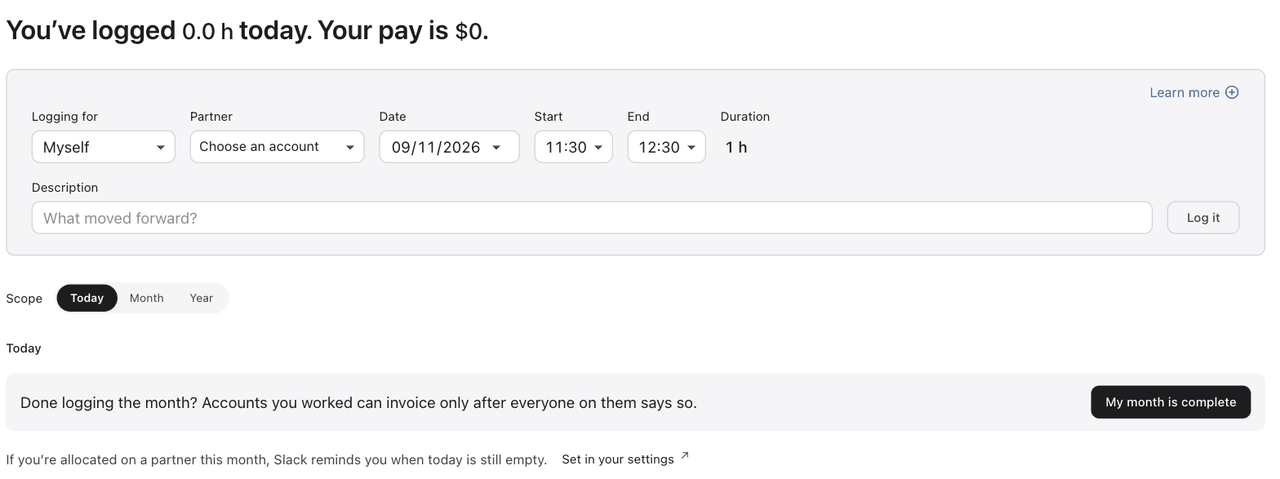
Ceed is the record we built to keep those habits at YSecurity. The team logs hours against each client’s budget from one Slack reminder a day, in under a minute, and each entry carries the person, the date and a line in their own words about what moved forward. “Checked the agent’s draft of the vendor risk assessment against the contracts. Fixed four rows.” is a perfectly good line. It says what the agent did and what the person did, and the entry puts the hour against its client on the day, while the time is still easy to report. Some of METR’s developers found their time hard to report once agents ran in the background. Why the reminder asks for one line and nothing more is in One minute a day. From Slack.
An hour that would push a client past its agreed budget is saved and marked pending approval the moment it is logged. It waits in the row where it happened for a named person, an owner or the account leader, to approve or decline, with the reason they type. Approved, it goes on the invoice at the agreed rate. Declined, it stays on the record, unbilled. Nothing disappears and nothing is billed quietly. The person who logged it sees at once that the client’s budget is in question, not their hour, as we described in What the person logging sees, and the details are on our questions page.
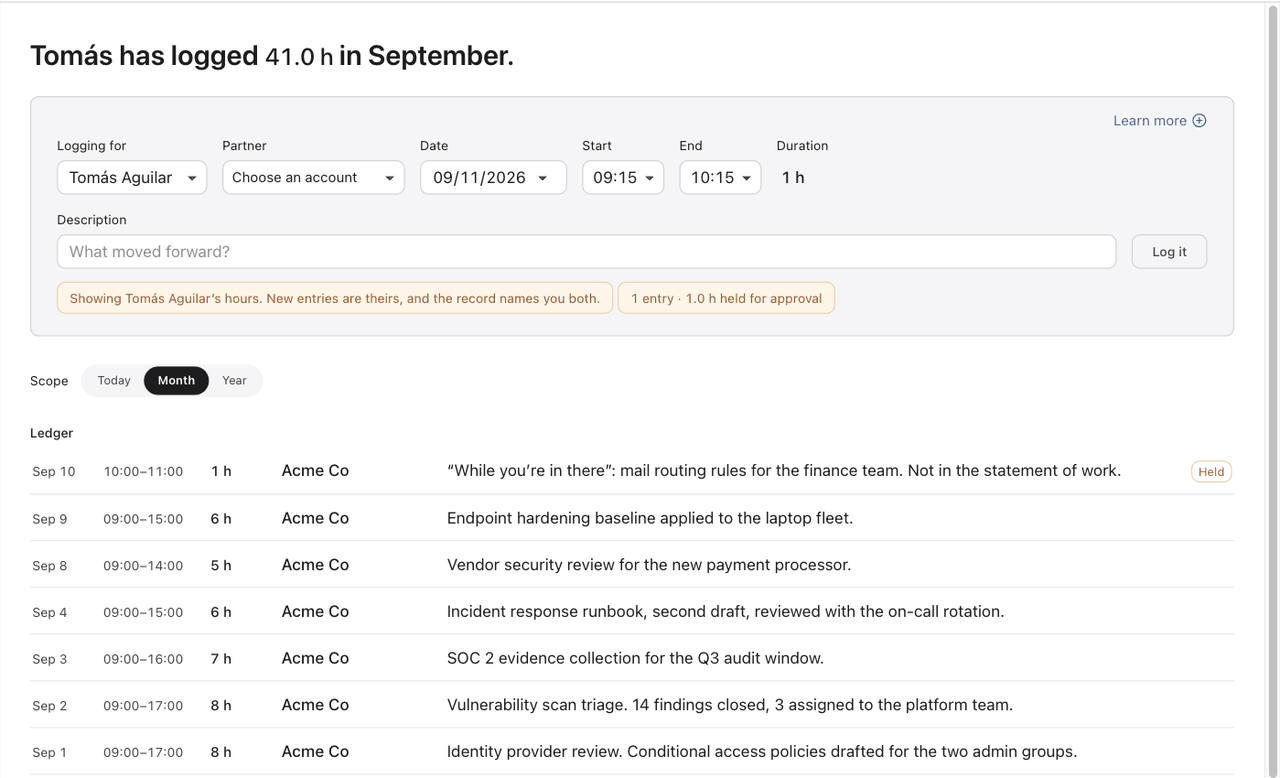
41.5 of 40 h
Tue 22 Sep · 1.5 h · Checked the agent’s draft of the vendor risk assessment against the contracts. Fixed four rows. Agent run about $3 · Tomás A.
Pending approval. 1.5 h over the client’s budget.
The card is the week from the start of this post, recorded on the day. The line about the agent is Tomás’s own, typed like any other description. His hour and a half of checking would take Acme Co past its 40 hours, so it waits for a yes or a no, and either answer is on the record before the invoice is.
From the same hours, Ceed computes revenue, cost and margin for every client every morning, as we described in Margin per client, this morning. The month reads invoiced, people cost, operating cost and cash margin side by side. Rates and margin are visible only to the owners and the people they name. That gives the weekly look at each client a place to start: the hours, in the words of the people who worked them, and the margin they left. It is what the time tracking page means by know in September, not in October.
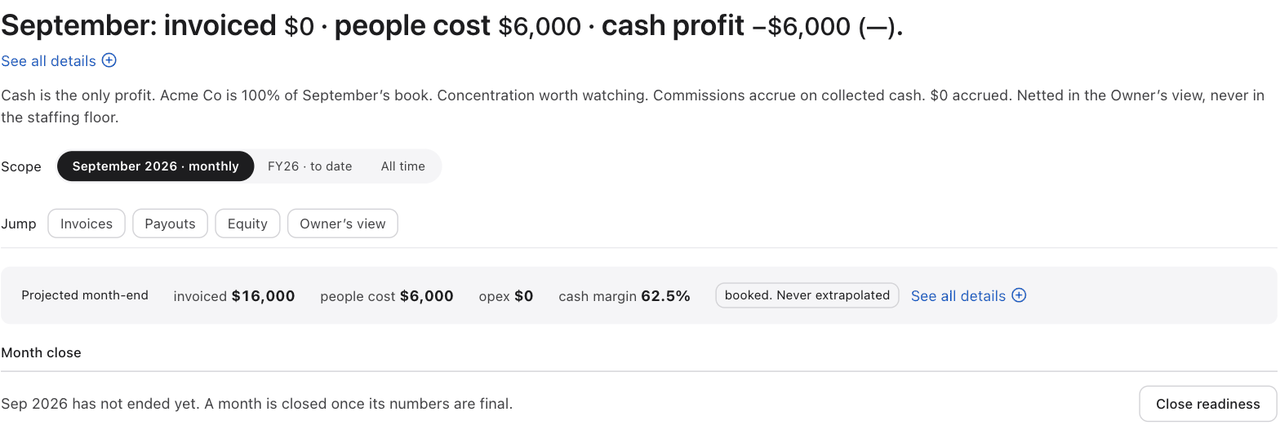
When the month closes, the invoices, the statements and the margin freeze, and nothing in a closed month changes. Every change is on an append-only trail, with tabs that separate what people did from what Ceed Intelligence did. Ceed Intelligence turns a sentence such as “log two hours on Acme Co” into the act. It proposes, a person confirms, and every act shows its price in dollars and tokens first. Every number on an invoice is computed from the agreement and the record, the same way every time.
A firm of ten. Where the hours went.
One year, ten people, four places the hours go. Pick one to see what it costs, and what a decision on the day changes.
Checking the AI
- Hours saved with AI, 4 a week each for 45 weeks1,800 h
- Spent checking and fixing what it made, 37%−666 h
- Left over1,134 h
- Of all of it, on any plan, budget or invoice0 h
Logged against the client, the 666 hours of checking become hours the firm can bill or price. Unlogged, they vanish with the 1,134 left over.
New work, unpriced
- Hours left over, spent on work nobody priced1,134 h
- At $175 an hour, never billed$198,450
- Half of it put to the client as priced work+567 h · +$99,225
- Share of available hours billed66.4% → 69.6%
- Margin for the year31.2% → 34.3%
Half the extra work, priced, adds three points to the share billed. The other half can still be given away, on purpose.
Unplanned work
- One client, a month sold at 100 h for $17,50054.3%
- With 15 unplanned hours absorbed, unbilled47.4%
- Six clients like it, for a year1,080 h · $189,000
- The 15 hours approved, billed at the rate+$2,625
- Margin on that client, with the hours approved54.3%
Each hour that would cross the budget waits for a named person. Approved, it is billed at the agreed rate. Declined, it stays on the record, unbilled.
Never written down
- Ten people, 225 days of 8 hours18,000 h
- Captured as billable, at Clio’s 3.0 of every 86,750 h
- Invoiced, then collected5,850 · 5,400 h
- Captured, never collected, at $1751,350 h · $236,250
- Two partners’ silent write-downs, 76 h each152 h · $26,600
An hour that never reaches the record cannot be billed, declined or learned from.
Our illustration: ten people, 45 weeks of 40 hours, $175 an hour billed and $80 an hour of loaded cost, close to the $78.88 an hour worked that the Bureau of Labor Statistics put on a management or professional worker in private industry in June 2026, the figure we used in Markup is not margin. Checking: 4 hours saved a week each, inside Workday’s one to seven, and its 37% lost to rework. New work: all 18,000 hours are paid either way, so margin is billed hours at $175, less 18,000 hours at $80, over what was billed. Unplanned: 15 hours on a 100-hour month, half of Unit4’s 30%. Never written down: Clio’s 2025 law-firm day and Thomson Reuters’ 76 hours a partner. The four panels are separate leaks and do not add up to one year.
Ceed costs 0.1% of what you invoice, with no seats, no tiers and no minimum, and nothing to pay until your first invoice. Your bank moves the money, and Ceed never touches it. Invoices and statements go to QuickBooks Online or Xero as documents. Where Ceed stands beside the time trackers and the suites is on the comparison page, and we ran our own books on it first.
BCG’s sentence has two verbs, and a firm of ten can keep both. The time people save “leaks out of the organization unless it is tracked and deliberately reinvested.” Tracked means today, by the person who did the work, in a line they wrote. Reinvested means a named person decided, before the invoice, what the hour was for. The morning saved on Monday is still there on Friday when somebody wrote it down on Monday.
What the books say.
Four books: three on time and attention, and one on the hours culture at the top.
- Four Thousand WeeksOliver Burkeman, 2021. The efficiency trap: the faster the work gets done, the more work arrives to fill the time, which is Accenture’s “more scope” in a personal key.
- Slow ProductivityCal Newport, 2024. Against pseudo-productivity, visible busyness standing in for output, the always-juggling week of the Berkeley study in book form.
- Attention SpanGloria Mark, 2023. The research on what switching between threads costs, a cost that grows when every task has an agent running beside it.
- The Meritocracy TrapDaniel Markovits, 2019. The hours culture at the top of law and finance, the background to every eaten hour in this post.
Five conversations about where the hours go.
The firm behind Ceed also hosts The Security Podcast of Silicon Valley, more than a hundred conversations since 2021 with the people who build and run security. It has never set out to talk about billable hours, but these five episodes are about where the time goes once agents arrive.
- 105
Yair Grindlinger, co-founder and chief executive of Surf AIOctober 2026 · What analysts wanted agents to take first: the follow-ups, the escalations and the tickets.
- 93
Jacob Andra and Stephen Karafiath of Talbot WestApril 2026 · Map the organization and its dependencies before choosing a tool, the scoping that decides where saved hours go.
- 84
Jack Cable, chief executive and co-founder of CorridorDecember 2025 · Code now ships faster than anyone can review it, which is where many of the saved hours end up.
- 87
Venkat Thiruvengadam of DuploCloudJanuary 2026 · Hours trapped in tickets, and the guardrails, permissions and human review that let agents take them on.
- 91
Neatsun Ziv, chief executive of Ox SecurityMarch 2026 · Hours lost to noise, and the business context that decides which work is worth a person’s time.
Ceed is for firms that sell their team’s time: security consultancies, managed security providers, IT and software firms, data and AI consultancies, management consultancies, law firms, professional advisors, fractional CFO practices, engineering firms and agencies up to fifty people, and nineteen kinds of firm in all. If the hours saved on Monday are gone by Friday, sign up and let this month show you where they went. Nothing to pay until your first invoice.
Sign upOr write to hello@ceed.so.
Questions.
What is a good billable share of hours for a consultant?
About 75% of available hours is SPI Research’s target, and the average firm falls short of it. The average fell to 66.4% in 2025, the lowest in the benchmark’s nineteen years, and in 2024 firms with fewer than ten people billed 64.3%, against 78.3% for firms of more than 5,000. A consultant who also sells and runs the business will bill less than one inside a large firm, and should price for it. The number that matters more is the one behind it: where the unbilled hours went, client by client.
Why are firms billing a smaller share of their hours?
Partly demand, partly hours that leak. SPI Research says firms have struggled to match capacity to shifting client priorities, and Deltek points to client caution and longer sales cycles. But hours also go to work nobody recorded or priced: Unit4 found around a third of allocated time is unplanned, Workday found nearly four of every ten hours saved with AI spent fixing its output, and Thomson Reuters counted 76 hours a year per law-firm partner never entered. A benchmark shows those hours only as the share that was not billed.
Does AI actually save time at work, or does checking it eat the savings?
Both. 85% of the employees Workday surveyed said AI saves them one to seven hours a week, but roughly 37% of the time saved went to fixing what the tools produced, and only 14% consistently came out ahead. METR found experienced developers 19% slower with early-2025 tools, and now says late-2025 tools probably speed them up, though its data is only very weak evidence of by how much. Boston Consulting Group’s finding applies either way: saved time leaks away unless it is tracked and deliberately reinvested.
What is workslop, and what does it cost a team?
Workslop is AI-generated work that looks polished but lacks real substance, so the effort lands on whoever receives it. Researchers at BetterUp Labs and the Stanford Social Media Lab named it in Harvard Business Review in September 2025. In their survey of 1,150 full-time US desk workers, 40% had received some in the previous month, each incident took about two hours to resolve, and the cost came to $186 a month for each person who received it, or $9 million a year for a company of 10,000. For a team of ten, the same arithmetic gives about $9,000 a year.
How do you record time when an AI agent does part of the work?
The same way as any other hour, with one more line. Log the time against the client on the day, and say in the entry what the agent did and what you did: drafted, directed, checked, fixed. Note what the run cost if you know it. Some of METR’s developers found their time hard to report while agents ran, which is why the line belongs in the entry on the day. If the hour would take a client over budget, let a named person approve or decline it before the invoice.
Does written-off time still count toward my billable hours?
Practices differ, so ask how your firm counts it. What is certain is that an hour you never record counts nowhere. It makes the firm look as if it has room to spare, the complaint of the McGladrey memo Going Concern published in 2014, and it leaves the next job priced too low. Thomson Reuters counted 76 hours a year per law-firm partner worked and never entered. The safer habit is to record every hour you worked and let a named person decide, on the record, what the client pays for.
 Jon McLachlan is a co-founder of Ceed and of YSecurity, where every hour a client pays for is logged against its budget on the day it is worked, in the words of the person who worked it. Published 3 November 2026. Corrections to hello@ceed.so, and they are dated when made.
Sources
- The 2026 benchmark. SPI Research, “SPI Research Publishes its 19th Annual Professional Services Maturity Benchmark Report”, EIN Presswire, 24 February 2026, https://www.einpresswire.com/article/894826291/spi-research-publishes-its-19th-annual-professional-services-maturity-benchmark-report. Deltek, “2026 PSO Benchmarks: What We Learned and What’s Next from the SPI Maturity Benchmark Report”, 30 July 2026, https://www.deltek.com/resources/articles/professional-services-benchmarks/, read again on 18 October 2026. Sarah Johansen, Certinia, “Analyzing the 2026 SPI Research Professional Services Maturity Benchmark Report”, 23 June 2026, https://www.certinia.com/blog/analyzing-the-2026-spi-research-professional-services-maturity-benchmark-report/. Kailash Ganesh, Rocketlane, “2026 Professional Services Maturity Benchmark”, 19 March 2026, https://www.rocketlane.com/blogs/professional-services-maturity-index-2026. Every source below was read on 12 October 2026 unless another date is given.
- Earlier editions of the benchmark. SPI Research, 2023 PS Maturity Benchmark executive summary, February 2023, hosted by Deltek, https://images.more.deltek.com/Web/DeltekInc/{6df92f3e-f779-42c5-a019-19b9fd118451}_2023PSMB_Executive_Summary_Final_2_13.pdf, for 2018 to 2022. SPI Research, 2025 PS Maturity Benchmark, February 2025, hosted by Kantata, table 17 for the share of hours billed by firm size in 2024, https://get.kantata.com/rs/677-LEJ-696/images/2025-ps-maturity-benchmark.pdf. MarketScale Newsroom on profit in 2023 and 2024, 7 August 2026, https://www.marketscale.com/industries/business-services/professional-services-ebitda-fell-to-a-five-year-low-of-98-in-2024-and-firms-are-still-closing-the-gap. SPI’s sample changes every year, and the 2023 share of hours billed was not in the sources we read.
- AI and earnings in Denmark. Anders Humlum and Emilie Vestergaard, “Large Language Models, Small Labor Market Effects”, Becker Friedman Institute working paper 2025-56, 15 April 2025, https://bfi.uchicago.edu/wp-content/uploads/2025/04/BFI_WP_2025-56-1.pdf, revised as “Still Waters, Rapid Currents: Early Labor Market Transformation under Generative AI”, NBER working paper 33777, March 2026, https://www.nber.org/papers/w33777. The Hacker News thread on the first version, https://news.ycombinator.com/item?id=43791385.
- Executives and the productivity statistics. Yotzov, Barrero, Bloom and ten coauthors, “Firm Data on AI”, NBER working paper 34836, 16 February 2026, https://www.nber.org/papers/w34836. Sasha Rogelberg, Fortune, on the survey and Solow’s paradox, 17 February 2026, https://fortune.com/2026/02/17/ai-productivity-paradox-ceo-study-robert-solow-information-technology-age/, and the Hacker News thread on it, https://news.ycombinator.com/item?id=47055979, with the comments of techpression and SoftTalker.
- Chief executives and the largest firms. EY, “AI drives productivity, but CEOs struggle to turn gains into growth”, 1 October 2026, https://www.ey.com/en_gl/newsroom/2026/10/ai-drives-productivity-but-ceos-struggle-to-turn-gains-into-grow. Accenture’s fourth-quarter fiscal 2026 earnings call, transcript by The Motley Fool, 1 October 2026, https://www.fool.com/earnings/call-transcripts/2026/10/01/accenture-acn-q4-2026-earnings-call-transcript/. Ken Houseman on LinkedIn, 16 May 2026, read in a browser on 12 September 2026, https://www.linkedin.com/posts/ken-houseman_everyone-is-asking-if-ai-will-kill-the-billable-ugcPost-7461449494262456320-mihI/.
- Rework and review. Workday with Hanover Research, “Beyond Productivity: Measuring the Real Value of AI”, released 14 January 2026, as reported by Adam Pitman, ERP Today, 16 January 2026, https://erp.today/workday-research-finds-ai-productivity-gains-are-lost-to-rework/, and Mark Tarre, IT Brief, 14 January 2026, https://itbrief.news/story/ai-productivity-paradox-as-rework-erodes-time-gains, read again on 18 October 2026. Beauchene, Duranton, Martin, Lyon and Walters, Boston Consulting Group, “AI at Work: Strategy Matters More Than Tools”, 3 June 2026, https://www.bcg.com/publications/2026/ai-at-work-why-strategy-matters-more-than-tools, and Bloomberg’s report on it, via Carrier Management, 4 June 2026, https://www.carriermanagement.com/news/2026/06/04/288711.htm. Kantata’s survey of 200 professional services leaders, Business Wire, 8 January 2026, https://www.businesswire.com/news/home/20260108295161/en. McKinsey, “Where AI agents pay off: A practical guide to the economics of agentic workflows”, 24 August 2026, https://www.mckinsey.com/capabilities/quantumblack/our-insights/where-ai-agents-pay-off-a-practical-guide-to-the-economics-of-agentic-workflows.
- Workslop. Niederhoffer, Kellerman, Lee, Liebscher, Rapuano and Hancock, “AI-Generated ‘Workslop’ Is Destroying Productivity”, Harvard Business Review, 22 September 2025, https://hbr.org/2025/09/ai-generated-workslop-is-destroying-productivity. BetterUp’s page on the survey, conducted with the Stanford Social Media Lab in September 2025, https://www.betterup.com/workslop. The Hacker News thread on the article, https://news.ycombinator.com/item?id=45337253.
- Felt faster, measured slower. METR, “Measuring the Impact of Early-2025 AI on Experienced Open-Source Developer Productivity”, 10 July 2025, https://metr.org/blog/2025-07-10-early-2025-ai-experienced-os-dev-study/, and “We are Changing our Developer Productivity Experiment Design”, 24 February 2026, https://metr.org/blog/2026-02-24-uplift-update/. METR on X, 10 July 2025, https://x.com/METR_Evals/status/1943360399220388093, as quoted by Zvi Mowshowitz, “On METR’s AI Coding RCT”, 18 July 2025, read on 18 October 2026, https://thezvi.substack.com/p/on-metrs-ai-coding-rct. The Hacker News threads on both, https://news.ycombinator.com/item?id=44522772 and https://news.ycombinator.com/item?id=47142078, and the Show HN post for Estela, which rebuilds billable hours from Claude Code and Codex logs, 29 September 2026, https://news.ycombinator.com/item?id=49895206. Joel Becker’s talk at AI Engineer Code 2025, read on 18 October 2026, https://ai.engineer/talks/why-agent-hype-can-fall-short-of-reality-joel-becker-metr.
- More threads. Aruna Ranganathan and Xingqi Maggie Ye, on how AI intensifies work, Harvard Business Review, 9 February 2026, https://hbr.org/2026/02/ai-doesnt-reduce-work-it-intensifies-it. Simon Willison, “AI doesn’t reduce work, it intensifies it”, 9 February 2026, https://simonwillison.net/2026/Feb/9/ai-intensifies-work/. The Hacker News threads, https://news.ycombinator.com/item?id=46955703 and https://news.ycombinator.com/item?id=46945755. Tom Cunningham and Parker Whitfill, METR, “Task Substitution and Uplift”, 8 May 2026, https://metr.org/blog/2026-05-08-task-substitution-and-uplift/.
- Unplanned work. Consultancy.uk on Unit4’s research, 24 September 2026, https://www.consultancy.uk/news/45671/connected-systems-mean-uk-professional-services-firms-outperform-global-average-on-unplanned-work. Phil Wainewright, Diginomica, 24 September 2026, https://diginomica.com/professional-services-firms-lose-day-week-project-inefficiencies-rework-unit4. ERP Today on the British results, 2 October 2026, https://erp.today/unplanned-work-is-eroding-professional-services-margins. Unit4, “Professional Services Firms Urgently Need to Reinvest Time”, 3 June 2026, https://www.unit4.com/news/professional-services-firms-urgently-need-reinvest-time. Ignition, 2025 Agency Pricing & Cash Flow Report, 22 May 2025, https://www.ignitionapp.com/news/2025-agency-pricing-cashflow-report.
- Agencies. Marcel Petitpas, Parakeeto, “Finance Problems are Operations Problems in Disguise”, 18 September 2026, https://www.parakeeto.com/blog/point-of-view-how-the-agency-industry-is-changing-and-what-were-doing-about-it/. Parakeeto’s episode pages: 216, 28 January 2026, https://www.parakeeto.com/blog/pm-am-time-in-pricing-with-carson-pierce-ep-216/, 206, 5 November 2025, https://www.parakeeto.com/blog/from-losing-money-to-strong-profits-real-case-client-study-with-carson-pierce-ep-206/, and 202, 8 October 2025, https://www.parakeeto.com/blog/parakeeto-vs-project-management-tool-whats-the-real-solution-with-kristen-kelly-ep-202/. The episode pages, with their chapter times, were read on 18 October 2026.
- Hours never written down. Point Blank, “Scathing KPMG report”, 11 October 2026, citing the Australian Financial Review, https://www.pointblank.law/p/scathing-kpmg-report. KPMG Australia, Action Plan version 2.0, October 2026, https://assets.kpmg.com/content/dam/kpmgsites/au/pdf/policies/kpmg-australia-action-plan-version-2-0.pdf.coredownload.inline.pdf. Fishbowl, the thread on eating hours because of the budget, https://www.fishbowlapp.com/post/have-you-ever-ate-hours-because-of-the-budget-pwc-ey-kpmg-deloitte-grant-thornton, and the thread on ghosting hours, https://www.fishbowlapp.com/post/ghosting-hours-yay-or-nay, with ages as the site showed them on 18 October 2026. Paul W. Swaney III on X, 1 January 2026, read in a browser on 12 September 2026, https://x.com/paulswaney3/status/2006806649764282745. Adrienne Gonzalez, Going Concern, on the McGladrey memo, 14 November 2014, https://www.goingconcern.com/dont-eat-hours-you-idiots/. Kelly F. Gamble, “Accounting Practice Issues in the Classroom: Underreporting Time”, Academy of Accounting and Financial Studies Journal, volume 25, issue 3, 2021, https://www.abacademies.org/articles/accounting-practice-issues-in-the-classroom-underreporting-time-10736.html, read on 18 October 2026.
- Law firms. Thomson Reuters Institute, “Law Firm Billing Efficiency and Write Downs”, 2023, https://www.thomsonreuters.com/en-us/posts/wp-content/uploads/sites/20/2024/04/Law-Firm-Billing-Write-Downs-2023-1.pdf. Clio, Legal Trends benchmarks, 2025 report, https://www.clio.com/resources/legal-trends/benchmarks/. Amy Coats, “Law Firm Write-Offs: What Your Leakage Is Trying to Tell You”, Attorney at Work, 4 June 2026, https://www.attorneyatwork.com/law-firm-write-offs/. Jacqueline Vinaccia, “How to Track Billable Hours Efficiencies and Stress Less”, Attorney at Work, 18 June 2026, https://www.attorneyatwork.com/billable-time-stress-less/.
- The record keepers at a large firm. Deloitte careers, the Engagement Financial Advisor posting, requisition 361992, https://usijobs.deloitte.com/en_US/careersUSI/JobDetail/USI-EH-FY27-Enabling-Areas-GFS-EFA-Spanish-Services-Specialist-Senior-Analyst/361992, and the Billing Services Specialist posting, requisition 365964, https://apply.deloitte.com/en_US/careers/JobDetail/Billing-Services-Specialist/365964, both read on 18 October 2026.
- The case against. Blair Enns and David C. Baker, 2Bobs, “Is AI Going to Kill Labor-based Pricing?”, 25 March 2026, transcript on the page, https://2bobs.com/podcast/is-ai-going-to-kill-labor-based-pricing. Jonathan Stark, “How do consultants manage to get over-the-budget funds covered by the client?”, 11 September 2026, https://jonathanstark.com/daily/20260911-2359-how-do-consultants-manage-to-get-over-the-budget-funds-covered-by-the-client. Earmark podcast, episode 8, “Deconstructing timesheet defenses with Ron Baker, CPA, founder of VeraSage Institute”, 24 January 2022, transcript, the passage in the section that starts at 16:55, https://podcast.earmarkcpe.com/episodes/timesheet-defenses-deconstructed-with-ron-baker/transcript, read on 18 October 2026.
- The cost of an hour. Bureau of Labor Statistics, Employer Costs for Employee Compensation, June 2026, released 9 September 2026, https://www.bls.gov/news.release/ecec.nr0.htm. The $78.88 is the figure as cited in our post “Bill rate. Pay rate.”, section “Markup is not margin.”, https://ceed.so/blog/bill-rate-pay-rate#the-arithmetic, checked there on 18 October 2026. The $175 billed rate, the $80 loaded cost and the firm of ten are our illustrations.
- YSecurity. Sasha Sinkevich, “The Art and Zen of Adopting AI”, 17 September 2026, https://ysecurity.io/blog/the-art-and-zen-of-adopting-ai/. “Why Shift-Left Security Keeps Failing (and What Actually Works)”, 25 March 2026, https://ysecurity.io/blog/why-shift-left-security-fails/. “Why 95% of Enterprise AI Projects Fail: The Scoping Discipline That Beats the Odds”, 23 April 2026, https://ysecurity.io/blog/why-ai-projects-fail-scoping/. Jon McLachlan, “What Even Is a SOC 2? A Founder’s Plain-English Guide to SOC 2 Reports”, 1 September 2026, https://ysecurity.io/blog/what-is-soc-2/. Agentic Engineering, https://ysecurity.io/services/agentic-engineering/. Business Modernization and Agentic Transformation, https://ysecurity.io/services/business-modernization/. “How YSecurity helped Augment Code earn ISO 42001 and close a $1M+ deal just 2 days later”, 14 August 2025, https://ysecurity.io/case-studies/iso-42001-augment-code-case-study/.
- Recordings, in the order they appear. Kantata with SPI Research, Takeaways From the 2024 PS Maturity Benchmark, 22 February 2024, https://www.youtube.com/watch?v=LlerYCr3wBg. Consulting Success, What Consultants Need To Know About Utilization Rate, Margin and More with Matt Hayter, 7 August 2023, https://www.youtube.com/watch?v=QpMa0F0z3C4. Thomson Reuters, 2026 AI in Professional Services Report, 12 February 2026, https://www.youtube.com/watch?v=MJi2w53Sj-I. Joel Becker, METR, Why Agent Hype can fall short of reality, AI Engineer Code 2025, https://www.youtube.com/watch?v=RhfqQKe22ZA. Parakeeto, episode 216, 28 January 2026, https://www.youtube.com/watch?v=VCjVu_S05Ww. Clio, Deep Dive on the 2024 Legal Trends Report, https://www.youtube.com/watch?v=Cb6-l0Roqx0. Parakeeto, episode 206, 5 November 2025, https://www.youtube.com/watch?v=lojntr6QIrY. Accounting High TV, The Timesheet Debate, Ed Mendlowitz and Ron Baker, 10 March 2024, https://www.youtube.com/watch?v=BP1Yq8oa_es. Parakeeto, episode 202, 8 October 2025, https://www.youtube.com/watch?v=VoXadyZ9lZE.
- Product pictures are of Ceed’s staging environment in September 2026, showing a demo account with invented names and figures. The drawn card uses the same demo account.
- The Security Podcast of Silicon Valley, a YSecurity production: episode 105, Yair Grindlinger, 6 October 2026, https://ysecurity.io/podcast/105-shrink-what-a-breach-can-reach/, read on 18 October 2026. Episode 93, Jacob Andra and Stephen Karafiath, 21 April 2026, https://ysecurity.io/podcast/93-the-conversation-nobodys-having-about-ai/. Episode 84, Jack Cable, 16 December 2025, https://ysecurity.io/podcast/84-what-gets-missed-when-nobody-reviews-the-code/. Episode 87, Venkat Thiruvengadam, 27 January 2026, https://ysecurity.io/podcast/87-escape-the-ticket-trap-how-ai-agents-are-replacing-manual-devops/. Episode 91, Neatsun Ziv, 24 March 2026, https://ysecurity.io/podcast/91-why-asking-developers-to-fix-everything-is-a-bad-idea/.