Blog · 27 October 2026 · Jon McLachlan
The agent worked. The meter ran.
The price of a token for the same capability falls about tenfold a year, and the bill for AI went up anyway. For a firm that sells its team’s time the bill raises a sharper question: when an agent does part of a client’s work, whose budget its meter runs on, and who pays. This post follows the year from spending to counting, shows why one task can have thirty prices and why the hour moves to review, and works one client’s month five ways. With nine recordings, three posts from X, the Hacker News threads, six figures, pictures of the product, four books and five episodes of The Security Podcast of Silicon Valley. None of it is legal, tax or financial advice. Correct as far as we know on 18 October 2026.
On 3 March 2026 someone asked Hacker News how an agency prices work when AI makes it faster and brings a bill of its own: “How do you factor in the overhead of AI tools without eating into your margins, and how do clients react?” It drew one point and one reply, and the reply is still the clearest statement of the problem we have read.
“I think there’s the work and there’s the compute bill. AI mostly changes the work side since you can finish faster but the compute cost is still real and can vary a lot. The way I’ve seen it handled is a fixed project fee with ‘normal’ AI usage included, and if it turns into heavy runs or lots of experimentation that part gets billed separately.”
“Otherwise you end up paying the API bill yourself.”
reggz, on Hacker News, 4 March 2026.
Seven months later the problem sat near the top of McKinsey’s reading list. In the third quarter, three of the ten articles its readers read most were about the economics of agents, after none in the first two lists of the year: “Is that AI agent worth it?” fifth, “The cost of intelligence” eighth and “Where AI agents pay off” ninth. The first of the three answers reggz in one sentence.
“No autonomous system should operate without a defined mandate, budget, and stopping rule.”
Lari Hämäläinen, Mark Patel, Sven Blumberg, Tanguy Catlin and Wasim Lala, McKinsey Quarterly, 13 July 2026.
The rule came late because the price fooled almost everyone. Tokens got cheaper, companies expected their bills to follow, and Accenture found many with “a token bill no one can forecast and value no one can prove.” For a firm that sells its team’s time, the meter runs on a client’s work. An agent’s run is a cost of that client’s month in the way an hour is, and the hour does not leave when the agent arrives: in McKinsey’s August numbers for a bank’s customer service agent, human oversight was 70% to 75% of the variable cost and the tokens 20% to 25%. So the rule for a firm of ten is ordinary. Set the budget before the work. Record what each client’s work cost, in people and in machines. Write into the agreement who pays: the firm inside its price, the client inside a fixed fee, or the client at cost. And let the run or the hour that would cross the client’s budget wait for a named person.
We run a security consultancy, YSecurity, and keep its books in Ceed, the record we built to run it. Every act of Ceed Intelligence shows its price before a person confirms it, and Ceed itself is built with agents that people at YSecurity run and answer for, so this meter runs on our work too.
None of this is legal, tax or financial advice. Who may pay for what is settled by each client’s agreement, and in law and other regulated work by rules that differ from place to place. Ask your attorney before you change an engagement letter, and your accountant before you change how a cost is booked.
541
tokens consumed on Azure AI by Bain’s estimate for March 2026, against 100 in December 2024, while the price fell to 42. Bain.
30×
the most that two runs of the same programming task differed in tokens, and so in cost, in a study McKinsey cites. McKinsey.
70% to 75%
of an agent’s variable cost is the people overseeing it, in banking customer service. McKinsey.
43%
of 314 leaders of large US companies report usage or token budgets, in the third quarter of 2026. KPMG.
Cheaper tokens. Bigger bill.
Start with the price, because it really did fall. Guido Appenzeller of Andreessen Horowitz named the fall LLMflation in November 2024, after the large language models that run on tokens: “For an LLM of equivalent performance, the cost is decreasing by 10x every year.” The list prices followed. Anthropic’s largest model cost $15 per million tokens read and $75 per million written as Opus 4.1, and $5 and $25 as Opus 4.6, a cut In-House APAC put at “roughly 67%”. Ramp, the corporate card company, reported on 9 September that its index of the effective price per million tokens had “declined 41% to $0.68 as of this week, down from the 2026 peak of $1.15 in March.”
Then look at the bill. Bain published the chart on 29 September, in its Technology Report. It sets Microsoft’s Azure AI at 100 in December 2024 and follows two lines to an estimate for March 2026. By that estimate, the price per million tokens fell to 42 and the number of tokens consumed rose to 541. Bain’s note on the chart is short: “higher usage has more than doubled the overall bill.” Our arithmetic, the product of the two, puts the bill at about 227, which is what more than doubled looks like.

The arithmetic
An index of the bill is the index of tokens consumed times the index of the price, divided by 100.
- Tokens consumed, March 2026541
- Price per million tokens, March 202642
- The bill, 541 × 42 ÷ 100227
- Against December 20242.27×
Bain’s explanation is short. “As token prices declined, companies expected their costs to follow.” They did not, because companies move to the latest frontier models, agents spend more tokens on harder tasks and the use spreads to more workflows, “leaving overall cost per task stubbornly high”. Accenture asked 750 executives what a cheaper token would do. “Nine in 10 executives say cheaper tokens will lead them to expand use cases,” and “only one in 20 say they would bank the savings”. Their companies spent “roughly $2.5 billion on AI tokens last year”, and Accenture expects that to “approach $3.6 billion, with no optimization applied”, “Even after accounting for a predicted 19% price decline.” Its summary would do as this section’s headline: “Falling AI prices will not ride to the rescue.”
For most of that time the meter was hidden behind a seat. McKinsey said so in July: “Bundled seat-based pricing acted as a ‘safety net’ because it hid the usage costs.” Even the sellers misjudged it. In January 2025 OpenAI’s chief executive wrote that the company’s $200-a-month plan was losing money.
insane thing: we are currently losing money on openai pro subscriptions…
people use it much more than we expected.
A minute later he added, as TechCrunch quoted him, “I personally chose the price,” “and thought we would make some money.” Then the seats began to turn into meters. GitHub moved Copilot to billing by usage on 1 June 2026, because “the current premium request model is no longer sustainable.”
A firm of ten feels this with a sharper edge, because its meter runs on a client. A seat was a fixed cost, like rent, and it belonged to the firm. A run is a variable cost, like an hour, and it belongs to whichever client’s work it did. We looked at the tool bill as a cost of the whole firm in A new line. On the cost side., with what the law says about passing it on. This post asks what one client’s month cost when an agent did part of the work, and who pays for it.
Spend first. Count later.
In 2026 the largest companies ran the experiment for everyone else, in public. They gave their engineers the most capable agents, in some cases ranked them by the tokens they used, and found out what it cost when the invoices came. The order of the year is the lesson.
Jensen Huang, the chief executive of Nvidia, sets the tone on the All-In Podcast, as Business Insider quoted him: “If that $500,000 engineer did not consume at least $250,000 worth of tokens, I am going to be deeply alarmed.”
Jellyfish’s data on 7,548 engineers, as TechCrunch reports it: those with the largest token budgets “achieved two times the throughput at 10 times the cost of tokens.”
Ars Technica reports that “Amazon employees are ‘tokenmaxxing’ due to pressure to use AI tools”, the habit KPMG later defined as “using as many tokens as possible, often tracked on internal leader-boards”. Uber’s chief operating officer, Andrew Macdonald, says in an interview on Rapid Response, as Business Insider reports, that “it’s very hard to draw a line between one of those stats and, ‘Okay, now we’re actually producing 25% more useful consumer features.’” On 28 May a Fortune headline begins “Tokenmaxxing is over”, and the story reports that Uber said it “had burned through its entire 2026 ‘token budget’ in just the first four months of the year”.
Uber puts “a $1,500 monthly cap on employee spending for AI coding tools”, Outlook Business reports, after Bloomberg. Meta’s employees used 73.7 trillion tokens in roughly 30 days, MLQ reports, citing a memo first reported by The Information, and Meta plans formal token budgets for 2027.
McKinsey publishes the first two of its three articles on what agents cost. The Associated Press reports tokenmaxxing fading and quotes Vincent Gusdorf of Moody’s Ratings: “As bills started to pile in, people realized that those new tools are quite expensive”.
404 Media’s headline: “Microsoft Tells Engineers ‘Tokenmaxxing Is Not What We Are Optimizing For’”. Among the top 1% of businesses in Ramp’s data, monthly AI spend per employee falls 9.7%, “from $7,976 to $7,205”, and Ramp hears from businesses “imposing company-wide defaults that reduce usage of frontier models”.
The playbooks arrive: Accenture’s guide to tokenomics, KPMG’s survey with 43% of large US companies now running usage or token budgets, Bain’s chart and BCG’s index of what agentic AI is worth.
EY’s survey of 1,200 chief executives: “Only 16% of CEOs have strong confidence in measuring AI ROI and have real-time visibility into AI costs and returns.”
The leaderboards had their critics from the start. In April, Linear’s chief operating officer put the objection in two lines, as Business Insider reported them.
Ranking engineers by token spend is like me ranking my marketing team by who spent the most money…
Don’t mistake a high burn rate for a high success rate.
McKinsey described the pattern in July in a sentence any owner of a services firm will recognize: “cost overruns frequently become visible only after consumption has already occurred.” That is the invoice that tells the owner last, at the scale of Uber. The spending was not foolish in itself, and much of it bought learning. What failed was the order. The spend came first, and the count came months later, from a vendor’s invoice, when nothing about the month could be changed.
The people whose job is counting noticed. The FinOps Foundation, the professional body for the people who manage companies’ cloud bills, found in February that 98% of the 1,192 practitioners it surveyed now manage AI spend, against 31% two years earlier, and in June it opened its conference with a keynote on token economics.
A firm of ten runs no leaderboards, but the giants’ year carries its lesson, because the meter in a small firm runs on a client’s work. An overrun there is one client’s month that cost more than anyone priced, and the owner finds it at the invoice, the problem we built Ceed around, in the month we told in Why we built Ceed.
One task. Thirty prices.
An hour has a price. Ten hours cost ten times one hour, and a firm can budget a month by multiplication. A run does not behave that way, and McKinsey said so in July, citing an April study of token use in agentic coding by Longju Bai and colleagues, in the sentence most useful to anyone who prices work: “In programming, for example, the same task can have a factor-of-30 variation between completions.” The consequences follow. “Cost behaves as a distribution, not a fixed unit price.” “Average-cost budgets will not be enough.”
Where the spread comes from is in the same article, from a second study: “About 60 percent of an agentic task’s costs, in fact, are tied to refining answers.” The spending is uneven between people too. Inside McKinsey, “Roughly 10 percent of users account for about 65 percent of total token consumption.” A budget set on the average user, or the average run, is set on a number almost nobody hits.
Guess how many times more tokens a multi-agent system uses than a chat.Show the answer
About 15×
Anthropic’s engineers measured it on their own research system, 13 June 2025: “In our data, agents typically use about 4× more tokens than chat interactions, and multi-agent systems use about 15× more tokens than chats.”

Anthropic drew the economic conclusion itself: “For economic viability, multi-agent systems require tasks where the value of the task is high enough to pay for the increased performance.” Its documentation for Claude Code, its coding agent, gives the averages a firm can plan with, “around $13 per developer per active day and $150-250 per developer per month, with costs remaining below $30 per active day for 90% of users,” and advice that could stand for this section: “Budget more for a coding seat than a chat seat.”
The averages hide the tail, and the tail is where a firm loses money. When Hacker News asked in March how much people were spending on AI coding at work, the answers ran from daemonologist’s “$40/month at work and $10/month at home, and it’s more than I can use” to jjmarr’s, in one line: “I’ve spent $15 000 this month.” The same question, answered at a spread of more than three hundred to one.
The sellers see the same tail. When Anthropic set weekly limits on its Claude plans in July 2025, it gave the reason as a number, as Simon Willison quoted the announcement: “For example, one user consumed tens of thousands in model usage on a $200 plan.”
We’re rolling out new weekly rate limits for Claude Pro and Max in late August. We estimate they’ll apply to less than 5% of subscribers based on current usage.

The tail does not need a careless user either. On 28 April a developer posted to Hacker News a bill from Amazon Bedrock for Claude Opus 4.6, run through an ordinary coding-agent setup: “The gross Opus usage was $37,901.73.” About $35,600 of it was roughly 6.47 billion input tokens the developer had assumed were cached. Nobody chose that cost, and nothing stopped it.
On our own show in September, the chief information security officer of a16z called it a problem of estimating, which is a firm’s whole craft. Yash Kosaraju had described one task that could cost five times as much depending on how it was run, a line we quoted in Fewer hours. Same margin.
“what I’m seeing is we’re not good at estimating what each task we’re giving an AI agent would take.”
“So we need to get better at estimating what it takes to get something done and what the associated dollar value will be…”
Yash Kosaraju, chief information security officer at a16z, on The Security Podcast of Silicon Valley, episode 104, 22 September 2026, at 28:36.
For a firm of ten the lesson is to budget the tail, not the average. A client’s monthly budget for agent work is a ceiling that covers the bad run, set before the work, with a person named for the run that would cross it. The levers that narrow the spread are ordinary decisions. Accenture found that 54% of AI requests go to a more capable and more expensive model than the task needs, and Bain’s Jue Wang told the Associated Press, “Not everything needs a Claude Opus 4.6.” Choosing the model for a task is a decision a person makes and answers for, like choosing who on the team does the work.
The hour moved. It did not vanish.
The token is the visible part of an agent’s cost, and usually the smaller part. McKinsey’s third article of the summer, on 24 August, looked at what an agent doing customer service work at a bank costs to run, and found that “token costs frequently represent just 20 to 25 percent of the variable run costs of an AI agent.” The rest was people: “Human oversight, on the other hand, accounts for 70 to 75 percent of the variable costs.” In customer onboarding, McKinsey expects “10 to 20 percent of agentic runs to be reviewed by risk and functional experts.”

The measure McKinsey proposes follows: “the ‘fully loaded’ cost to finish the job.” EY’s guide to the true cost of an agent, published in July, lists seven kinds of cost. Consumption, the tokens and the calls that use them, is one of them. The workforce is another, “the people and skills needed to build, manage and oversee agents”, and failure and recovery a third. EY’s post about the guide on LinkedIn, headed “What’s the true cost of an AI agent? Not just tokens”, had 2,319 reactions and 496 reposts when we looked on 12 October.
The people who do the work describe the same shift without the percentages. A corporate lawyer at a large firm, by their own account, writing as terminalcommand on Hacker News in September, said what is left of a task when the tool finds the issues: “A lawyer will spend the time on reviewing the red flags identified and draft a report.” And what happens when nobody priced that time: “If you charge 10k for a job to a client and the hourly costs ramp up to 20k, the management criticises the partner, the associates become unwilling to work for the partner (as their hours get written off).”
Capgemini put the principle in a definition on 1 October: “AI Yield is the verified business value created by AI minus the full cost of achieving it safely,” a cost that includes “governance and human oversight.” The hour did not vanish when the agent arrived. It moved from doing the work to checking it, and the checking is still a person’s hour, on a particular client’s work, in a particular month. It belongs on that client’s budget like any other hour. Who pays for it, and for the runs, is easiest to see in one client’s month.
A firm reviews ten pull requests for a client in a month, the changes the client’s developers want merged into its code. Before the agent, each review took a person two hours. With the agent, each review costs $20 in tokens, inside the $15 to $25 average Anthropic’s documentation gave for its automated code review when we read it on 12 October 2026, and a person spends half an hour on the findings. People cost $90 an hour and the review bills at $200. The rates and times are illustrative, chosen for easy arithmetic.
Ten reviews. Five ways to pay for the agent.
One client, one month, the same work. Before the agent the ten reviews took 20 hours, billed $4,000 and earned $2,200, a margin of 55%. Pick who pays for the agent.
Absorb it
- Invoice, 5 review hours at $200$1,000
- People, 5 hours at $90−$450
- Agent runs, 10 at $20, paid by the firm−$200
- Margin$350 · 35.0%
The client pays for the review hours and the firm pays the meter. The client got 75% off without asking, which is what billing by the hour does with a saving.
Absorb it, no budget
- Invoice, 5 review hours at $200$1,000
- People, 5 hours at $90−$450
- Agent runs, 40 at $20, on every push−$800
- Margin−$250 · −25.0%
The same work and the same invoice, with a setting nobody chose: the agent ran on every push, four times a review. The meter grew fourfold and the month lost money.
Price the review
- Invoice, 10 finished reviews at $250$2,500
- People, 5 hours at $90−$450
- Agent runs, 10 at $20−$200
- Margin$1,850 · 74.0%
The client buys a finished review at $250, $150 less than the $400 a review cost when it took two hours, and the firm earns 74%. The saving is shared.
Price it, no budget
- Invoice, 10 finished reviews at $250$2,500
- People, 5 hours at $90−$450
- Agent runs, 40 at $20, on every push−$800
- Margin$1,250 · 50.0%
The fixed price protects the client and leaves the meter with the firm. Every extra run comes out of the margin, and four runs a review cost 24 points of it.
Pass it through
- Invoice, 5 review hours at $200$1,000
- Invoice, agent runs at cost, 40 at $20$800
- People, 5 hours at $90−$450
- Agent runs, paid to the provider−$800
- Margin$550 · 30.6%
The agreement says the client pays the meter at cost, so the firm’s $550 is safe whatever the runs cost. The client’s invoice is not: with the agent on every push, its line for agent runs is $800, 44% of the bill.
Our arithmetic, with illustrative rates and times. Before the agent: 20 hours billed at $200, $4,000, with people at $90 an hour, $1,800, a margin of $2,200, 55%. With the agent: half an hour a review, 5 hours, $450 of people cost, billed at $1,000. A run costs $20, inside the $15 to $25 average Anthropic’s documentation for its code review gave on 12 October 2026. Its page on what Code Review costs says that running it after every push multiplies the cost by the number of pushes, and that a repository added from the admin page starts at that setting. With a budget the agent runs once a review, 10 runs, $200. With no budget it runs on every push, four a review, 40 runs, $800. Absorb it: $1,000 − $450 − $200 = $350, 35.0%. No budget: $1,000 − $450 − $800 = −$250, −25.0%. Price the review: $2,500 − $450 − $200 = $1,850, 74.0%. No budget: $2,500 − $450 − $800 = $1,250, 50.0%. Pass it through: $1,800 − $450 − $800 = $550, 30.6%. In the first option the review is $450 of $650 of variable cost, 69%.
The same ten reviews land anywhere from −25% to 74%, and nothing about the work explains the difference. How often the agent runs is a setting. Who pays for the runs is a sentence in the agreement. Whether the review is sold by the hour or by the piece is the price. The one thing that stays the same is the review: five hours of a person’s time and $450, the largest single cost of the month whenever the agent runs to a budget, and in the first option 69% of the variable cost, close to McKinsey’s 70% to 75%. Billing it by the hour hands the whole saving to the client before anyone asks, the trap we described in Faster work. Smaller invoice. That may be right for a client the firm wants to keep at any price. It should still be a decision somebody made.
A mandate. A budget. A stopping rule.
McKinsey’s sentence has three nouns, and each is a decision a person makes before an agent runs. The mandate is what the agent may do, and for whom. The budget is what it may spend doing it. The stopping rule is what ends the run when nobody is watching. The same article gave the reason for all three: “Some 93 percent of respondents to a McKinsey survey report exceeding their AI budgets.” Its footnote takes the figure from 75 respondents in May 2026, a small sample with a clear answer.
The bill from Amazon Bedrock in the section on thirty prices is the case for the third noun. The developer who posted it had set budget alerts, and they stopped nothing. The post reads in places like rules learned the expensive way.
“Prompt caching is not a checkbox.”
“Budget alerts are not a kill switch.”
“Credits are not protection.”
“Why is there no simple hard cap at the Bedrock/API level?”
Zephyr0x, on Hacker News, 28 April 2026, after a bill of $37,901.73.
An alert reports. It does not stop. We made the same argument about hours in An alert is a report., and it applies to runs: a message that arrives after the spend is a record of the spend, not a decision about it.
The largest companies are writing the rule down. KPMG’s survey of 314 leaders of large US companies, published on 24 September, found that 43% “have implemented usage or token budgets,” and that 74% now “include cost reviews in AI approval processes, up from 61% last quarter.” On 30 September BCG, which had asked eight days earlier for a hard ceiling on every payments agent, put the order of operations in eight words.
“Put the controls in before you grant autonomy.”
BCG, “The Formula for Agentic AI Value”, 30 September 2026.
For anyone who runs an agent, the stopping rule now ships as a setting. In the reference for Claude Code’s command line, --max-budget-usd will “Stop the run once estimated spend on API calls reaches this amount” in its non-interactive print mode, with an honest warning, “Spend can pass the cap, so leave headroom,” and --max-turns will “Limit the number of agentic turns”. Anthropic’s automated code review takes a monthly cap, and Anthropic’s business plans and GitHub’s budgets set limits for a whole organization, a cost center or a single person.
None of these settings decides anything by itself, and set badly they backfire. A budget is a sentence written in advance by someone who answers for it. The setting keeps the sentence while the run moves faster than anyone can read.
For a firm of ten, the client’s budget is the edge of the mandate. An agent that works on Acme Co’s code works inside Acme Co’s month, and the run that would push that month past what the client agreed to pay is the same event as the hour that would. In Ceed, the hour that would cross the budget waits as pending approval for a named person’s yes or no. In a firm’s own practice the run can wait the same way: set the agent’s ceiling at what the client’s budget has left, and when the ceiling is reached, a named person decides whether to raise it. Who that person should be, and why the person who starts a run should not be the one who approves its crossing, is the subject of The agent enters. A person approves.
The responsibility belongs to people at every step. Agents are software that people write, prompt and run, and the person who starts a run answers for what it spends, as the person who logs an hour answers for the hour. I put it this way in September, in a post on YSecurity’s blog about the approve button: “A spending ceiling is a boundary too, and like a scoped credential, it’s one an agent can’t talk its way around.” And in October, in one about the keys a developer hands an agent: “Give the agent a gift card with a limit, a merchant and an expiry date, not your wallet.”
Whose client. Whose run.
A budget per client needs a cost per client. The hour has always had one, because the person who logs it names the client. The run does not, unless someone arranges it. Legora, which sells AI to law firms, built its new pricing around exactly that in June: “Every run can be attributed to the matter, giving law firms cost transparency for each client.” GitHub’s budgets for Copilot follow the organization chart, by enterprise, cost center and user. Each of these sees the run from the vendor’s side, and none knows which of a firm’s clients a run was for unless the firm tells it.
Most large companies cannot yet say where their tokens went. Accenture found that only 53% of token usage can be traced to a particular user or team, and that “Just 7% of companies use a chargeback model for tracking AI costs.” Its definitions are the choice a firm faces with each client: “Chargeback bills the consuming team for what it uses.” “Showback makes consumption visible but attaches no financial consequence.” McKinsey’s experience, in July, was that 20% to 30% of AI spend “is often unaccounted for,” and KPMG’s June report named the rule a company needs before any of this works, a rule for “who owns AI-related costs”.

The counting is moving from the finance department into the teams that run the agents. At FinOps X, the foundation’s conference, Pinterest’s engineers presented how they think about token efficiency, and Shutterstock how it turns AI cost data into decisions.
At the scale of a small firm the answer is not a dashboard. It is a habit with three parts, each something a person does. The first is to give each client its own key, workspace or project at the model provider, so that the provider’s own report splits the bill by client without anyone tagging runs after the fact. The second is to log the hour against the client, as always, including the hour spent reading what the agent produced. The third is to write, in that hour’s entry, what the agent did and what the runs cost, in the person’s own words: “Reviewed the agent’s findings on four pull requests, four runs, $80 at the provider.” Then each client’s month has both of its costs on record, the people from the hours and the machines from the provider’s report, and the margin on that client is arithmetic instead of a guess at the close. It is the number we wrote about in Margin per client, this morning., and the one only the owner knows under a flat fee, in The number only you know.
Attribution starts with knowing which agents and keys exist at all. A run on someone’s personal account, or on a pilot nobody switched off, is a cost no one can put on a client and a risk no one can name. YSecurity’s post on shadow AI covers the tools a company uses without having approved them, and its Corporate Shadow-AI Detection and Mitigation work starts with an inventory of “every AI tool, browser extension, and API key touching company data”. In “Who Holds Your Agent’s Keys?” I put the ownership point in one line: “A pilot ends. Its credential doesn’t, unless someone owns it.” YSecurity’s AI User Access Control Audits apply the same idea to access instead of cost.
Absorb it. Include it. Or pass it on.
Once a firm knows what a client’s work cost, it has to decide who pays, and the largest firms have not settled that either. McKinsey’s August article ended with four open questions, and the first is this section’s: “When should AI costs be passed through to customers or absorbed by the organization?”
Agencies have been answering in practice all year, and Sam Bradley of Digiday collected their answers on 3 March. They fall into three groups, and every group needs a record.
| Answer | Who uses it, in their words | What the agreement says | What the firm keeps on record |
|---|---|---|---|
| Absorb it | Lisa Herdman, RPA: “We can’t expect to charge our client for something we don’t know is actually going to work for them.” | Nothing about the meter. The price carries it. | Runs and review hours for each client, to know what the price still earns. |
| Include it | Taryn Crouthers, Big Spaceship: “We’re treating it similar to a production cost.” reggz, on Hacker News: a fixed fee with “normal” usage included. Pencil gives each client an allotment of tokens. | The usage the fee includes, and what happens past it. | Each client’s usage against its allotment, and the runs beyond it. |
| Pass it on at cost | Josh Archer, Lerma/: “We’re not marking it up, we just show it as a line item similar to other costs.” Domenic Venuto, Horizon Media: “It’s cost recovery, not revenue.” | Agent runs billed at what they cost, disclosed, and approved in advance above a limit. | Every run tagged to its client, at what it actually cost. |
Each answer has a price of its own. Absorbing the meter is the kindest to the client and the hardest on the margin, and it is the default for any firm that never decided. Venuto explained why Horizon recovers its token costs and stops there: “We don’t want to create barriers for our clients.” “But at the same time, we don’t erode our margins as well.” Ruben Schreurs of Ebiquity, which audits agencies for advertisers, said what a client will do with a line for tokens: “If it’s part of the contract … then yes, we’d audit that.” Not marking a cost up is a different decision from earning a margin on it, as we set out in Markup is not margin. And the AI Journal, on 9 October, warned any firm tempted to absorb the meter in public and recover it somewhere quieter: “don’t tell your clients the AI is free while quietly changing the economics of the media relationship”.
Law has thought about this longest, because lawyers answer to a bar as well as to a client. In-House APAC set out in June the four ways law firms pass on the cost of legal AI, a line-item disbursement, an uplift on the hourly rate, a technology surcharge or absorption into a fixed fee, and advised disclosure and the client’s written approval before any AI disbursement. Sergey Polak of Ropes & Gray described what clients now ask for: “line-item transparency on invoices, was AI used on this task, and how much time or money did it save?” The American Bar Association’s Law Practice Today put the rule for lawyers in one sentence: “Lawyers can only bill for the direct costs of using an AI tool and should not add a surcharge to the client.” We went through the rules on charging a client for metered AI in A new line. On the cost side., and they make a sensible default outside the law too.

Set the month from the switcher beside these answers and the trade is plain. Absorbing the agent cost the firm twenty points of margin with a budget, and more than all of it without one. Selling the finished review earned the most and left the firm carrying every extra run. Passing the runs through at cost kept the firm’s margin at $550 whatever the meter did, and with the agent on every push thinned the percentage to 30.6%, because a cost recovered at cost earns nothing on the way through.
For a firm of ten the right answer can differ from one client to the next. What does not differ is the order. Decide before the work, write the decision into the agreement, and keep the record that lets anyone check it: the runs and the review hours for each client, whichever way the bill goes. A client who agreed in writing to pay agent runs at cost will ask to see them, and a firm that absorbed them will want to know what they did to the margin before it renews the fee. If the decision changes what the client is buying, it belongs in a dated change notice, before the work.
Sold by the job. Costed by the run.
The companies that sell agents have mostly stopped charging for runs. They charge for the finished job and keep the meter themselves. Intercom charges 99 cents for each conversation its agent, Fin, resolves, and only when the customer confirms the answer solved the problem or asks for no more help. Its head of pricing, Aisling O’Reilly, told Stripe that “Outcome-based pricing has been hugely helpful in terms of building user trust.” HubSpot moved its customer agent from $1.00 a conversation to $0.50 a resolved conversation, and Jon Dick of HubSpot put it plainly: “You pay when it works, full stop.” Salesforce began at $2 a conversation and in May 2025 added credits worth $0.10 an action, and Zendesk charges only for issues “resolved autonomously by AI”.
Bret Taylor, a co-founder of Sierra, which sells customer service agents, gave the clearest account of why, at Sequoia’s AI Ascent in May 2025.
“If you’re selling software that completes a job, what is the secular business model for that?”
“And it felt like, let’s pay for a job well done.”
Bret Taylor of Sierra, in conversation with Ravi Gupta at Sequoia’s AI Ascent 2025, published 8 May 2025.
Sequoia’s write-up of the talk said what that means for the buyer: “customers pay when the AI agent successfully resolves an issue and pay nothing when it has to escalate to a human.” The seller carries the run, the retries and the tail, and can afford to only because it knows its cost per resolution, failures included.
McKinsey set the same standard for every company that runs agents: “The unit of governance is the completed business outcome, not the token, model call, or technology line item.” Capgemini gave the idea a name on 1 October, “Cost Per Verified Outcome”, without defining it on the page, and Accenture measured how rare the skill is: “Just 35% of companies can calculate the cost per business outcome even for their largest AI use case.”
A firm that sells to clients can borrow the vendors’ model, and the switcher in the section on the hour shows the condition. Selling the review at $250 a piece earned 74% when the agent ran once a review and 50% when it ran on every push, and the client paid $250 either way. An outcome price is only as safe as the firm’s cost per outcome, and that cost comes from one place: the record of the runs and the review hours for each client, month by month. Sasha works through the same bet for fixed fees and renewals in Fixed price. Hourly cost., and who keeps a saved hour under each kind of agreement is in Whose hour is it. Read the contract.
A freelancer asked Hacker News the same question in September with the numbers left out. hhthrowaway1230: “Do I charge my clients the old time + rate, or just the new reality (which means I’d need more gigs in order to make the same amount of money)”. Either can work. Neither can be priced well without knowing what the work now costs, run by run and hour by hour.
The case against. In full.
The first objection is that caps backfire. Bain, whose chart opened this post, is blunt: “Low caps often create exactly the wrong behavior, discouraging experimentation and slowing adoption.” At another technology company, engineering leaders “left their allocated $40-per-person monthly budget unspent”. Hassan El Mghari of Together AI told the Associated Press that “It’s better to kind of just empower employees on how to use this stuff,” and on Hacker News aurareturn defended even the leaderboards: “Tokenmaxxing was just a way to force employees to start leveraging AI in a meaningful way.” We agree that a low cap set to save money is a bad budget, and that a firm learning to use agents should spend on learning. This post argues for a budget for each client and kind of task, set before the work, sized to cover the bad run, with a named person who can raise it. McKinsey warned against the reflex the objection fears: “The temptation in the face of these AI cost pressures is to simply cut spend.” A budget is not a cut. It decides which client pays for which run while there is still time to decide.
The second is that tokens are too small to matter. James O’Dowd, the founder of Patrick Morgan, wrote on LinkedIn in August, “I understand the technology cost and token cost argument,” and went on that the cost is small next to the gains. James Londal of Avelin told Digiday that “The bigger economic shift isn’t token arbitrage.” We agree on the size, and it is why this post spends more words on the review hour than on the token. In McKinsey’s banking example the people are 70% to 75% of an agent’s variable cost. But small is not the same as stable. In the study McKinsey cites, two runs of the same task differed by as much as thirty times in tokens. Uber said it had burned through its 2026 token budget in four months, and one developer’s ordinary setup produced a bill of $37,901.73. A cost that is usually small and now and then enormous is exactly the kind a firm budgets for in advance.
The third is that prices will fall and the problem will solve itself. Yash Kosaraju, on our show, said what most people hope: “My hope, like others, is that the token cost would come down.” It has been coming down for years, and Bain’s chart shows what happened next: by its estimate for March 2026, the price fell to 42 and the use rose to 541. Nine in ten of Accenture’s executives would spend a cheaper token on more work, and Epoch found reasoning models using about eight times the tokens of models that do not reason. Cheaper tokens make a budget more necessary, not less, because they make more runs worth starting.
The fourth is that AI is overhead, like rent, and itemizing it insults the client. Legatics heard it from legal leaders: “For most firms, AI is no longer a line item.” Chris Neff of the agency Anomaly told Digiday, on the same question, “It feels like a money grab.” Jess Lewis of Crossmedia warned that agencies passing token costs through risk becoming “solely focused on cost and margin, rather than focused on value and architecture”. This post does not argue for itemizing tokens. It argues for deciding before the invoice, and absorbing the meter into the price is one of the three answers above. All three need the same record. A firm that absorbs its agents still has to know which clients they ran on, or it cannot tell which fees still pay.
The fifth is the strongest: measure outcomes, not inputs, whether the inputs are tokens or hours. andsoitis put it on Hacker News: “measure outcomes (impact), not effort (token usage, lines of code, code coverage, hours worked, etc.)”. Peter Rice of Kepler told Digiday, “Impact is the metric that we care about.” Capgemini: “The goal is to maximize value per token, not minimize token consumption.” We concede most of this. A client should be sold the outcome when the outcome is what it wants, and no firm should manage its people by the tokens they burn. But someone has to know what the outcome costs, or an outcome price is a guess with a contract around it. Only 35% of large companies can work that out even for their largest use of AI. A firm of ten can, if it keeps the runs and the hours for each client, and that is the whole of what this post asks.
Budget set. Payer named.
Who pays for the agent comes down to a few records for each client: the budget, the hours, the review of an agent among them, what the runs cost, and the sentence that says who pays. The part Ceed keeps is the hours, the budget, the margin and the agreement.
In Ceed the team logs hours against each client’s budget from one Slack reminder a day, and the hour spent reading what an agent produced is an hour like any other. Each entry carries the person, the date and a line in their words about what moved forward, and that line is where a firm can say what the agent did and what the runs cost. The entry can also start as a sentence. Ceed Intelligence, the part of Ceed that reads and proposes, turns “log two hours on Acme Co” into the entry and shows what the act will cost before anyone confirms it.
“log two hours on Acme Co, review of the dependency report the agent drafted”
Within budget. Nothing is logged until you confirm.
$0.01 · 2k tokens. The price of this act, shown before you confirm it.
When an hour would push a client past its agreed budget, it is saved and marked pending approval the moment it is logged. It waits in the row where it happened for a named person, an owner or the account leader, to approve or decline it, with the reason they type. Approved, it goes on the invoice at the agreed rate. Declined, it stays on the record, unbilled. Nothing disappears and nothing is billed quietly. It is the rule we wrote about in August, and the one this post asks a firm to keep for its runs: the crossing is decided before it is billed, by a person with a name. For work an agent did, the hour that crosses is often the review.
41.5 of 40 h
Thu 22 Oct · 1.5 h · Reviewed the agent’s findings on four pull requests, four runs, $80 at the provider · Tomás A.
Pending approval. 1.5 h over the client’s budget. Waiting for Dana K.
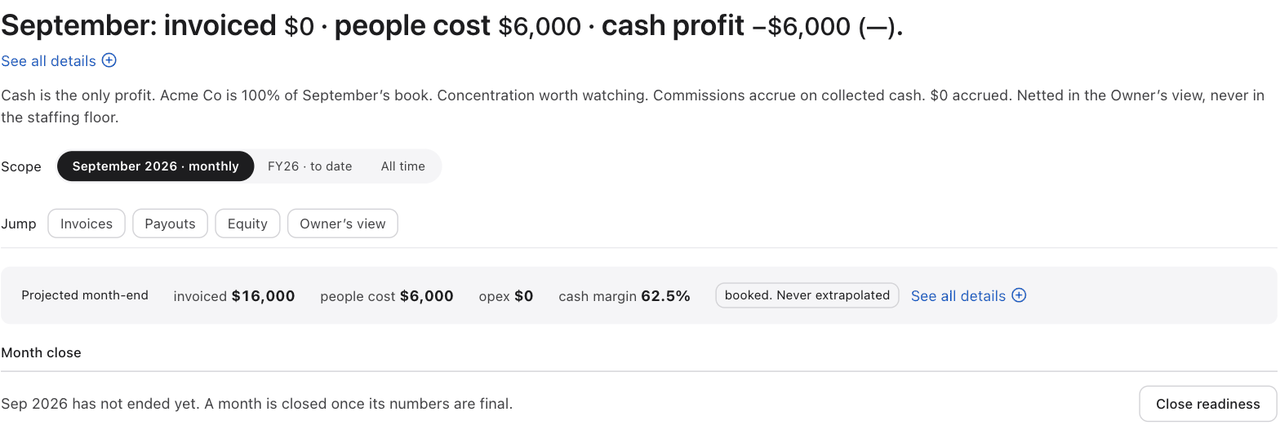
Revenue, cost and margin for every client are there every morning, computed from the hours as they are logged, and visible only to the owners and the people they name, enforced on the server. The month reads invoiced, people cost, operating cost and cash margin side by side, which is where an owner sees whether a price still pays for the work after agents changed its shape, as we wrote in Margin per client, this morning. The home page shows it in Know in September. Not in October.
The answer to who pays belongs in the agreement, and the agreement in Ceed is a versioned terms card: the monthly cap or budget, rates by role or tier, the discount, the yearly escalator and any equity taken as payment, with the signed paperwork attached to the version it belongs to. Every invoice is computed from the version in force, never typed. A clause on agent runs, absorbed, included up to an allotment or passed through at cost, is a sentence in that signed paperwork.
Ceed Intelligence works in the order this post asks for: the price first, then a person’s decision. On episode 104, after Kosaraju said nobody was yet good at estimating what an agent’s task would cost, I said what I wanted from every AI tool I use.
“If there was a little dollar sign that told you how much that prompt was going to be before you clicked it…”
“…like you’re buying something, ’cause honestly, that’s what you’re doing.”
Jon McLachlan, on The Security Podcast of Silicon Valley, episode 104, 22 September 2026, at 29:31.
Kosaraju doubted the model makers had “the incentive to do that for us.” In Ceed it is the rule. Every act of Ceed Intelligence shows its price, in dollars and tokens, before a person confirms it, every record it adds is marked imported, and what the model cost is its own line on the firm’s statement. Ceed works without it, and every number on an invoice is computed from the agreement and the record, the same way every time. The home page answers what it costs among its questions, and the about page says what it is.
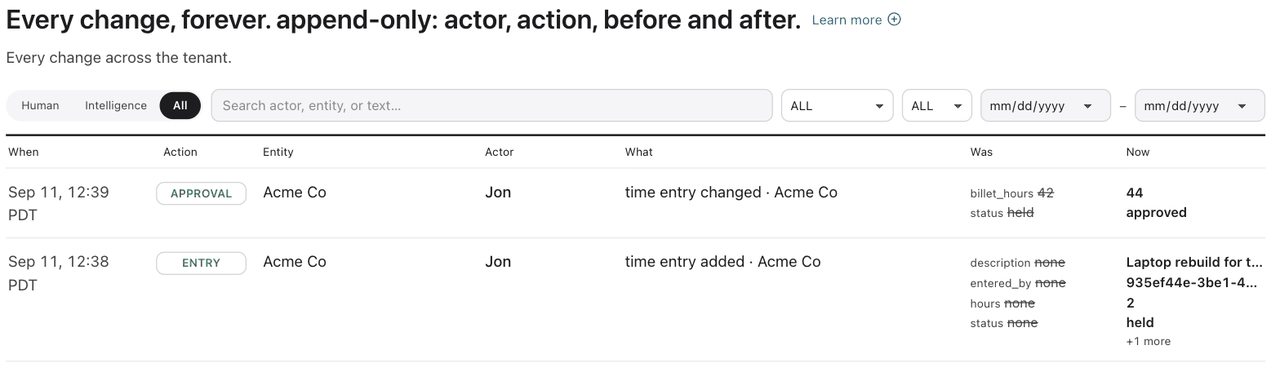
When the month closes, its invoices, statements and margin freeze, and nothing in a closed month changes. The review hours a client paid for in October, with the lines that say what the agent did, are the same record when the fee comes up for renewal.
Ceed’s own price is a share of the invoice: 0.1% of what the firm invoices, with no seats, no tiers and no minimum, as we set out in Seats, tiers, meters. Or 0.1%. Ceed never touches the money: the firm’s bank moves it. Where Ceed stands beside the time trackers and the suites is on the comparison page.
None of this asks a firm to stop using agents, or to count every token. It asks for the order the largest companies learned this year at a high price. Budget set: the client’s budget, and a ceiling for the runs inside it, before the work. Cost recorded: the review hours on the client, and a line in each entry for what the agent did and what it cost. Payer named: a sentence in the agreement on who pays for the runs, and a person named for the moment a month would cross what the client agreed. The agent will keep working and the meter will keep running. The firm decides, before the invoice, whose money it is.
What the books say.
Four books: two on what a unit of work costs, one on setting the price before building, and one on what AI changes and what it leaves to people.
- Cloud FinOpsJ.R. Storment and Mike Fuller, second edition, 2023. Showback, chargeback and unit economics for cloud bills, the discipline the FinOps Foundation now carries over to tokens. Storment is the foundation’s executive director.
- Time-Driven Activity-Based CostingRobert S. Kaplan and Steven R. Anderson, 2007. Cost each activity by the time and capacity it uses, the method for costing a finished task across people and machines.
- Monetizing InnovationMadhavan Ramanujam and Georg Tacke, 2016. Set the price before you build, the discipline every outcome price needs.
- Power and PredictionAjay Agrawal, Joshua Gans and Avi Goldfarb, 2022. What changes when prediction becomes cheap, and why judgment, the part a person answers for, becomes the scarce part.
Five conversations about what an agent costs.
The firm behind Ceed also hosts The Security Podcast of Silicon Valley, more than a hundred conversations since 2021 with the people who build and run security. Five of them are about what an agent costs, in money and in trust.
- 104
Yash Kosaraju, chief information security officer at a16zSeptember 2026 · Why nobody can yet say what an agent’s task should cost, and why his team scopes AI tools instead of saying no.
- 81
Eric Olden, co-founder and chief executive of Strata IdentityNovember 2025 · “AI agents can burn through budgets and trust in minutes.”
- 79
Veronica Moturi of Brinks HomeOctober 2025 · AI on the first line of support, people kept for the hard cases, and the whole judged on unit economics.
- 73
Michael Moore, vice president and head of legal at GleanJuly 2025 · How a free AI tool becomes an expensive mistake: the legal, privacy and trust costs it pushes onto later deals.
- 105
Yair Grindlinger, co-founder and chief executive of Surf AIOctober 2026 · Why shrinking what a breach can reach deserves as much effort as keeping intruders out. A ceiling on what a run may spend is the same discipline, applied to money.
Ceed is for firms that sell their team’s time: data and AI consultancies, software and IT firms, security consultancies, managed security providers, managed service providers, agencies, management consultancies, engineering firms, law firms, professional advisors and fractional executives up to fifty people, and nineteen kinds of firm in all. If an agent did part of a client’s work this month, sign up and give the review hour its budget and its name. Nothing to pay until your first invoice.
Sign upOr write to hello@ceed.so.
Questions.
How much does it cost to run an AI agent?
It depends on the task, and the spread is wide. Anthropic’s documentation, as read on 12 October 2026, put the average for its coding agent across enterprise deployments at about $13 per developer per active day, and for its automated code review at $15 to $25 a review. In a study McKinsey cites, two runs of the same programming task differed by as much as 30 times in tokens. The tokens are often the smaller part: in McKinsey’s banking example, the people overseeing an agent were 70% to 75% of its variable cost and the tokens 20% to 25%. Budget the run and the review together, for each client.
Should I charge clients for my AI tools or treat them as overhead?
Either can be right, and the choice belongs in the agreement before the work. Firms use three answers: absorb the cost in the price, include normal usage in a fixed fee and bill heavy runs separately, or pass the runs through at cost with disclosure. For lawyers, the American Bar Association’s guidance allows only the direct cost of an AI tool, with no surcharge. All three answers need a record of runs and review hours for each client. This is not legal or tax advice.
What is a token budget, and how do I stop an agent run at a dollar amount?
A token budget is a spending limit set before the work, for a person, a team or a client. KPMG’s survey, published in September 2026, found that 43% of large US companies had one. The tools now carry the limit as a setting: Claude Code’s budget flag stops a run in print mode once its estimated spend reaches a dollar amount, with a warning that spend can pass the cap, and providers set limits for an organization and for each person. For a firm, set the ceiling for each client, and name the person who may raise it.
Is an AI agent cheaper than a person?
For a single task, often. For a finished job, not always, because a person still checks the work. In McKinsey’s analysis of a bank’s customer service agent, the people overseeing it were 70% to 75% of its variable cost, and McKinsey’s measure is the fully loaded cost to finish the job, agents and people together. In this post’s worked example, with illustrative rates, ten code reviews fell from 20 hours to 5 hours plus $200 of runs, and the review was still 69% of the variable cost.
Can AI usage costs sit next to hours in a client’s budget?
Yes, if the firm records them for each client. Give each client its own key or project at the model provider so the provider’s report splits the bill by client, log the review hour against the client’s budget, and write in the entry what the agent did and what the runs cost. In Ceed the hours sit against each client’s budget, and the hour that would cross it waits as pending approval for a named person.
Why is my AI bill so high when token prices keep falling?
Because use grew faster than the price fell. Bain’s index of Azure AI tokens shows the price per million tokens falling to 42 and the tokens consumed rising to 541 between December 2024 and its estimate for March 2026, more than doubling the bill. By Anthropic’s count an agent uses about 4 times the tokens of a chat and a multi-agent system about 15 times, and Accenture found that nine in ten executives would spend a cheaper token on more work. Budget by client and by task, not by the price per token.
 Jon McLachlan is a co-founder of Ceed and of YSecurity, and hosts The Security Podcast of Silicon Valley. Ceed is built with agents that people at YSecurity run and answer for, so the meter in this post runs on his own work as well. Published 27 October 2026. Corrections to hello@ceed.so, and they are dated when made.
Sources
- McKinsey. Lari Hämäläinen, Mark Patel, Sven Blumberg, Tanguy Catlin and Wasim Lala, “Is that AI agent worth it? Agentic economics and the modern operating model”, McKinsey Quarterly, 13 July 2026, https://www.mckinsey.com/capabilities/quantumblack/our-insights/is-that-ai-agent-worth-it-agentic-economics-and-the-modern-operating-model, whose 93% comes from McKinsey’s Enterprise AI FinOps Survey of May 2026, 75 qualified respondents. Its factor of 30 and its roughly 1,000 times cite Longju Bai, Zhemin Huang, Xingyao Wang, Jiao Sun, Rada Mihalcea, Erik Brynjolfsson, Alex Pentland and Jiaxin Pei, “How Do AI Agents Spend Your Money? Analyzing and Predicting Token Consumption in Agentic Coding Tasks”, arXiv, 24 April 2026, https://arxiv.org/abs/2604.22750, read on 18 October 2026, and the 1,000 times also cites Anthropic’s post below. Its 60 percent cites Mohamad Salim and others, “Tokenomics: Quantifying where tokens are used in agentic software engineering”, arXiv 2601.14470, January 2026, which we read only through McKinsey’s footnote. Pankaj Sachdeva and Wasim Lala, with Avinash Javaji, Kaavini Takkar and Purva Arora, “The cost of intelligence: How CIOs can manage AI demand at scale”, 20 July 2026, https://www.mckinsey.com/capabilities/quantumblack/our-insights/the-cost-of-intelligence-how-cios-can-manage-ai-demand-at-scale. Chandana Asif, Dieter Kiewell, Lari Hämäläinen, Tom Kolaja and Tunde Olanrewaju, “Where AI agents pay off: A practical guide to the economics of agentic workflows”, 24 August 2026, https://www.mckinsey.com/capabilities/quantumblack/our-insights/where-ai-agents-pay-off-a-practical-guide-to-the-economics-of-agentic-workflows. McKinsey’s Top Ten for the third quarter of 2026, 27 September 2026, https://www.mckinsey.com/~/media/mckinsey/email/top-ten/2026/2026-09-27a.html, for the second quarter, https://www.mckinsey.com/~/media/mckinsey/email/top-ten/2026/2026-07-04a.html, and for the first, https://www.mckinsey.com/~/media/mckinsey/email/top-ten/2026/2026-04-04a.html. Every source below was read on 12 October 2026 unless another date is given.
- Bain. Jue Wang, Anne Hoecker, Alec Koh, Chris McLaughlin and Vito Trinchera, “Managing Token Spending without Choking Off Opportunity”, Technology Report 2026, 29 September 2026, https://www.bain.com/insights/managing-token-spending-without-choking-off-opportunity-technology-report-2026/. Its Figure 2, “Average cost per token is falling, but token use is rising faster”, runs to an estimate for March 2026 built from Wells Fargo’s data of October 2025 and Bain’s analysis, and the bill in our Figure 1 is our arithmetic.
- Accenture. Ajoy Menon, Lan Guan, James Burrows and Surya Mukherjee, “The CIO’s guide to AI tokenomics”, 10 September 2026, a survey of 750 senior executives at companies with more than $1 billion in revenue in 17 countries, June and July 2026, https://www.accenture.com/en/insights/ai-data/cios-guide-ai-tokenomics.
- KPMG. The US AI Pulse for the third quarter of 2026, 24 September 2026, 314 leaders of companies with more than $1 billion in revenue, https://kpmg.com/us/en/media/news/q3-ai-pulse-2026.html. The Global AI Pulse for the second quarter, 24 June 2026, https://kpmg.com/xx/en/media/press-releases/2026/06/growing-adoption-signals-progress-as-cost-visibility-and-accountability-drive-ai-value.html, and its report, https://assets.kpmg.com/content/dam/kpmgsites/cn/pdf/en/2026/07/ai-pulse-q2-2026.pdf.
- BCG. “The Formula for Agentic AI Value”, 30 September 2026, https://www.bcg.com/publications/2026/the-formula-for-agentic-ai-value. Sandra Nudelman, Anne Kleppe, Jeanne Bickford, Biljana Bajic-Bizumic, Kirill Katsov and Eitan Yehuda, “The Authorization Gap”, 22 September 2026, https://www.bcg.com/publications/2026/authorization-gap-ai-agent-governance.
- EY. The EY-Parthenon CEO Outlook, 1 October 2026, 1,200 chief executives in 21 countries, https://www.ey.com/en_gl/newsroom/2026/10/ai-drives-productivity-but-ceos-struggle-to-turn-gains-into-grow. “What is the true cost of an AI agent?”, 23 July 2026, https://www.ey.com/en_sg/simply-explained/true-cost-of-ai-agents. The counts on EY’s LinkedIn post were read in a browser on 12 October 2026.
- Deloitte. CFO Signals for the second quarter of 2026, 23 July 2026, 200 chief financial officers of North American companies with more than $1 billion in revenue, https://www.deloitte.com/us/en/about/press-room/deloitte-q2-2026-cfo-signals-survey.html.
- Capgemini. Capgemini Invent, “The era of AI Yield: Mastering tokenomics to maximize enterprise value”, 1 October 2026, https://www.capgemini.com/us-en/insights/research-library/the-era-of-ai-yield-mastering-tokenomics/.
- The FinOps Foundation. The Linux Foundation on the State of FinOps 2026, 19 February 2026, 1,192 respondents, https://www.linuxfoundation.org/press/state-of-finops-survey-ai-value-and-skills-top-priorities-as-finops-matures-across-technology-value-98-manage-ai-90-saas-64-licensing-48-data-center-1. “FinOps for AI Overview”, updated 17 February 2026, https://www.finops.org/wg/finops-for-ai-overview/. Andrew Nhem, recap of the FinOps X 2026 Day 1 keynote, 9 June 2026, https://www.finops.org/insights/finops-x-2026-day-1-keynote/. The sessions of FinOps X, https://x.finops.org/.
- Anthropic. Jeremy Hadfield, Barry Zhang, Kenneth Lien, Florian Scholz, Jeremy Fox and Daniel Ford, “How we built our multi-agent research system”, 13 June 2025, https://www.anthropic.com/engineering/multi-agent-research-system. Claude Code’s documentation on managing costs, https://code.claude.com/docs/en/costs, its command line reference, https://code.claude.com/docs/en/cli-reference, and its code review, https://code.claude.com/docs/en/code-review, which gave an average of $15 to $25 a review when we read it on 12 October 2026. On 18 October that page no longer gave an average, and its page on Code Review costs, https://code.claude.com/docs/en/code-review-costs, read that day, is our source for the cost of reviews after every push and for that setting being where a new repository starts. “Claude Code and new admin controls for business plans”, 20 August 2025, https://www.anthropic.com/news/claude-code-on-team-and-enterprise.
- Seats that became meters. Mario Rodriguez, GitHub, “GitHub Copilot is moving to usage-based billing”, 27 April 2026, https://github.blog/news-insights/company-news/github-copilot-is-moving-to-usage-based-billing/. Legora, “Introducing Consumption-Based Pricing”, 23 June 2026, https://legora.com/blog/consumption-based-pricing. Kyle Wiggers, TechCrunch, 5 January 2025, for Sam Altman’s reply on the price, https://techcrunch.com/2025/01/05/openai-is-losing-money-on-its-pricey-chatgpt-pro-plan-ceo-sam-altman-says/.
- The falling price. Guido Appenzeller, Andreessen Horowitz, “Welcome to LLMflation”, 12 November 2024, https://a16z.com/llmflation-llm-inference-cost/. Epoch AI, “LLM responses to benchmark questions are getting longer over time”, 17 April 2025, https://epoch.ai/data-insights/output-length. Ara Kharazian, Ramp, “Cracks in the AI Thesis Part 2”, 9 September 2026, https://ramp.com/data/ai-index-sept-2026. Abigail Serrano, In-House APAC, 24 June 2026, https://www.inhouseapac.com/insights/law-firms-now-pay-legal-ai-vendors-by-the-meter-will-they-invoice-the-bill-back-to-clients, which is also the source for the four ways law firms pass on the cost and for Sergey Polak’s words.
- The year. Lee Chong Ming, Business Insider, “Jensen Huang says he would be ‘deeply alarmed’ if his $500,000 engineer did not consume at least $250,000 of tokens”, March 2026, https://www.businessinsider.com/jensen-huang-500k-engineers-250k-ai-tokens-nvidia-compute-2026-3, read on AOL on 18 October 2026, https://www.aol.com/news/jensen-huang-says-deeply-alarmed-040314321.html, which is our source for Jensen Huang’s words on the All-In Podcast. The Associated Press, 27 and 28 July 2026, read on WTOP, https://wtop.com/news/2026/07/a-flex-in-corporate-america-ai-tokenmaxxing-fades-as-workplaces-look-to-cut-tech-spending/, which is our source for Jue Wang’s, Hassan El Mghari’s and Vincent Gusdorf’s words. Tim Fernholz, TechCrunch, 17 April 2026, https://techcrunch.com/2026/04/17/tokenmaxxing-is-making-developers-less-productive-than-they-think/. Ars Technica, 12 May 2026, https://arstechnica.com/ai/2026/05/amazon-employees-are-tokenmaxxing-due-to-pressure-to-use-ai-tools/, quoted by its headline. Aditi Bharade, Business Insider, via Yahoo Finance, 25 May 2026, https://finance.yahoo.com/sectors/technology/articles/ubers-coo-says-getting-harder-050841491.html, on Andrew Macdonald’s interview on Rapid Response. Jeremy Kahn, Fortune, 28 May 2026, https://fortune.com/2026/05/28/tokenmaxxing-is-dead-companies-didnt-get-the-roi-from-ai-they-wanted-to-see/, which is also our source for what Uber said of its 2026 token budget, read again on 18 October 2026. Outlook Business, 3 June 2026, https://www.outlookbusiness.com/corporate/uber-caps-ai-tool-usage-after-exhausting-yearly-budget-in-just-4-months, after Bloomberg, 2 June 2026, https://www.bloomberg.com/news/articles/2026-06-02/uber-caps-usage-of-ai-tools-like-claude-code-to-cut-costs, which we could not open. MLQ, citing a memo first reported by The Information, 13 June 2026, https://mlq.ai/news/meta-caps-internal-ai-token-spending-after-costs-approach-billions-in-2026/. Emanuel Maiberg, 404 Media, 4 August 2026, https://www.404media.co/microsoft-tells-engineers-tokenmaxxing-is-not-what-we-are-optimizing-for/.
- Agencies. Sam Bradley, Digiday, “Agencies grapple with economics of a new marketing currency: the AI token”, 3 March 2026, https://digiday.com/marketing/agencies-grapple-with-economics-of-a-new-marketing-currency-the-ai-token/, for Josh Archer, Taryn Crouthers, Lisa Herdman, Domenic Venuto, Will Hanschell of Pencil, Ruben Schreurs, James Londal, Chris Neff, Jess Lewis and Peter Rice. The AI Journal, “Your Marketing Agency Has an AI Invoice for You. They Just Don’t Send It.”, 9 October 2026, https://aijourn.com/your-marketing-agency-has-an-ai-invoice-for-you-they-just-dont-send-it/.
- Law. Kirsten Medder, Legatics, 11 June 2026, after seven roundtables with more than 80 legal leaders, https://www.legatics.com/from-line-item-to-operating-model/. Michele Carney, American Bar Association, Law Practice Today, “The reasonableness of fees when using AI”, December 2024, https://www.americanbar.org/groups/law_practice/resources/law-practice-today/2024/december-2024/the-reasonableness-of-fees-when-using-ai/, on Formal Opinion 512 of 29 July 2024, which we read only through this summary.
- Pricing by the outcome. Stripe’s customer story on Intercom’s Fin, https://stripe.com/customers/fin-ai. Zendesk, 28 August 2024, https://www.zendesk.com/newsroom/articles/zendesk-outcome-based-pricing/. Jason Lemkin, SaaStr, 9 April 2026, https://www.saastr.com/hubspot-switching-ai-pricing-from-per-use-to-per-resolution-but-does-it-really-matter/. Salesforce, via Business Wire, 15 May 2025, https://www.businesswire.com/news/home/20250515332990/en/Salesforce-Introduces-New-Flexible-Agentforce-Pricing-to-Accelerate-the-Digital-Labor-Revolution. Sequoia, “How AI is Reinventing Software Business Models ft. Bret Taylor of Sierra”, 8 May 2025, https://inferencebysequoia.substack.com/p/how-ai-is-reinventing-software-business. Sierra, “Bret Taylor of Sierra on AI agents, outcome-based pricing, and the OpenAI board”, 10 March 2026, https://sierra.ai/resources/podcasts/bret-taylor-of-sierra-on-ai-agents-outcome-based-pricing-and-the-openai-board.
- Hacker News, comments quoted as posted, with points and comments as shown on 12 October 2026. “Ask HN: How do agencies price projects when AI increases productivity and costs?”, 3 March 2026, 1 point, https://news.ycombinator.com/item?id=47231886, with hakonbogen and reggz. “Ask HN: How much are you spending on AI coding at work?”, 23 March 2026, 7 points and 11 comments, https://news.ycombinator.com/item?id=47484203, with daemonologist, apothegm, eleventhborn, supernova215 and jjmarr. “$38k AWS Bedrock bill caused by a simple prompt caching miss”, 28 April 2026, 8 points, https://news.ycombinator.com/item?id=47933355, by Zephyr0x. “The $15,000 AI Bill. Your $20 Subscription is a DELUSION”, 11 June 2026, 27 points and 58 comments, https://news.ycombinator.com/item?id=48491670, with simonw. “Tokenmaxxing is dead, long live tokenmaxxing”, 28 June 2026, 191 points and 291 comments, https://news.ycombinator.com/item?id=48708795, with aurareturn. “Meta caps internal AI token spending”, 1 July 2026, 148 points and 148 comments, https://news.ycombinator.com/item?id=48754713, with andsoitis. “Astra for Law”, 17 September 2026, 589 points and 689 comments, https://news.ycombinator.com/item?id=49745940, with terminalcommand, https://news.ycombinator.com/item?id=49750033. “Ask HN: As a freelancer how should I charge my clients in AI era?”, 19 September 2026, 4 points, https://news.ycombinator.com/item?id=49766918, by hhthrowaway1230. We could not read Reddit for this post.
- Posts on X, quoted as the pages below quote them, since we did not open X itself, dated in Pacific time, where the articles give the day and otherwise from each post’s status number. Sam Altman, 5 January 2025, https://x.com/sama/status/1876104315296968813, as quoted by Marco Quiroz-Gutierrez in Fortune, 7 January 2025, https://fortune.com/2025/01/07/sam-altman-openai-chatgpt-pro-subscription-losing-money-tech, where an exclamation mark follows “subscriptions” and our card puts an ellipsis, and his reply a minute later, https://x.com/sama/status/1876104580070813976, in the words TechCrunch quoted, which places both posts on Sunday, 5 January. Cristina Cordova, chief operating officer of Linear, 6 April 2026, https://x.com/cjc/status/2041299419845599489, as quoted by Henry Chandonnet in Business Insider, read on AOL, updated 8 April 2026, https://www.aol.com/news/tokenmaxxing-techies-debating-leaderboards-tracking-185800252.html, which quotes her two lines separately. Anthropic, 28 July 2025, https://x.com/AnthropicAI/status/1949898511287226425, as quoted by Simon Willison on 28 July 2025, https://simonwillison.net/2025/Jul/28/anthropic/, which is also our source for the line about one user on a $200 plan. The cards for Sam Altman and Anthropic show the opening of each post, and the card for Cristina Cordova shows the two lines Business Insider quoted, in its order. All three were checked again on 18 October 2026.
- A post on LinkedIn, read in a browser on 12 September 2026: James O’Dowd, 20 August 2026, https://www.linkedin.com/feed/update/urn:li:activity:7496115838916263936/.
- YSecurity. Sasha Sinkevich, “Too Fancy: When Your Agent Costs You $50,000 an Hour to Operate”, 20 September 2026, https://ysecurity.io/blog/too-fancy-agent-50000-an-hour/, which takes the reconciliation agent from Mandiant’s AI Risk and Resilience Report 2026, Case Study 6, figures the Cloud Security Alliance notes are Mandiant’s own and not independently verified. Jon McLachlan, “The Human in the Loop Is Going Away”, 23 September 2026, https://ysecurity.io/blog/human-in-the-loop-is-going-away/. Jon McLachlan, “Who Holds Your Agent’s Keys? The 30-Minute AI Credential Inventory”, 7 October 2026, https://ysecurity.io/blog/ai-agent-credential-inventory/. Jon McLachlan, “The .env File Is Your First Security Program”, 10 October 2026, https://ysecurity.io/blog/env-file-first-security-program/. “Shadow AI: The Risks, and How to Govern It Without Blocking AI”, 30 June 2026, https://ysecurity.io/blog/shadow-ai-governance/. The services pages for Corporate Shadow-AI Detection and Mitigation, https://ysecurity.io/services/shadow-ai-detection/, and AI User Access Control Audits, https://ysecurity.io/services/ai-access-control-audits/.
- Recordings on YouTube. “The $15,000 AI Bill. Your $20 Subscription is a DELUSION”, as posted to Hacker News on 11 June 2026, https://www.youtube.com/watch?v=UfApUobqN8Y. The FinOps Foundation’s keynote at FinOps X, 9 June 2026, embedded on its recap page, https://www.youtube.com/watch?v=W4g8xvduIbs. YSecurity, episode 104 of The Security Podcast of Silicon Valley, 22 September 2026, https://www.youtube.com/watch?v=my6Rie4TR0s. Pinterest’s and Shutterstock’s sessions at FinOps X, as listed on the conference’s site, https://www.youtube.com/watch?v=IkhTYERL8T0 and https://www.youtube.com/watch?v=pCHS_pz-KtA. Bret Taylor at Sequoia’s AI Ascent 2025, as embedded on Sequoia’s page, https://www.youtube.com/watch?v=xlQB_0Nzoog. Sierra’s podcast with Bret Taylor, 10 March 2026, as embedded on Sierra’s page, https://www.youtube.com/watch?v=n4E4xNYCkYM. Sequoia Capital, the keynote of AI Ascent 2025, 7 May 2025, with its views as read on 28 September 2026, https://www.youtube.com/watch?v=v9JBMnxuPX8. “Why AI Tokens are so Expensive”, posted to Hacker News on 3 July 2026, https://news.ycombinator.com/item?id=48774208, where a commenter names the presenter as Mike Pound, https://www.youtube.com/watch?v=-0HRzXk8vlk. Search results on 18 October 2026 give its channel as Computerphile, which we could not confirm on a publisher’s page. Lengths, dates and views are given only where a publisher’s page or our own records show them.
- The worked example of ten reviews is ours, with illustrative rates: people at $90 an hour, the review billed at $200 an hour, and a run at $20, inside the $15 to $25 average Anthropic’s documentation gave for its code review when we read it on 12 October 2026. The times are illustrative too: two hours a review before the agent, half an hour after it, and four pushes a review when the agent runs on every push.
- Product pictures are of Ceed’s staging environment in September 2026, showing a demo account with invented names and figures. The drawn cards use the same demo account, and their entries, sentences and prices are ours.
- The Security Podcast of Silicon Valley, a YSecurity production: episode 104 with Yashvier Kosaraju, 22 September 2026, https://ysecurity.io/podcast/104-why-a16zs-ciso-doesnt-trust-the-approve-button/, quoted from the automatic transcript on the page at 28:36, 29:31 and 29:59. Episode 81 with Eric Olden, 4 November 2025, https://ysecurity.io/podcast/81-how-to-put-ai-agents-safely-into-production/. Episode 79 with Veronica Moturi, 7 October 2025, https://ysecurity.io/podcast/79-ai-at-brinks-home-lower-costs-better-customer-support/. Episode 73 with Michael Moore, 15 July 2025, https://ysecurity.io/podcast/73-how-free-ai-tools-become-expensive-mistakes/. Episode 105 with Yair Grindlinger, 6 October 2026, https://ysecurity.io/podcast/105-shrink-what-a-breach-can-reach/.