Blog · 27 August 2026 · Jon McLachlan
The client paid late. The invoice was later.
The average American small business invoice is now paid nine days late, and the wait to be paid is 28.8 days and rising. The firms in the threads below wait far longer, because their clock started when the work was done, not when the invoice went out. What late payment looks like from inside a firm that sells its team’s time, the four things practitioners agree on, and the part of the delay that belongs to the firm. With seven recordings, three threads, a law, and four books.
A late payment is an invoice paid after the date the agreement set. That is the whole definition, and it hides the harder half. For a firm that sells time, the money was earned on the day the hour was worked. The invoice for that hour goes out at the end of the month, or a few days into the next one, then waits out its terms, then waits out the client. By the time the cash arrives the firm has carried the hour for two months and paid the person who worked it twice over.
She knows the feeling. The principal of a fractional CFO practice, the operator of a security boutique, the owner of a twelve-person agency. She did the work, on time, sometimes early. The invoice went out. Then the silence, the polite nudge, the second nudge, the call she rehearses in the car. She is not bad at business. She is waiting on two clocks, and she only ever looks at one of them.
Nine days late, and the wait is growing.
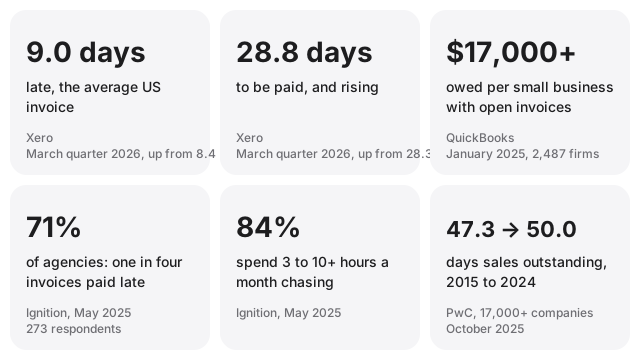
Xero reads the ledgers of its small business customers every quarter. For the March 2026 quarter in the United States, invoices were paid 9.0 days late on average, up from 8.4, and firms waited 28.8 days to be paid, up from 28.3. QuickBooks put a dollar figure on the same picture in January 2025: among 2,487 American small businesses surveyed, those with outstanding invoices were owed more than $17,000 each.
For agencies, Ignition’s 2025 report on pricing and cash flow, from 273 managers and executives, found that 71% have at least one in every four invoices paid late, 56% say it typically takes two weeks to two months after the due date to get paid, and 84% spend three to ten or more hours a month chasing what they are owed. Sixty-three percent describe their cash flow as unpredictable. The big firms see it from above. PwC’s Working Capital Study for 2025 and 2026, across more than 17,000 companies, shows days sales outstanding rising from 47.3 days in 2015 to 50.0 in 2024, and Deloitte’s 2025 roundup of 2,300 companies records that days sales outstanding “rose as collection pressures persisted.” The clients are paying everyone later, not only you.
The thread with 657 comments.
In November 2024 a graphic designer posted in r/smallbusiness that net 30 and net 60 terms were wrecking her cash flow. She delivered on time and then waited two months, and asked how she was supposed to pay contractors and software in the meantime. The thread drew 484 points and 657 comments, and the comments were not sympathy. They were the same four instructions, over and over, from people who had already learned them.
The top reply, with 606 points, was four words: “Then switch to pay on delivery.” Below it, u/Stabbycrabs83 priced the terms themselves: “Have different pricing for different payment terms. You are charging a premium for that 60 day term right?” u/JeffTS gave the contractor’s version, “50 down, 50 before handing off deliverables,” and u/2buffalonickels described what a small firm actually did: “For many longstanding customers we’ve gone down to a net 10 or 15 because they were stringing us out 45-60. I’ve changed a lot of my billing practices to weekly instead of monthly.” One designer put it flatly: “In a creative business, I learned early on to never ever offer those payment terms.”
X says it shorter. A designer’s post from June 2023 has been liked 1,400 times and seen by nearly half a million people, and it is one sentence long.
Net 30 is crazy but net 60 is insane…
Nick Huber, who runs a self-storage business and writes about small business to a large audience, had the sharpest version of who pays late, in September 2023. It was liked 2,400 times.
$100 customer: Can you come early? I have a little extra I need you to do as well. Can you stay longer? This didn’t work out as well as I expected I need to talk about the bill. Can you call me please right away?
$10,000 customer: Send invoice. Thx.
Blake Emal had said the same thing with three price points the year before: the $100 client needs it by midnight, does not care that it is out of scope and cannot pay, the $10,000 client has one tweak, and the $1 million client says “Cool, invoice paid.” Read the two together and the lesson is not that big clients are kind. It is that terms, scope and payment travel together, and the client who argues about one will argue about all three.
Jonathan Stark, who has spent a decade arguing that consultants should stop selling hours, gets to the same place from the other side. His advice is to ask for the whole fee up front, and to ask even when you are sure you will not get it, because the terms you end up with are better than the terms you would have started from.
Dave Ramsey’s business channel gives the operator’s version of the same rule in fourteen minutes: decide the terms before the work, put them in writing, and collect at the moment the client is happiest, which is delivery.
Overdue is the norm.
Zoom out and the picture does not improve. Atradius, the trade credit insurer, reported in September 2025 that in the United States 43% of business-to-business sales made on credit terms are overdue, and that bad debts now write off 5% of the invoices that go long overdue. The Federal Reserve Banks’ Small Business Credit Survey, published in March 2026 from 6,525 employer firms, found that the most common reason a small firm sought financing was to meet operating expenses, at 56%. Read those two together: nearly half of what a firm is owed arrives late, and more than half of the firms that borrow do so to cover the gap between the work and the cash.
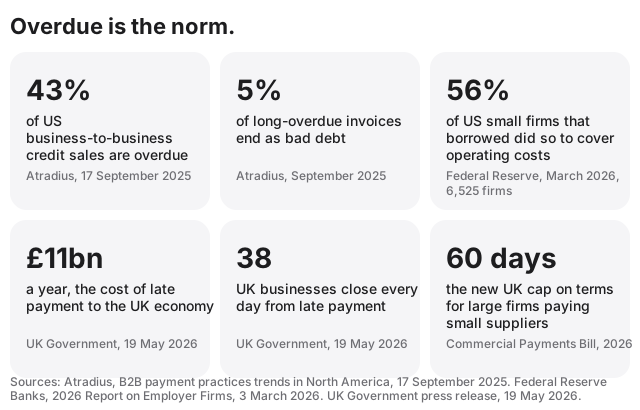
The United Kingdom put a national number on it this year. On 19 May 2026 the government introduced the Commercial Payments Bill with a press release that called it the largest crackdown on late payment in more than 25 years: late payments cost the economy £11 billion a year and close 38 businesses every day. The bill caps the terms large firms can impose on smaller suppliers at 60 days, sets statutory interest at 8% above the Bank of England base rate, and gives the Small Business Commissioner the power to investigate poor payment practice, adjudicate disputes and fine the worst offenders, with fines the release described as worth tens of millions for persistently late payers. The Commissioner’s office explained the bill to small firms in 45 seconds.
There is no American equivalent for commercial work. The federal Prompt Payment Act binds government agencies, and the state prompt-payment statutes mostly bind construction, so for a consultancy, an agency or a fractional practice the only late-payment law that applies is the one written into its own agreement.
Follow your contract.
When the client has not paid at all, the advice gets shorter. In r/msp, a technician asked what the firm should do when a client does not pay. The top answer, at 95 points, was three words from u/dumpsterfyr: “Follow your contract.” The second, from u/ntw2, was to “inform your client that you will be stopping work until their overdue” balance is settled. The third, from u/whatsforsupa, drew the line that matters inside a firm: “techs do not make this call.” The decision to stop belongs to the owner, and it belongs in the agreement before it is ever needed.
A freelancer in r/freelance showed what that looks like when it works. Owed $12,000 by an agency that had already been paid by its own client, he set a deadline of a few days for the full amount, said work would stop the moment it passed, and said legal proceedings would follow a week after that. The agency paid. What he had was not a collections process. It was a line he was willing to hold, written down before the money was late.
The other lesson in these threads is about size. When an MSP owner described a client who had gone silent owing about $1,300, the replies were unanimous that the amount was not worth a court date, and one, from u/Due_Lake94, named the real safeguard: “The key for me is to have a ‘stop loss’ so I don’t wake up with a client owing me 6-12 months of work.” The stop loss is a limit on how much unpaid work a client can hold at once. Most firms have one. Almost none of them have it anywhere but in the owner’s head.
Nobody was reading the ledger.
In August 2026 someone who had taken over billing at a family company posted in r/smallbusiness that they had found a customer owing nearly $200,000. The balance dated from 2022. The customer, another small business, said it had never known about the balance and never received the invoices. The thread reached 656 points and 190 comments, and the top reply, at more than a thousand points, was policy rather than sympathy: “All current orders go to pre-pay or COD until balance is paid in full.” A former accountant added the uncomfortable inference: if a receivable that size could sit unnoticed for three years, “there are other things wrong with the books.”
The $200,000 is unusual. The mechanism is not. A receivable is a fact about the past that nobody in the firm is paid to look at, and it ages quietly until somebody new opens the ledger. When a bicycle painter in r/smallbusiness described his first small-claims hearing in February 2025, the reply with 407 points was seven words long: “Good to win small claims, hard to collect.” Another owner in the same thread said his firm carries $60,000 to $100,000 in receivables at any time on net 30 and net 60 terms, and that “the only thing we can continue to do is improve upon our accounts receivable process.” Neither firm was doing anything wrong. Both had built a business in which the money arrived long after the work, and neither had a number in front of them every morning that said how much was outstanding and how old it was.
The invoice was late first.
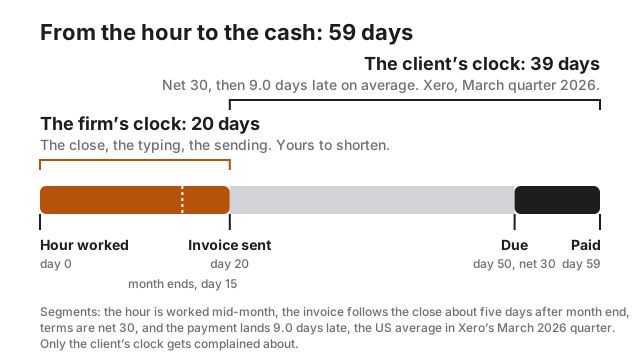
Here is the part the threads do not dwell on, because everyone in them is angry at the client. Before the client was late, the invoice was late. The hours were typed in from memory on Friday, or the following Tuesday. The month closed over three days of the owner’s time. The invoice was assembled in a spreadsheet, checked, sent on the fourth or the fifth. Then the terms started.
A consultant in r/consulting did the arithmetic in 2023, after a client paid in forty-five days on a contract that said ten. Monthly invoicing, one reply pointed out, “means invoicing is 30 days after the first hours were worked for the client, so payment is 60 days after the first hours worked.” Sixty days, and that is a client who pays on time.
Then a third delay, which is a dispute. Clio measured it across the legal profession in its 2025 Legal Trends Report: in an eight-hour day lawyers capture 3.0 billable hours, invoice 2.6 of them, and collect 2.4. Some of the gap between invoiced and collected is clients who cannot pay. More of it is clients who will not pay a number they were not expecting. In August 2026 an agency owner asked r/agency whether a client had ever asked them to prove the hours behind an invoice, then went and had twenty-five conversations about it. His conclusion: “When the invoice is the first thing the client has seen since kickoff, the counting starts.” An invoice that carries a surprise is an invoice that will be paid late, and every day it spends in dispute is a day the firm added, not the client.
So the firm’s side of the wait has three pieces. The days between the hour and the invoice. The days the invoice takes to write. And the days it spends being argued about because it told the client something for the first time. All three are the firm’s to shorten, and none of them require a single client to change.
Profitable. Not paid.
A firm can be profitable on paper and unable to pay its own people on Friday, which is the whole reason the wait matters. Harvard Business School Online has the two-minute version of why profit and cash are different numbers, and it is worth two minutes of anyone who runs a firm on retainers and net 30.
Ignition’s agencies described the consequence in the same 2025 survey: 82% had delayed or canceled hiring or an investment because of cash flow. For a firm of eight, that is the ninth hire who never arrives, paid for by hours that were worked in March and collected in May. NerdWallet’s seven ways to deal with late-paying clients is the calm, professional version of the thread above. The cautionary tale is EntreLeadership’s caller who used client deposits to pay his debts, which is what happens when the two clocks are managed from the same bank account.
The longer treatment is half an hour from EntreLeadership on cash flow in a business that has to pay its people before its customers pay, which is every firm in this post.
Josh Aharonoff, a fractional CFO, walks through what a receivables ledger should tell an owner, how to age it, and what days sales outstanding means for a firm that bills monthly.
What the books say.
Four books for the owner who wants the long version. None of them is about software.
- Profit FirstMike Michalowicz, 2017. Take the profit out first and run the firm on what is left, which is the discipline that makes a late payment survivable.
- Simple Numbers, Straight Talk, Big ProfitsGreg Crabtree, 2014. The four numbers a small firm actually runs on, and why cash is the one the owner should read every week.
- Financial Intelligence for EntrepreneursKaren Berman and Joe Knight, Harvard Business Review Press, 2008. The chapter on receivables, days sales outstanding and what an aging report is for.
- Never Split the DifferenceChris Voss with Tahl Raz, 2016. A former hostage negotiator on the call you rehearse in the car, including the one about the unpaid invoice.
The stop loss lives at the hour.
We ran a security consultancy on those spreadsheets, and our invoices went out on the fourth or the fifth like everyone else’s. The month that made us build Ceed is in The invoice told us last. Why we built Ceed. What we built does three things to the firm’s side of the wait.
First, the stop loss moves out of the owner’s head and into the agreement. Each client has a budget in hours, and if an hour would push a client over it, Ceed holds that hour for approval the moment it is logged. The account leader approves or declines it that day, and the client hears about the extra before the invoice, not on it. That is u/Due_Lake94’s stop loss, applied at the hour instead of at the sixth month, and it is the one thing that happens here and nowhere else. Held. Not hidden. shows what the person who logged the hour sees.
32.5 of 32 h
Thu 24 Sep · 2 h · Vendor review · Priya S.
Held for approval. 0.5 h over the client’s budget. The client hears today, not on the invoice.
Second, the invoice is computed from the agreement, not typed. The retainer, the budget, the rates by role, the approved hours past the budget, the discounts: it comes out the same way every time and matches what the client signed because it was made from what the client signed. When the month closes, the invoice exists. The fourth and the fifth go back to being ordinary days.
Month closed 30 Sep. Invoice computed the same day. Nothing typed.
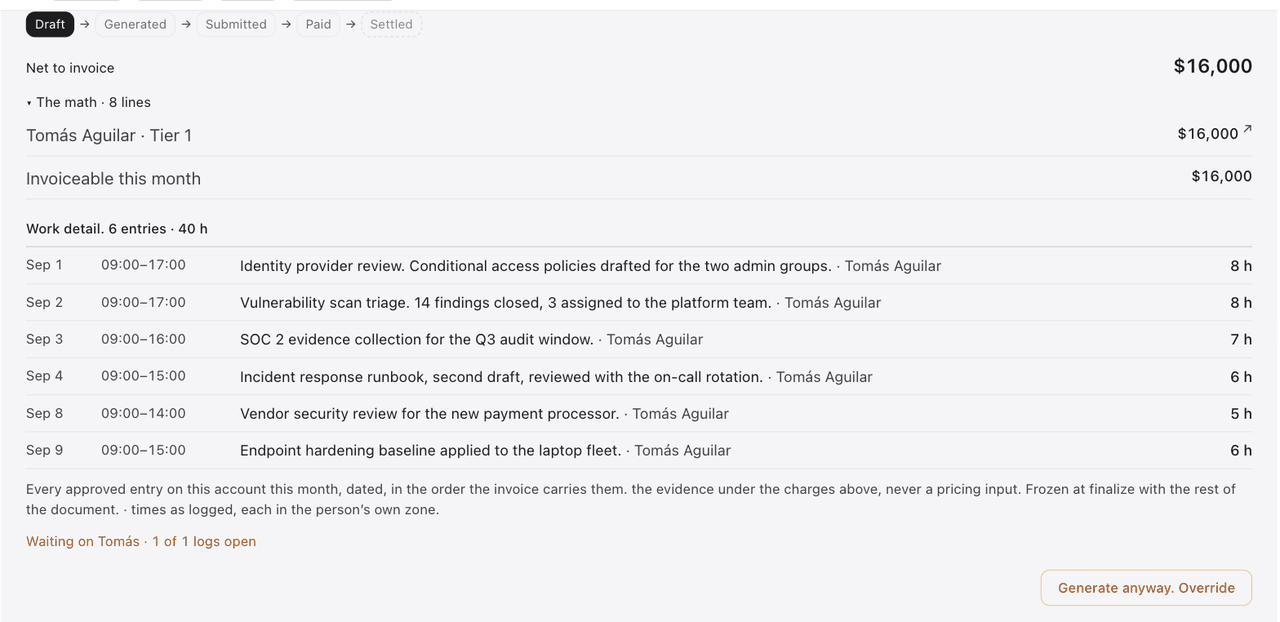
Third, the invoice carries no news. Every hour on it was either inside the budget or approved by name before it was billed, so the client has already seen the number that would have started the counting. The dispute that adds three weeks does not begin.
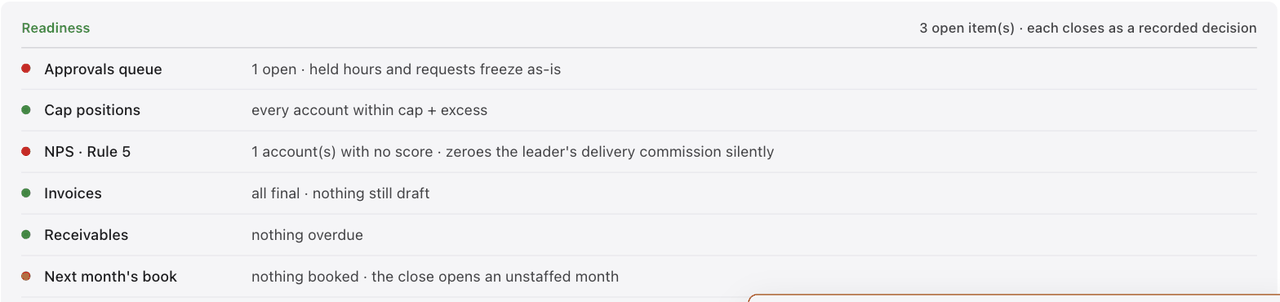
The firm’s clock, the part of the wait that was always yours, gets shorter by the length of a close and the length of an argument.
Margin per client is visible to the owners the morning after the close, and the contractor’s payout statement comes from the same hours the invoice used. So when a client is late, she knows exactly what that client is carrying, and exactly what she is carrying for them. That is where a fractional CFO practice, a security boutique or an agency starts the conversation about terms, with the hours in hand. The pricing side of that conversation is The rate was set on day one. The client grew. and the agreement side is The agreement said 40 hours. The month said 47.
Three conversations with people who run firms.
The firm behind Ceed also hosts The Security Podcast of Silicon Valley, 102 conversations since 2021 with the people who build and run security. Three of them are with people who have had to pay a team out of a receivables ledger.
- 14Biff Clark, owner of Coefficient TechnologiesMarch 2022 · Fifteen years of running a small security consultancy, clients and invoices included.
- 83Phil Howie, founder and CEO of SidekickDecember 2025 · How small companies build a security practice before they can afford a team, which is the client on the other side of the invoice.
- 102Chris Kirschke, founder of Kyberis AIAugust 2026 · Twenty-seven years in security operations, then a company to run, with revenue and customers that were suddenly his problem.
Ceed is for firms that sell their team’s time: fractional CFO, CISO, CMO and CTO practices, security and engineering boutiques, consultancies and agencies up to fifty people. If your invoices go out on the fifth and come back in sixty days, sign up and see the product with your own numbers. Nothing to pay until your first invoice.
Sign upOr write to hello@ceed.so.
Questions.
How late are small business invoices paid on average?
In the United States, 9.0 days late on average in the March 2026 quarter, with firms waiting 28.8 days in total to be paid, according to Xero’s Small Business Insights, published 30 April 2026. Both figures were up on the previous quarter. Among agencies, 71% report that at least one in four invoices is paid late (Ignition, May 2025, 273 respondents).
Should a consultant stop work when a client does not pay?
Practitioners in r/msp and r/freelance agree on the order: follow the contract, tell the client in writing that work stops on a stated date if the balance is not settled, and let the owner make that call rather than the technician. The stronger position is to have the stop loss, the most unpaid work a client may hold at once, written into the agreement before the work starts. Ceed applies a budget in hours to each client and holds the hour that would cross it, so the limit is enforced at the hour rather than remembered at the invoice.
How do I get clients to pay invoices on time?
Shorten both clocks. On the client’s side: shorter terms or payment on delivery, a deposit before work starts, a premium for longer terms, and weekly rather than monthly billing for clients who stretch. On the firm’s side: send the invoice the day the month closes rather than a week later, and make sure nothing on it is news to the client. An invoice computed from the agreement, with every over-budget hour approved before it was billed, removes the surprise that starts most disputes.
Is there a law against paying invoices late?
In the United Kingdom, from 2026, yes for large firms paying smaller suppliers: the Commercial Payments Bill introduced on 19 May 2026 caps payment terms at 60 days, sets interest at 8% above the Bank of England base rate and lets the Small Business Commissioner fine persistent late payers. In the United States the federal Prompt Payment Act covers government agencies and most state prompt-payment laws cover construction, so for commercial services work the enforceable terms are the ones in the agreement and on the invoice, plus whatever late fee or interest the agreement names.
 Jon McLachlan is a co-founder of Ceed and of YSecurity, whose invoices used to go out on the fifth. Published 27 August 2026, updated 11 September 2026. Corrections to hello@ceed.so, and they are dated when made.
Sources
- Xero, “Xero Small Business Insights: US small businesses, March quarter 2026”, media release, 30 April 2026. https://www.xero.com/us/media-releases/us-xsbi-march-quarter/ (read 11 September 2026).
- Intuit QuickBooks, “Small business late payments report 2025”, survey of 2,487 US small businesses, January 2025. https://quickbooks.intuit.com/r/small-business-data/small-business-late-payments-report-2025/ (read 11 September 2026).
- Ignition, “The 2025 Agency Pricing & Cash Flow Report”, 273 agency managers and executives, 22 May 2025. https://www.ignitionapp.com/news/2025-agency-pricing-cashflow-report (read 11 September 2026).
- PwC, “Working Capital Study 25/26”, more than 17,000 companies, 7 October 2025. https://www.pwc.co.uk/services/value-creation/insights/working-capital-study.html (read 11 September 2026).
- Deloitte, “Working Capital Roundup 2025”, 2,300 companies. https://www.deloitte.com/us/en/services/consulting/articles/working-capital-management-report.html (read 11 September 2026).
- Clio, “Legal Trends Report 2025”, benchmarks on captured, invoiced and collected hours. https://www.clio.com/resources/legal-trends/benchmarks/ (read 11 September 2026).
- u/Fit_Register2849, on net 30 and net 60 payment terms, r/smallbusiness, 24 November 2024, 484 points, 657 comments. https://www.reddit.com/r/smallbusiness/comments/1gyu8dr/ (read 11 September 2026).
- u/send_pie_to_senpai, “When client doesn’t pay”, r/msp, 16 January 2025. https://www.reddit.com/r/msp/comments/1i2wz7k/. u/SettingIntentions, “Victory Update”, r/freelance, 15 December 2020. https://www.reddit.com/r/freelance/comments/kdip1r/. u/ThrowRAthisthingisvl, “A client is ghosting and they owe us money”, r/msp, 11 June 2026. https://www.reddit.com/r/msp/comments/1u2k4h4/. u/Ok-Illustrator-4845, “Has a client ever asked you to prove the hours behind an invoice?”, r/agency, 13 August 2026. https://www.reddit.com/r/agency/comments/1vnbgxa/ (all read 11 September 2026).
- Atradius, “B2B payment practices trends in North America 2025”, 17 September 2025. https://group.atradius.com/knowledge-and-research/reports/b2b-payment-practices-trends-in-north-america-2025. Federal Reserve Banks, “2026 Report on Employer Firms”, Small Business Credit Survey, 6,525 responses, 3 March 2026. https://www.fedsmallbusiness.org/reports/survey/2026/2026-report-on-employer-firms (both read 11 September 2026).
- UK Government, “Largest crackdown on late payments in over 25 years as landmark Bill enters Parliament”, press release, 19 May 2026. https://www.gov.uk/government/news/largest-crackdown-on-late-payments-in-over-25-years-as-landmark-bill-enters-parliament. House of Lords Library, briefing on the Commercial Payments Bill, 2026. https://lordslibrary.parliament.uk/research-briefings/lln-2026-0028/. The Small Business Commissioner, “What does the Commercial Payments (Late Payments) Bill mean for your small business?”, YouTube, 5 August 2026. https://www.youtube.com/watch?v=1Hra1kEw-U8 (all read 11 September 2026).
- u/ComprehensiveTutor63, “Took over billing for a family company, found a customer owes nearly $200K”, r/smallbusiness, 17 August 2026, 656 points, 190 comments. https://www.reddit.com/r/smallbusiness/comments/1vqttzt/. u/illinihand, “Have my first lawsuit hearing Monday”, r/smallbusiness, 22 February 2025, 797 points. https://www.reddit.com/r/smallbusiness/comments/1ivqest/. u/73chGuy, “Client late payments”, r/consulting, 13 February 2023. https://www.reddit.com/r/consulting/comments/111iwo6/ (all read 11 September 2026).
- Posts on X: @itscloudnai, 28 June 2023, https://x.com/itscloudnai/status/1674147281422131210. @sweatystartup (Nick Huber), 3 September 2023, https://x.com/sweatystartup/status/1698313894425403863. @heyblake (Blake Emal), 11 April 2022, https://x.com/heyblake/status/1513478977624682498. Like counts as read 11 September 2026.
- Jonathan Stark, “How to Get Clients to Pay Faster: Get Paid 100% Upfront”, YouTube, 5 July 2019. https://www.youtube.com/watch?v=uC3MN3tXntU. EntreLeadership, “The Simple Way to Get Your Clients to Pay on Time”, 24 November 2023. https://www.youtube.com/watch?v=CgSYM8ieo-8. Michael Janda, “How to Handle Clients Who Don’t Pay”, 18 May 2019. https://www.youtube.com/watch?v=xImX7ZJHXqE. HBS Online, “Cash Flow vs. Profit: What’s the Difference?”, 2 February 2023. https://www.youtube.com/watch?v=lkEtgnhsV04. EntreLeadership, “Cashflow Secrets for Long-Term Business Success”, 11 December 2023. https://www.youtube.com/watch?v=nP4JU39whr0. Josh Aharonoff, “Everything you need to Know About Accounts Receivable”, 16 July 2024. https://www.youtube.com/watch?v=SzmgqIpkLGY. View counts as read 11 September 2026.
- Product pictures are of Ceed’s staging environment on 11 September 2026, showing a demo account with invented names and figures.
- The Security Podcast of Silicon Valley, a YSecurity production: episode 14 with Biff Clark, 1 March 2022, https://ysecurity.io/podcast/14-biff-clark-cybersecurity-specialist-and-owner-of-coefficient-of/. Episode 83 with Phil Howie, 2 December 2025, https://ysecurity.io/podcast/83-how-small-companies-can-make-their-security-doable/. Episode 102 with Chris Kirschke, 25 August 2026, https://ysecurity.io/podcast/102-ciso-does-not-spell-ceo/.