Blog · 21 July 2026 · Jon McLachlan
They see the fee. You see the hours.
A flat retainer is a fixed fee sized in hours only the owner knows. Here is what happens to the margin when nobody watches that number, and what changes when the hour past it waits for a decision. Updated in September 2026 with six recordings, two posts from X, a thread, a figure and eight books.
The advice in the fractional world is consistent. Do not sell hours. Sell the outcome, price the value, put a monthly fee on the agreement and stop thinking about time. It is good advice, and the people who give it size their retainers in hours anyway.
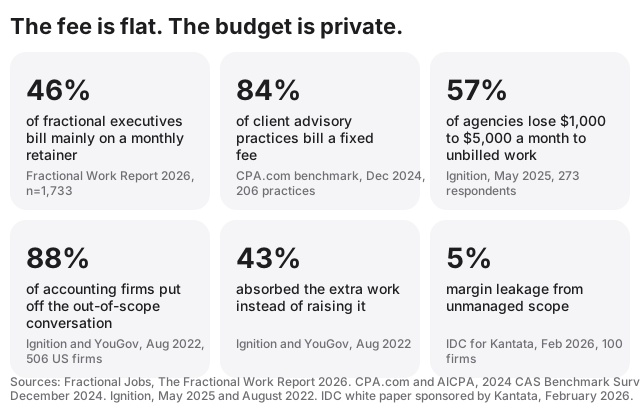
The “gold standard for a fractional executive,” in Taylor Crane’s words at Fractional Jobs this February, “is a retainer for $10,000 per month for approximately 10 hours per week of work.” The Fractional Work Report 2026, with 1,733 respondents, found 46% of fractional executives bill primarily on a monthly retainer. In accounting, CPA.com’s 2024 benchmark of 206 client advisory practices found 57% bill a fixed fee with regular out-of-scope monitoring and another 27% a fixed fee with minimal monitoring. The fee is flat. Behind it, always, is a number of hours.
The pressure to sell the fee rather than the hour is real and it is growing. In March 2025 Greg Isenberg asked whether $750-an-hour law firms would survive a tool that drafted his contract in fifteen minutes, and 18,000 people liked the question.
Are we going to pretend $750/hour law firms are going to be business as usual in the AI age?
I just used Grok Deep Research to draft a simple contract. Took 15 minutes. Would have cost $2,000 with a lawyer.
When I sent it to my attorney to review, his response was “looks good”
Taylor Crane has made the case for the retainer at length on other people’s shows. In January 2026 he spent half an hour with WRKdefined on how fractional work is bought and sold, including the arithmetic behind the monthly fee.
The number only you know.
That number is the private budget. The client bought a fee and a result. You priced the fee by asking how many hours it should take and multiplying by what your time is worth, and then you did the decent thing and never mentioned the hours again. Which is fine, until the hours change and the fee does not.
40.0 of 40 h
Within budget. The client sees $6,000. You see forty hours.
Crane names the cost in the same breath as the standard: “There’s a natural incentive for scope creep, which means you’re working for less than you expected.” That sentence is the whole problem. The fee is a promise to the client. The hours are a promise to yourself, and nobody is holding you to it.
Jonathan Stark, who has spent a decade telling consultants to stop billing by the hour, described the client’s side of the fee in April 2026, after buying a website for a flat $2,800 that took the agency perhaps ten hours.
I paid $2,800 flat fee for a new website.
Would I be happier if it took longer? No.
In fact, I would’ve paid more for them to finish it in a day instead of a week.
The client sees the fee and is glad of it. The agency saw ten hours against a budget it wrote when it quoted, and whether it made money on the job depended on that budget, not on the fee. Stark’s 2019 video on retainers puts the harder question in its title: do you trust your clients?
Ron Baker and Ed Kless said on The Soul of Enterprise in 2018 what the subscription firms are actually selling: “We’re not pricing a service, we’re pricing an outcome and insurance (peace of mind).” Insurance is a good word for it. An insurer that does not count its claims is not brave. It is briefly profitable.
What it costs to look away.
The numbers are not small. In Ignition’s May 2025 survey of 273 agency managers and executives, 57% said they lose between $1,000 and $5,000 every month to unbilled work, and 78% said they rarely or only sometimes charge for out-of-scope work. Arron Bennett, who runs a finance practice for agencies, put the mechanism in one line this June: “The extra hours get logged under the client, the retainer fee stays fixed, and the effective hourly rate on the account drops month by month.” His worked example is a $15,000 retainer consuming 240 hours at a $75 loaded cost, which is $18,000 of delivery on a $15,000 fee. The account looks profitable in the pipeline and loses $3,000 a month.
Dillon Towey, who runs operations at a nineteen-person accounting firm, told Ignition how it feels from inside: “We’d charge a client $600 a month on the assumption that we would spend no more than six hours taking care of their accounting needs. For a long time, even when we could see it was taking eight, 10, or 12 hours to take care of their needs, we’d just take it in the shorts.” Ignition’s 2022 survey of 506 US firms found 88% had delayed or avoided the conversation about it, and 43% absorbed the work.
The threads say the same thing in the first person. In December 2025 a web designer asked r/Entrepreneur how to tell a client the project was finished when the quick requests kept arriving after the final invoice, eight emails in three weeks. The thread reached 223 points. The reply with 80 points reframed it: “How does a grocery store treat you if you keep coming back in for additional items? They smile and happily ring you up and charge you for your items.” The reply with 66 turned it into the retainer: “Work a maintenance retainer into future contracts so you can continue to get paid.” Both are right, and together they are how the private budget is born. The retainer that answers scope creep is sized in hours, and then the hours creep.
IDC put a number on the creep in February 2026, from a survey of 100 professional services firms for Kantata: a “5% margin leakage from unmanaged scope due to poor variation tracking.” Five points of margin is the difference between a practice that pays its owner and one that pays its clients.
Notice what every one of those firms had. They had the private number. They knew six hours was the budget. What they did not have was the moment: a point at which the seventh hour was a question to be answered rather than a fact to be discovered.
Watched at the hour. Not at the invoice.
That moment is what Ceed adds, and it is the only thing it adds to the retainer. You keep the fee flat. You keep the hours to yourself. You write the hours behind each retainer into the client’s agreement, and Ceed counts every hour the team logs against it. The hour that would cross the budget is held, marked, and put in front of you for a yes or a no, the moment it is logged.
42.0 of 40 h
Thu 19 Mar · 2.0 h · Landing page revisions, round 3 · Priya K.
Held for approval. 2.0 h over the client’s budget.
Approve it, and the extra goes on the invoice at the rate in the agreement. Decline it, and it stays on the record and off the invoice, so you know exactly what you chose to give and to whom. Either way the month is not a surprise, the seventh hour was a decision, and by the third held hour you are having the conversation 88% of firms postpone, with the hours in hand and the fee not yet broken.
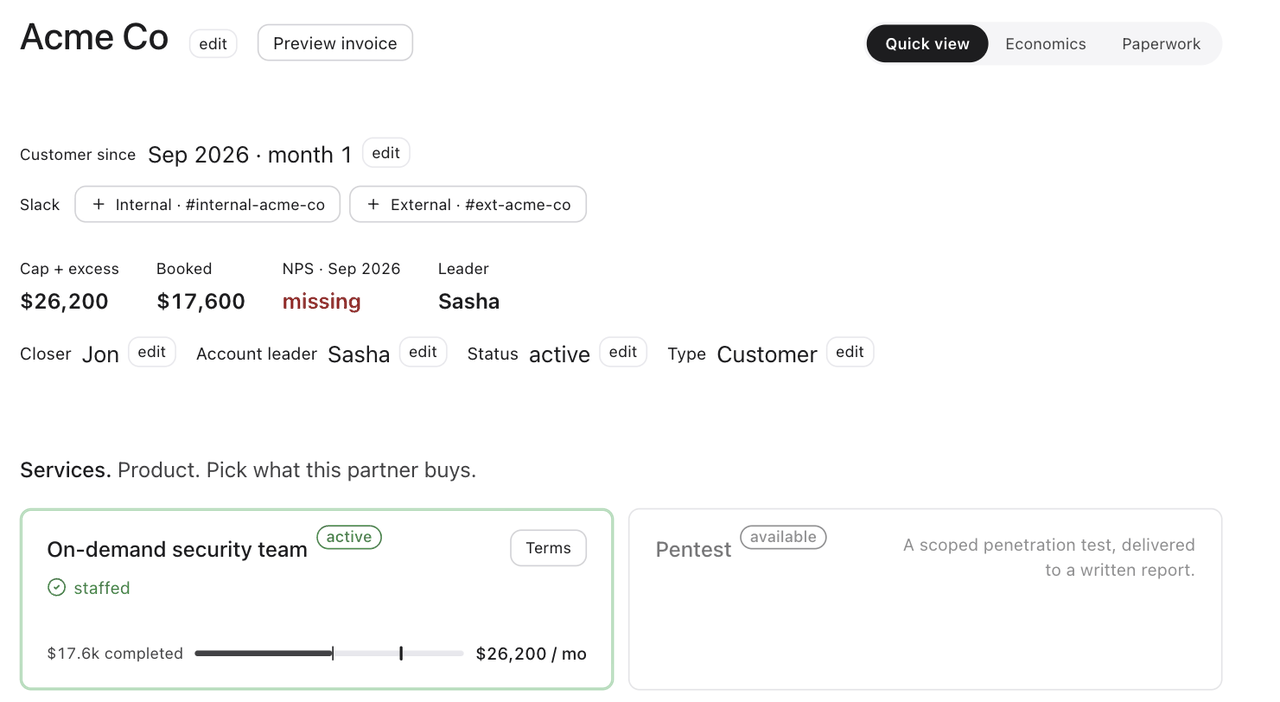
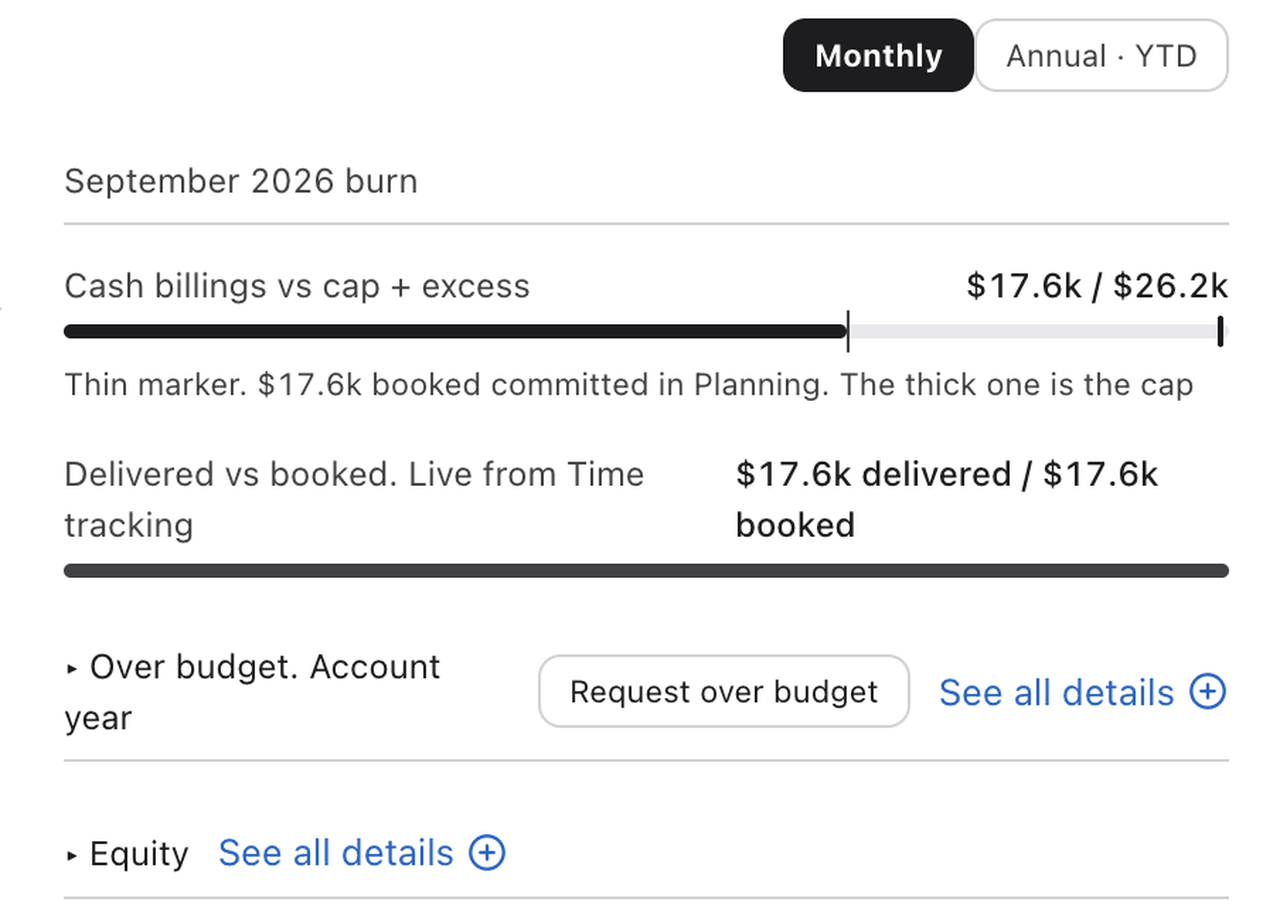
The month reads as a burn. Cash billings against the cap. Hours delivered against hours booked. Both are live, and both come from the same entries the invoice will use.
A fractional CFO who runs his practice this way explained in 2023 how he keeps the hours out of the client conversation entirely, which is the point. The hours are for the firm. Charles Leikauf’s seventeen minutes on what a fractional CFO can charge is the fuller version of the same arithmetic.
The invoice still says one line.
None of this reaches the client unless you want it to. A flat retainer invoices as a flat retainer. The hours behind it, and the budget you sized it with, stay yours.
Computed from the agreement dated 2 Feb 2026. Nothing typed.
The 2.0 h declined on 19 Mar stay on the record and off this invoice.
Chris Do’s advice to designers on the same subject, never justify the price, has been watched more than a million times. The retainer client bought a result, and the one-line invoice is the result’s price. The hours behind it were never the client’s business, and with a record at the hour they no longer have to be the owner’s worry either.
The longest argument for the flat fee is Ron Baker’s. He spent seventy minutes with Jonathan Stark in 2023 on the subscription model for professional firms, the book he wrote about it with Paul Dunn, and why the hour should go. He is right about the price. The firms in this post show what happens to the hours after the price is right.
What the books say.
Eight books on the fee, the retainer and the subscription. Every one of them assumes the owner knows the hours behind the price.
- Time’s UpPaul Dunn and Ronald J. Baker, 2022. The subscription business model for professional firms, from the man who has argued against the hour since the 1990s.
- The Automatic CustomerJohn Warrillow, 2015. Nine subscription models and what each does to a firm’s value, including the ones a consultancy can actually run.
- SubscribedTien Tzuo with Gabe Weisert, 2018. Why the subscription economy happened, from the founder of Zuora, and what it asks of the seller every month.
- Value-Based FeesAlan Weiss, third edition, 2021. Fees on outcomes rather than time, and the retainer chapter every fractional executive should read before quoting one.
- Million Dollar ConsultingAlan Weiss, sixth edition, 2021. The whole practice, from proposal to fee to the client who wants more than the agreement says.
- The Irresistible Consultant’s Guide to Winning ClientsDavid A. Fields, 2017. How consulting work is actually bought, which is the half of the fee conversation the seller does not see.
- Hourly Billing Is NutsJonathan Stark. The short, blunt case against the hour. Read it, then count the hours anyway.
- The Four ConversationsBlair Enns, 2024. The conversations that set the price, from the author of the Win Without Pitching Manifesto.
Three things to do this month.
- Write down the hours behind every retainer you sell. Not the rate you tell clients. The number you priced it with.
- Count every hour the team works against that number, by client, as it is logged. Not on Friday. Not at the close.
- Decide the hour past the budget the day it is logged, on the record, with the client’s name on the decision.
The first is yours. Ceed does the second and the third, for 0.1% of what you invoice, for fractional CFO and accounting practices, fractional executives, agencies and the other firms that sell their team’s time. The month that taught us the third, and the moment we built to catch it, is in The invoice told us last. Why we built Ceed. The pricing side of the private budget, the rate set on day one and never moved, is in The rate was set on day one. The client grew., and what the retainer’s rollover rule and block hours have to do with it is in The agreement said 40 hours. The month said 47.
The firm behind Ceed also hosts The Security Podcast of Silicon Valley, 99 conversations since 2021 with the people who build and run security. Three of them sit on either side of a retainer.
- 7Michael Brooks, vCISO and Director of Cyber Risk Services at TravaAugust 2021 · The fractional CISO model from someone who runs it, and what a fraction of a CISO is worth.
- 83Phil Howie, founder and CEO of SidekickDecember 2025 · How small companies build a security practice before they can afford a team, which is the client on the other side of the retainer.
- 14Biff Clark, owner of Coefficient TechnologiesMarch 2022 · Fifteen years of running a small security consultancy, clients and invoices included.
Sign upOr write to hello@ceed.so.
Questions.
What is the private budget behind a retainer?
The number of hours the owner divided the fee by when pricing it. A $6,000 retainer priced at $150 an hour has a private budget of forty hours. The client sees $6,000 and a result. The firm’s margin on the account depends entirely on whether the team’s hours stay near forty, which is why the budget has to be counted even though the client never hears the number.
Should I tell the client how many hours are behind the fee?
Usually not, and Ceed does not. A flat fee invoices as a flat fee. The hours are the firm’s cost and the firm’s business. What the client should hear about, before the invoice rather than on it, is work outside the agreement, and a held hour gives the account leader that conversation on the day the hour is logged, with the hours in hand.
How do I price a monthly retainer?
Taylor Crane’s benchmark for a fractional executive is about $10,000 a month for roughly ten hours a week. Jonathan Stark and Alan Weiss would price the outcome rather than the hours. Whichever way the number is set, write down the hours you sized it with, because that number is the budget the month will be measured against, and the month does not care how the fee was justified.
What happens when a retainer’s hours run out before the month does?
On a spreadsheet, nothing, until the invoice. On Ceed, the hour that would cross the budget is held the moment it is logged and put in front of the account leader or an owner with the client’s name on it. Approved, it is billed at the rate in the agreement. Declined, it stays on the record and off the invoice, so the firm knows what it gave away and to whom. Either way the retainer stays flat on the invoice.
 Jon McLachlan is a co-founder of Ceed and of YSecurity, which sells its team’s time on exactly these terms. Published 21 July 2026, updated 11 September 2026. Corrections to hello@ceed.so, and they are dated when made.
Sources
- Taylor Crane, “Should I charge an hourly rate, a monthly retainer, or something else?”, Fractional Jobs, 24 February 2026. https://www.fractionaljobs.io/help/should-i-charge-an-hourly-rate-a-monthly-retainer-or-something-else (read 11 September 2026).
- The Fractional Work Report 2026, Fractional Jobs, n=1,733. https://www.fractionaljobs.io/the-fractional-work-report (read 11 September 2026).
- 2024 CAS Benchmark Survey, CPA.com and AICPA, 206 practices, December 2024. https://www.cpa.com/sites/cpa/files/2024-12/2024-CAS-Benchmark-Survey.pdf (read 11 September 2026).
- 2025 Agency Pricing and Cash Flow Report, Ignition, n=273, 22 May 2025. https://www.ignitionapp.com/news/2025-agency-pricing-cashflow-report (read 11 September 2026).
- Arron Bennett, “How agencies lose money on profitable clients”, Bennett Financials, 15 June 2026. https://bennettfinancials.com/how-agencies-lose-money-on-profitable-clients-and-how-to-spot-it/ (read 11 September 2026).
- Dillon Towey, quoted in “How one accounting firm managed and conquered scope creep”, Ignition, 30 March 2023. https://www.ignitionapp.com/blog/how-one-accounting-firm-managed-and-conquered-scope-creep (read 11 September 2026).
- “Putting off awkward client conversations is costing accountants over $76K each year”, Ignition and YouGov, n=506, 23 August 2022. https://www.ignitionapp.com/news/putting-off-awkward-client-conversations-is-costing-accountants-over-76k-each-year (read 11 September 2026).
- IDC, “The Cost of Inaction: The Business Impact of Not Using Professional Services Automation”, white paper sponsored by Kantata, February 2026, 100 professional services organizations, as summarized in Kantata’s release of 17 March 2026. https://finance.yahoo.com/news/study-finds-professional-services-firms-120000176.html (read 11 September 2026).
- Ron Baker and Ed Kless, “The Subscription Business Model”, The Soul of Enterprise, episode 217, 13 November 2018. https://www.thesoulofenterprise.com/217 (read 11 September 2026).
- u/Pale_Pipe9196, “How to politely tell a client the project is actually finished when they keep coming back with quick requests?”, r/Entrepreneur, 29 December 2025, 223 points, 108 comments. https://www.reddit.com/r/Entrepreneur/comments/1pyqmp5/ (read 11 September 2026).
- Posts on X: @gregisenberg (Greg Isenberg), 25 March 2025, https://x.com/gregisenberg/status/1904632504667300165. @jonathanstark (Jonathan Stark), 6 April 2026, https://x.com/jonathanstark/status/2041162767525105877. Like counts as read 11 September 2026.
- Recordings: Taylor Crane on WRKdefined, episode 211, 30 January 2026, https://www.youtube.com/watch?v=q6Fn0siOO9A. Jonathan Stark, “Consulting Retainers: Do You Trust Your Clients?”, 31 January 2019, https://www.youtube.com/watch?v=qS2L3dNcnDQ. The CFO Report, “How I Avoid Hourly Pricing Discussions (Fractional CFO)”, 11 April 2023, https://www.youtube.com/watch?v=xDcYuosv0Eg. Charles Leikauf, “How Much Can I Charge As A Fractional CFO?”, 27 May 2024, https://www.youtube.com/watch?v=s0LMxS76M6I. Chris Do, “Don’t Justify Your Prices. Do This Instead.”, The Futur, 19 October 2023, https://www.youtube.com/watch?v=Abi8kwkfZbA. Ron Baker with Jonathan Stark, “Time’s Up”, 18 July 2023, https://www.youtube.com/watch?v=5DKtt8YEUzE. View counts as read 11 September 2026.
- The Security Podcast of Silicon Valley, a YSecurity production: episode 7 with Michael Brooks, 10 August 2021, https://ysecurity.io/podcast/7-michael-brooks-vciso-and-director-of-cyber-risk-services-at/. Episode 83 with Phil Howie, 16 December 2025, https://ysecurity.io/podcast/83-how-small-companies-can-make-their-security-doable/. Episode 14 with Biff Clark, 1 March 2022, https://ysecurity.io/podcast/14-biff-clark-cybersecurity-specialist-and-owner-of-coefficient-of/.
- Product pictures are of Ceed’s staging environment on 11 September 2026, showing a demo account with invented names and figures.