Blog · 22 October 2026 · Sasha Sinkevich
Fixed price. Hourly cost.
On 1 October Accenture said its fixed price work continues to grow. Two days earlier Bain reported that buyers of technology services now price the AI saving into the renewal and the bid before the work starts. A fixed fee moves the risk of the hours from the client to the firm, and an assumed saving moves the saving with it. This post follows that transfer from the largest firms to a firm of ten, and ends with the five numbers to know before you sign. With ten recordings, two posts from X, the Hacker News threads, six figures, two scenarios to work through, pictures of the product, six books and five episodes of The Security Podcast of Silicon Valley. None of it is legal, tax or financial advice. Correct as far as we know on 18 October 2026.
Keith Bachman, an analyst at BMO Capital Markets, asked Accenture the question this post is about on 1 October, in a follow-up about renewals on the call for the last quarter of its fiscal year. “And what I’m really trying to understand is with AI, there has been some deflationary forces,” he said. He wanted to know how Accenture was thinking about “the impact of AI on sort of like-for-like renewals and the amount of deflation that you’re baking into those due to AI.” Julie Sweet, the chair and chief executive, did not dispute the premise.
“So we are definitely giving more productivity due to AI.”
“…we’re offsetting as we have in the past with new kinds of work, more scope, et cetera.”
Julie Sweet, chair and chief executive of Accenture, on the fourth quarter fiscal 2026 call, 1 October 2026.
Answering another analyst, she called the year’s pricing “overall stable”, and then added the quarter: “And at the same time, in Q4, we saw lower pricing in many areas of our business.” Bookings for the quarter were $22.2 billion. Earlier in the call the chief financial officer had given the number that explains the rest of this post.
Guess the share of Accenture’s bookings that are now fixed price.Show the answer
Over 65%
“Fixed price work, which includes outcome based, is now over 65% of bookings and continues to grow.” Angie Park, Accenture’s chief financial officer, on the call of 1 October 2026.
Put the two answers side by side and they describe the year. At the top of the market the price has left the hour. The client buys a result for a fixed fee, or a managed service with a price per outcome. The hours did not leave with it. They moved to the cost side, where only the firm can see them. And the clients, who read the same reports about AI as everyone else, now ask for part of the saving at the renewal, before anyone has measured it. A fixed fee was always a bet on hours. In 2026 the buyer gets to set the odds.
This post is about that bet, and how a firm of ten can take it well. The price can be the outcome’s. The record has to stay the hours’. A firm that knows its hours per outcome, by client and by kind of work, can sign a fixed fee or a renewal at 20% less with its eyes open, or decline it with numbers instead of nerve.
In September we wrote about the client who asks for a share of the saving after the work is done, in Fewer hours. Same margin. This is the next step: the renewal and the bid, where the saving is priced in before the work starts. We run a security consultancy, YSecurity, which bills by the quarter hour with an optional monthly cap, and the record we built to run it is Ceed. Both facts shape what follows.
Off the hour. Onto the bet.
Accenture is not alone, and on its largest AI work BCG is further along. Christoph Schweizer, BCG’s chief executive, told the Wall Street Journal that “For the majority (three quarters) of our largest AI cases, we now have a variable-fee arrangement.” Asked what share of the rest of the firm’s work is priced on outcomes, he said: “It’s significantly less than a third.” BCG republished the interview on its own site with a line of narration a small firm should read twice: “The value-based model carries risks for BCG but also greater upside potential.” In April the firm had reported $14.4 billion of revenue for 2025, with AI and technology work at more than 40% of it.
By May the question had reached the opinion pages of the Financial Times.
How AI is forcing McKinsey and its peers to rethink pricing
McKinsey has moved toward outcome fees itself, as we wrote in September, and in July it told an industry that still bills by time what to do about it. Writing for architecture, engineering and construction firms, six of its authors put the risk in one sentence: “Without new commercial models, firms may give away productivity gains.” Their prescription: “The opportunity is not only to shift from charging for time and materials to charging fixed fees, but also to transition from selling capacity to selling excellence”. For engineering firms, its estimate that “AI has the potential to automate 50 percent of nonphysical work in the architecture and engineering sectors” is a forecast of hours.
The market priced the same bet in public. On 18 June Accenture cut its outlook for the year and its shares fell 18% on roughly eight times their normal volume, in what one analysis of the day called “Accenture’s worst day in years”. The same day an investor put the market’s reading in two sentences.
Now the tool may not need a teacher. The work that fills billable hours, the coding, the testing, the documentation, is exactly what agentic AI does first and cheapest.
On 1 October, the day of the renewal question, the shares closed up about 16%, according to market coverage. Nothing about the work changed between those two days. What changed was the market’s guess about who would keep the hours the tools take out of it: the firm, as margin on a fixed price, or the client, as a lower price. That is the bet inside every fixed fee, and every renewal now asks the firm to place it again.
So the price has left the hour at the top, and the hours have moved from the invoice, where the client could argue about them, to the cost side. A fixed fee is a bet that the firm knows those hours better than the client does.
Priced in. Before the work starts.
Two days before Accenture’s call, Bain published its technology report for 2026, and one paragraph in it describes the change exactly. It is about technology services, but the mechanism is general.
“Customers are already factoring in productivity gains before they arrive, demanding as much as 20% efficiency improvements at renewal negotiations and awarding new work on assumptions of at least 30% (and in some cases as much as 50%) lower delivery costs. With many contracts spanning three to five years, service providers are committing to productivity they have yet to achieve.”
Megha Chawla, Mark Brinda, Sushant Khandelwal and Sandeep Nayak, Bain & Company, Technology Report 2026, 29 September 2026.
Read it again from the firm’s side. In September we wrote about the email that asks for a share of a saving the firm has already found. In Bain’s paragraph the saving has not been found yet. The buyer assumes it, prices it and signs, for three to five years, and the provider promises to find it. Elsewhere Bain says that productivity “is already expected to improve by 20% to 35% compared with the current baseline,” and that pricing by time and materials “rewards inputs, not outcomes.” Its conclusion is fair to both sides: “The goal of any model must be to deliver real savings to the client and better margins for the provider.” Both halves of that sentence depend on hours nobody has logged yet.
The providers describe the same thing in their own words. On 8 October Tata Consultancy Services’ chief financial officer, Samir Seksaria, was asked whether the quarter’s margins came from subcontracting and investment, with no pricing pressure. “Broadly, yes,” he said, and then mentioned “some front loading of productivity benefits that could happen.” Its chief executive, K Krithivasan, was plainer: “on one hand, there is a deflation because of the productivity benefit.” ISG, which counts the industry’s contracts, wrote on 9 October that providers focus much of their AI on using it “to improve delivery, which is having a significant deflationary impact on pricing,” and that “AI-driven productivity is starting to have a more visible effect on pricing.”
Over 65%
of Accenture’s bookings are fixed price, outcome-based work included. Accenture, 1 October 2026.
3 in 4
of BCG’s largest AI cases are on a variable fee. Christoph Schweizer, BCG, 2026.
Up to 20%
efficiency improvement demanded by buyers at renewal. Bain, 29 September 2026.
30% to 50%
lower delivery cost assumed when new work is awarded. Bain, 29 September 2026.

The 20% at renewal and the 30% to 50% on new work are assumptions, made before an hour is logged. The 20% to 35% is a benchmark. The 40% to 70% are the providers’ own promises, as InformationWeek reported them in April. None of them measures the hours on a particular client’s work. That measurement exists in one place, the firm’s own record.
That is what changed in 2026. The saving used to be discovered after the work and argued over at the invoice. Now it is assumed before the work and written into the price, and the firm carries it from the day it signs. The question is no longer whether to share the saving. It is whether the firm will find the saving the buyer assumed, in the hours this client’s work takes.
Same fee. New owner of the risk.
A fixed price does not remove the risk of the hours. It moves it, and the clearest statement of where it goes is in the rulebook the United States government uses to buy services. Under a firm-fixed-price contract, the Federal Acquisition Regulation says, the price is “not subject to any adjustment on the basis of the contractor’s cost experience” in doing the work, and the arrangement “places upon the contractor maximum risk and full responsibility for all costs and resulting profit or loss.” Under time and materials the client carries the overrun instead, and the regulation is frank about what that costs the client: “A time-and-materials contract provides no positive profit incentive to the contractor for cost control or labor efficiency.” It may be used “only when it is not possible at the time of placing the contract to estimate accurately” how far the work will go or how long it will take.
In September the government proposed to go further. Its rewrite of the rules on contract types, published on 18 September, “would further emphasize the use of fixed-price contract types” and would require justification and approval for the others. Comments were due by 19 October. In the same month the Department of War awarded Ernst & Young “a labor-hour contract with a maximum value of $989,996,050” for audit services on the Inspector General’s audits of its consolidated financial statements for fiscal 2027 to 2031. The buyer that wants fixed prices by default bought a new audit, with a ceiling of nearly a billion dollars, by the hour. That is the regulation working as written: where nobody can say in advance how many hours the work will take, the buyer keeps the risk of them. Defense contractors live with both kinds of contract.
Inside the large firms people put it more plainly. On Fishbowl, where professionals post under an employer’s name or a job title, a thread from about 2021 asked whether clients choose fixed price or time and materials, and a principal answered.
“The only benefit of T&M is that I take on no margin risk.”
“Long story short, if you’re good at pricing and delivering work, fixed price is easily better than T&M.”
A principal, on Fishbowl, about 2021.
A manager in the same thread gave the recipe in one line: “Actuals + buffer + margin = client fixed fee.” Every term in that sum is a number of hours, or a number made from them. The principal’s condition matters as much as the conclusion. Fixed price is better if you are good at pricing, and being good at pricing a fixed fee means knowing the actuals.
The people who sell outcomes say the same about the risk. Benjamin Alarie, who runs Blue J, a company that sells AI for tax work, wrote in Accounting Today in July: “Value pricing moves performance risk from the client to the firm, and firms are not structured to absorb it.” Bret Greenstein, West Monroe’s chief AI officer, told Business Insider in June that AI moved the conversation to outcomes because it is a moving target and transformational: “There’s an enormous risk in it.” Of “the shared risk that comes from outcome-based pricing”, he said most clients want fees “tied to outcome metrics, not pure gain share.” And in September, arguing with the Internal Revenue Service about fees, the American Institute of Certified Public Accountants, the AICPA, made the accountants’ version of the point through Melanie Lauridsen, its vice president for tax policy and advocacy: “you have to be able to include the liability that you’re taking.”

So the same monthly fee can carry four different risks. On time and materials the client owns the overrun. On a fixed price the firm owns it. On a fixed price renewed at 20% less because the buyer assumed a saving, the firm owns the overrun and the saving it promised. On an outcome fee it owns the result as well. The invoice can look identical in all four. What differs is who finds out when the hours run long, and when. Under a fixed fee that is the firm, at the end of the month, unless it watches the hours as they are logged.
Estimated. Then exceeded.
A fixed price is an estimate that has been turned into a promise. Steve McConnell’s book on software estimation draws the distinction with care, between an estimate, a target and a commitment, and a fixed fee is a commitment made from an estimate. So the first question for a firm about to sign one is how often its estimates prove right. The base rates are not kind.
Bent Flyvbjerg and Alexander Budzier studied 1,471 IT projects for the Harvard Business Review in 2011 and found that “the average cost overrun was 27%”, and that “Fully one in six of the projects in the sample was a Black Swan, with a cost overrun of 200%, on average”, and a schedule overrun of almost 70%. McKinsey and the University of Oxford, studying more than 5,400 projects, found that “large IT projects run 45 percent over budget and 7 percent over time” while “delivering 56 percent less value than predicted”. Those are corporate IT programs, and the McKinsey figure is for projects priced above $15 million. The services version is in Kantata’s survey of 200 professional services leaders, published in January, with “more than half of firms (54%) reporting that at least 10% of their projects miss budget goals.” Kantata sells software to services firms, so read it as a vendor’s survey that points the same way.

The average is not what breaks a fixed fee. A firm can price in a 27% overrun. What breaks it is the tail, the one project in six in Flyvbjerg’s sample that cost three times its budget, and nobody can tell in advance which job that will be. Under time and materials that job is the client’s problem. Under a fixed fee it is the firm’s, and it arrives as a thin month nobody saw coming.
Competition makes it worse, because the lowest bid wins. Thomas Kern, Leslie Willcocks and Eric van Heck described the winner’s curse in IT outsourcing in a 2002 paper built on one long case: “This occurs when the supplier over-promises on what can be delivered for the contract price.” In their case it was lifted by renegotiating the deal. Bain’s phrase from September, providers “committing to productivity they have yet to achieve”, is the same curse with AI in it. Economists also have a rule for when not to fix the price at all. Patrick Bajari and Steven Tadelis, in a paper on procurement in 2001: “We show that cost-plus contracts are preferred to fixed-price contracts when a project is more complex.”
The buyer of security work meets the same curse from the other side. My co-founder, Jon McLachlan, wrote on 5 October about SOC 2 reports that a buyer should “Be wary of anything that promises a certification, a guaranteed clean opinion or a fixed timeline that ignores your scope.” A fixed promise that ignores scope is the winner’s curse, sold to a client who will pay for it later.
Practitioners have their own base rates, and they price with them. On Hacker News, in a thread about McKinsey and AI, dahcryn noted that McKinsey takes outcome fees “usually in areas where they are very certain,” and stronglikedan gave a rule of thumb: “Same reason I 3x my initial estimates.” In May noduerme, a developer asking whether $300 an hour was too low, wrote: “I try to overestimate a bit so as to never blow past the client’s budget.” And in September a viewer asked Jonathan Stark the freelancer’s oldest question: “I could never understand, how consultants manage to get over-the-budget funds covered by the client?” When he went over his estimate, the viewer said, clients either demanded that he finish without more pay or “just fold the project and demand the money back.”
Padding is a guess about a guess. Flyvbjerg’s better answer, in How Big Things Get Done, is reference-class forecasting: price the next job from the spread of your own past jobs of the same kind, not from the plan for this one. For a firm of ten the reference class is its own record. It says how many hours the last six SOC 2 readiness projects took, or the last twelve month-end closes for clients of a similar size, or the last four brand refreshes, and how far apart the best and the worst of them were. A firm that can read that can price the tail.
Renewal day. Repricing day.
The renewal used to be the quietest day in a services contract. The client signed again, the escalator applied, and the work went on. In 2026 buyers come to it with clauses. Tripp Lake, a lawyer at Dickinson Wright, told InformationWeek in April that “When AI efficiency gains go entirely to the provider’s margin, buyers are subsidizing a competitive advantage they funded,” and named the remedy: “Productivity-sharing clauses that prevent providers from capturing all efficiency gains.” Gordon Wong of West Monroe said providers are willing to commit to productivity up front, and “They’re also more open to reopening the contract.”
CIO.com gave buyers the other half in July. “Outcome pricing is becoming the default everywhere,” Serge Tkach wrote, and when venture-backed firms buy up a provider and rebuild it around AI, “the renewal that follows arrives priced per outcome, sold as your advantage.” His warning to buyers is the firm’s opportunity read backwards: “it hands the advantage to whoever can measure the outcome…” Whoever measures wins the renewal. For a firm of ten, the thing it can measure better than any client is its own hours per outcome.
The renewal works both ways, and the firm should walk in knowing which way its own numbers point. If the hours on the client’s work fell, a share of the fall may be fair, and we set out four ways to give it, from a lower fee to more work for the same one, in One email. Four answers. If the hours rose, the renewal is the day to say so. Michael Zipursky of Consulting Success wrote in July about a consultant whose engagement “had outgrown its fee months earlier. He just hadn’t found the nerve to say so.” And his script is plain enough to use as it stands: “What we’re doing now has grown well past what we first scoped. I want to name that and figure out how we handle it from here.” We wrote about what happened when one firm raised its rates by 40% in The 40 percent raise.
In security the renewal is built into the work. A SOC 2 report goes stale, and as I put it on 6 October in YSecurity’s guide to the two kinds of SOC 2 report, “Twelve months is the norm once you’re renewing every year.” The client buys the same outcome again each year, and last year’s hours are the best basis for this year’s price. YSecurity sells that outcome as a SOC 2 Type 2 program with a promise on the page, “Audit-ready in five months, not fifteen.” A promise about months is a promise about hours, and it is only as good as the record of the last ones.
For tax practitioners in the United States the renewal arrived as a bulletin. In June the Office of Professional Responsibility at the IRS published introductory guidelines on AI in federal tax practice, and two of its sentences read like a renewal clause written by a regulator.
“Cost savings should be passed on openly, with billing practices that reflect the efficiencies gained from the use of GAI.”
“Practitioners should not only disclose, in general or specific terms as needed, the AI activities performed, but also fairly credit to the client’s account any cost reductions.”
Internal Revenue Service, Office of Professional Responsibility, Issue Number 2026-19, 24 June 2026.
The bulletin warns that billing “for manual labor or time that was not actually spent” may breach § 10.27 of Circular 230, the rule that “A practitioner may not charge an unconscionable fee in connection with any matter before the Internal Revenue Service.” The AICPA pushed back in September. Eva Simpson, its vice president for member value, tax and advisory services, called the guidance “an overly simplistic view that ignores the full economics of AI adoption” and said that “professional services are increasingly priced based on value delivered, not just time spent.” For the argument here, notice what both sides assume. The IRS wants the saving credited and the AICPA wants the value priced, and neither can be done without knowing the hours the work took before the tools and after them.
Read together, the clauses, the column and the bulletin say one thing about renewal day. The buyer arrives with an assumption about the hours, and in a growing number of contracts and professions, a claim to share in them. The firm can answer with a better assumption, or with the record. Only the record ends the argument.
Small firm. Same renewal.
Everything so far has been about firms of tens of thousands. At ten people the pressure arrives anyway, through the same renewal. Start with the firms the IRS wrote to in June. Thomson Reuters’ 2026 State of Tax Professionals Report, from a survey of 600 tax professionals, says that “Hourly pricing remains the dominant model, with 78% of respondents saying their firms primarily use hourly billing”. But 73% also offer flat fees, and the report notes that “high-margin firms tend to use more fixed-fee and value-based pricing.” In July Alarie cited a survey of small accounting firms by Ignition, which sells proposals, engagement letters and payment collection: fixed fees led for tax preparation at 37%, and pure hourly billing was under 3%. The populations differ, so read the two side by side and not as a trend.
The same Thomson Reuters report found advisory work, which many accounting practices sell beside the returns, earning margins of “only 20% to 24%, compared to 28% for individual tax-return preparation,” and gave one reason: firms “have not established an evidence-based rationale for charging higher fees”. That is the argument of this post, in Thomson Reuters’ words.

IT managed service providers sell a fixed price of another kind, per user per month, and it is under the same pressure. In July the notes on a Business of Tech episode with Jessica Davis, research director at Omdia, cited a poll of 255 providers: 40% were keeping per-user pricing and 60% were reevaluating it or moving toward hybrid, outcome or consumption models. In September the notes on an episode with Gleb Tsipursky put the fixed-fee version plainly: “For MSPs, especially those on fixed-fee contracts, this competitive dynamic may lead to price-driven client churn unless operational efficiencies can be recaptured as profit or used to accelerate market share gains.” A price per user is a fixed fee on a seat. What it costs to serve the seat is hours and tools, and the client who reads about AI will ask why the seat costs the same.
Fractional and virtual chief information security officers, vCISOs for short, the part of the market YSecurity works in, face a sharper version. On the same show in September, David Primor of Cynomi, which sells software to the providers that offer them, argued that one person can now do far more, and the episode’s notes report that “a single vCISO operator can now serve up to 10-12 clients” and that “pricing anchored to CISO scarcity becomes less tenable.” Brian Haugli of SideChannel told buyers in April to ask “What happens when we exceed our allocated hours?” and named the month every fixed retainer has to price: “If an incident happens mid-month, you can burn your hours quickly.” Rob Black’s firm, Fractional CISO, sets its price as a fixed retainer, paid quarterly, so that clients “don’t need to worry about billable hours when asking about cybersecurity questions.” The client does not have to. The firm still does.
For fractional executives the fixed price is usually a retainer. Jonathan Grana, Go Fractional’s chief executive, wrote on 5 October that “Retainers are the dominant structure for senior engagements, typically $10,000 to $25,000 per month per client, invoiced in advance against an agreed number of hours or deliverables.” Taylor Crane of Fractional Jobs wrote in October that monthly retainers are “the most common arrangement, used by 46% of fractional workers”, against 23% who bill by the hour. Umbrex, a network of independent consultants, sets out the limits in its playbook for fractional executives. A principal can “rarely sustain more than three primary clients” at ten to fifteen hours each “without quality slippage”, and “Scope creep almost always shows up by Week 6”. For a fractional security chief Umbrex suggests a cap of 32 to 48 hours a month, with overages “billed at a preset rate to prevent stealth scope creep.” Among the red flags it lists for the company that hires is this one: “Retainer invoices arrive without time breakdown or scope narrative.”
The rate tables say what a retainer is, a number of hours with a price on top: Go Fractional publishes its monthly figures as an hourly rate “multiplied by the role’s typical weekly hours and a four-week month.”
| Seat | Average an hour | Hours a week | Monthly retainer |
|---|---|---|---|
| General counsel | $250 | 13 | $9,100 to $15,600 |
| Chief information security officer | $217 | 13 | $10,400 to $13,000 |
| Chief technology officer | $209 | 15 | $9,000 to $15,000 |
| Chief operating officer | $193 | 12 | $7,200 to $10,800 |
| Chief financial officer | $178 | 14 | $7,000 to $11,700 |
| Chief marketing officer | $175 | 15 | $7,500 to $12,000 |
Joe O’Mahoney, a professor of consulting who advises boutique consultancies, told them in August: “Shift pricing models away from time-and-materials billing for routine tasks towards fixed-fee or outcome-based structures.” He adds the step that makes it work, an assessment of how much revenue “depends on routine data processing”. That assessment is a reading of the hours.
Agencies hear it more softly. Drew McLellan of the Agency Management Institute asked 400 client decision-makers what they expect from agencies because of AI: “Only 29% said ‘reduce fees.’ Twenty-nine percent.” It is the figure we cited in September from the same institute. Promethean Research, which benchmarks agency finances, found that “Only 8% or fewer rely on any single model exclusively.” A firm with three ways of pricing still needs one way of knowing its cost.
Put the small firms together and the pattern is the giants’ pattern with fewer zeros. The price is a retainer, a fee per user, a capped month or a fixed project, and under each one is a number of hours that only the firm can see. The renewal at 20% less reaches a firm of ten through a fractional client who read about AI, a buyer with a productivity clause, or a regulator’s bulletin.
Fixed to the client. Hourly to you.
The strongest case for the fixed price comes from the people who sell nothing else, and it concedes this post’s argument in its own words. Jonathan Stark, who has spent years teaching consultants to stop billing by the hour, answered the viewer’s question in September.
“I don’t think I’ve ever given an estimate to a client in 20 years of being in business for myself.”
“If the project ends up taking more time than I expected, my profits go down.”
“If the project ends up taking less time than I expected, my profits go up.”
“This creates a powerful financial incentive for me to get really good at delivering the client’s desired outcome as fast as possible.”
Jonathan Stark, in his daily email, 11 September 2026.
Three days later he answered the readers who had tried it and lost money: “If you have been burned by giving a fixed project price in the past, there is exactly one reason:” “You set the price too low.” He is right about the price. A fixed fee set on what the outcome is worth can carry a bad month that an hourly invoice would have handed to the client. But read his first answer again. The profit goes down when the project takes more time than he expected. The expectation and the measure are both his. The bet is settled in hours, on his side of the ledger.
Blair Enns, who hosts the 2Bobs podcast with David C. Baker, put the economics in one line in July, in an episode prompted by the pressure AI puts on labor-based pricing: “You’re effectively making less money if you are charging by the hour…” His question for every firm is the right one: “are you going to price the services, or are you going to price the client?” Price the client, by all means. Then count the hours, because the client is not going to.
Hacker News has the argument in miniature. In June a developer titled a post “I’m making 1K USD per hour with AI”, and natch replied: “But… how many hours are billable?” The author’s answer: “I’m not charging by hour, but per project.” The price is per project. The margin is per hour. In noduerme’s thread in May, codegeek, a buyer, wrote it as a rule: “Going forward, I am no longer hiring hourly rate devs. Either fixed rate project or full time as needed. No hourly.”
The largest firms reconcile the two in their own accounts. KPMG’s UK and Swiss group, in its members’ report for 2025, says that “revenue derived from fixed fee contracts is recognised over time … generally assessed by reference to actual inputs of time and expenses as a proportion of the total expected inputs”. PwC UK’s financial statements for 2025 say of its fixed-fee contracts: “This is determined based on the actual inputs of time and expenses relative to total expected inputs.” The client of either firm sees a fixed price. The firm’s own books measure its progress in hours.
Across the industry the two pricing models end up in nearly the same place, which is what you would expect if the hours decide both. SPI Research’s 2026 benchmark of professional services firms, as Rocketlane summarized it, found that “T&M-specific margins reached 36.4%, and fixed-price reached 37.2%.” Less than a point apart. What separates a good fixed fee from a bad one is not the model. It is whether the firm priced it from its own hours, and whether it watched them.

Security work has its own version of the same rule. Jon wrote on 7 October about what enterprise buyers expect from a penetration test: “Price tracks scope, so a $100 test of one app and 25 person-days of white-box testing by four senior testers aren’t the same product.” The client compares prices. The firm compares scope, and scope is counted in person-days.
So the reconciliation is two records for two readers. The client gets a price for an outcome, one line on the invoice, which is what our home page means by the client sees the fee, you see the hours. The firm keeps the hours, by client and kind of work, as the cost and the evidence. We wrote about that private number in The number only you know. What AI changed is that the client now asks about the hours at the renewal, whether or not the invoice ever showed them.
Know the hours. Then sign.
Nothing here argues against fixed fees or for refusing the renewal at 20% less. Some firms should sign it gladly, because their hours on that client’s work really have fallen by more than 20%. The point is to know, before the signature, what the 20% will cost in hours. Five numbers do it, all from the hours as they were logged.
Five numbers. Before the signature.
The first is hours per outcome, by client and by kind of work, with the spread as well as the average. The spread says what the worst job in six takes, and the worst one is what a fixed fee has to survive. The three clients above, on the same fee at 70, 95 and 120 hours, are one firm’s spread. A price set on their average makes money on one client and loses it on another, and only the hours say which.
The second is the break-even saving: how far the hours must fall for the renewal to keep last year’s margin. For the client in the scenarios below, renewed at 20% less with $400 a month of tools, it is 24.2%, not 20%. To keep last year’s margin in dollars and not just as a rate, it is 46.3%. The buyer asked for 20%. The firm has to find 24.2% to stand still.
The third is the cost of the tools on each client, a new line on the cost side that moves the break-even by 4.2 points on its own in the example. Where an agent does part of the work, a firm can log the hour a person spent reviewing it against the client, and say in the entry what the agent did and what it cost. Jon wrote on 20 October about who answers for what an agent enters. The same name can answer for what it cost.
The fourth is the share of hours that fall outside what the agreement covers. A saving on the agreed work can disappear into work nobody agreed to. Take 15% off the old hours, add 20% of new scope, and the month takes 102 hours on a fee that needed 75.8. The answer is a change notice sent the week the new work appears, and a written answer to whether unused hours roll over, both agreed before the renewal.
The fifth is the length of the contract against the proof. A one-year renewal at 20% less is a bet the firm can correct in a year. Signed for three years with no saving found, the same renewal costs $4,400 a month against last year, $158,400 over the term. A term of three to five years, the length Bain describes, is a fair trade when the saving has already been seen on this client’s work for months. When it has not, a review date at twelve months, written into the agreement, is cheaper than a renegotiation later.
None of this needs a new kind of contract. The hours are logged against each client’s budget as the work happens, whatever the fee. The hour that would cross the budget waits as pending approval for a named person’s yes or no, with a reason, so an overrun becomes a decision on the day and not a discovery at the end of the month. Margin per client is read every morning, from the hours as they are logged. And each month closes as a record that does not change, so next year’s renewal is priced from twelve closed months and not from memory.

The renewal at 20% less. Six ways the year goes.
One client. Last year it paid $20,000 a month for work that took 100 hours, a 52.5% margin. It renews at 20% less, a fee of $16,000, and the firm adds $400 a month of AI tools. Pick what the hours do.
Hours flat
- Hours100 h
- People at $95 an hour−$9,500
- AI tools−$400
- Margin$6,100 · 38.1%
- Fee per hour worked$160.00
- Against last year−$4,400
The client got its 20% and the firm paid for all of it, $4,400 a month against last year.
15% fewer hours
- Hours85 h
- People at $95 an hour−$8,075
- AI tools−$400
- Margin$7,525 · 47.0%
- Fee per hour worked$188.24
- Against last year−$2,975
A real saving, smaller than the one assumed, and still $2,975 a month short.
24.2% fewer, the break-even
- Hours75.8 h
- People at $95 an hour−$7,200
- AI tools−$400
- Margin$8,400 · 52.5%
- Fee per hour worked$211.11
- Against last year−$2,100
The rate is back at 52.5%, on a smaller fee. Standing still costs 24.2%, not 20%.
30% fewer hours
- Hours70 h
- People at $95 an hour−$6,650
- AI tools−$400
- Margin$8,950 · 55.9%
- Fee per hour worked$228.57
- Against last year−$1,550
The saving beat the ask, and the month still earns $1,550 less than last year.
45% fewer hours
- Hours55 h
- People at $95 an hour−$5,225
- AI tools−$400
- Margin$10,375 · 64.8%
- Fee per hour worked$290.91
- Against last year−$125
The tools changed the work. The dollars come back to within $125 of last year.
15% fewer, scope up 20%
- Hours102 h
- People at $95 an hour−$9,690
- AI tools−$400
- Margin$5,910 · 36.9%
- Fee per hour worked$156.86
- Against last year−$4,590
The saving was real and new scope spent it. The margin ends below the month with no saving at all.
Illustrative numbers, not a client of ours. Last year: 100 hours at a loaded cost of $95 an hour, $9,500, against a $20,000 fee. The renewal takes Bain’s “as much as 20%”. Margin = $16,000 − hours × $95 − $400. Fee per hour worked = $16,000 ÷ hours. The last option is 85 hours plus 20% for new scope: 85 × 1.2 = 102.
The arithmetic, and the formula for your own client
Last year’s margin rate is $10,500 ÷ $20,000 = 52.5%. The renewed fee is $20,000 × (1 − 20%) = $16,000. To keep 52.5% of it, cost can be at most $16,000 × 47.5% = $7,600. The tools take $400 of that, which leaves $7,200 for people, and at $95 an hour that is 75.8 hours. From 100 hours, a cut of 24.2%.
Without the tools the answer would be 80 hours, a cut of exactly 20%, so the tools alone add 4.2 points. To keep last year’s $10,500 in dollars instead of the rate, cost can be at most $16,000 − $10,500 = $5,500, which leaves $5,100 for people, 53.7 hours, a cut of 46.3%.
For your own client: break-even hours = (new fee × (1 − last year’s margin rate) − tools) ÷ cost per hour. Compare the answer with the hours the work took last year, month by month, and not with the hours you hope it will take.
A new bid works the same way, except that it starts from a job done for someone else, priced on Bain’s “at least 30%” lower delivery cost before the first hour.
A new bid at 30% less. Four ways the job goes.
A project that took 300 hours was priced at $60,000. The same project is now bid at 30% less, a price of $42,000. Pick the saving the work actually finds.
No saving
- Hours300 h
- People at $95 an hour−$28,500
- Margin$13,500 · 32.1%
- Price per hour worked$140.00
- Against the old job−$18,000
The bid priced in a saving the work never found.
15% fewer hours
- Hours255 h
- People at $95 an hour−$24,225
- Margin$17,775 · 42.3%
- Price per hour worked$164.71
- Against the old job−$13,725
Half the saving the bid assumed, and 10.2 points below the old job’s 52.5%.
30% fewer hours
- Hours210 h
- People at $95 an hour−$19,950
- Margin$22,050 · 52.5%
- Price per hour worked$200.00
- Against the old job−$9,450
The saving matches the bid. The rate is back at 52.5%, on 30% less money.
45% fewer hours
- Hours165 h
- People at $95 an hour−$15,675
- Margin$26,325 · 62.7%
- Price per hour worked$254.55
- Against the old job−$5,175
The saving beat the bid, and the dollars are still $5,175 short of the old job.
Illustrative numbers. The old job: 300 hours at $95 an hour, $28,500, priced at $60,000, a margin of $31,500, 52.5%. Margin = $42,000 − hours × $95. Price per hour worked = $42,000 ÷ hours. With $1,200 of AI tools on the job, keeping 52.5% takes 197.4 hours, a cut of 34.2%.
A price cut agreed before the work is paid for with hours found during it. On a renewal the rate can come back. The dollars come back only when the saving runs well past the discount, or when the firm sells more work into the hours it freed.
The case against. In full.
This post has serious opponents, most of whom have spent years telling firms to stop counting the hours it asks them to keep.
The first is that a fixed price is how a firm keeps the saving, not how it loses it. Stark, in August: hourly billing “typically results in very thin margins”, so “even though hourly feels safe in the short term, it might be more risky overall.” Alarie adds that “Firms with serious AI capability are now far better at predicting that cost than they were five years ago, which changes the risk calculation considerably.” Both are right about a saving the firm finds for itself. In 2026 the buyer finds it first, on paper, and prices it in, and the firm keeps only the difference between the hours the buyer assumed and the hours the work took. And Alarie’s condition, a firm that can predict its cost, describes a firm with a record of it.
The second is that the hours are nobody’s business once the price is set on value. Michael Zipursky of Consulting Success: “Price on effort and you invite the client to argue about the effort.” “Price on value and you invite them to weigh the result instead.” Thomson Reuters, studying law firms in June, found them “producing far more value per lawyer even though hours per lawyer have softened slightly,” and concluded that “Value per lawyer provides the clearer signal”. We agree about the price. Our own firm describes its sales support by the deal it unblocks, not by the hour: “Measured against a stalled or dead enterprise deal, this is the cheapest line item in your sales motion.” A YSecurity case study of an AI security company reports its SOC 2 Type 2 audit passed “with zero deviations”, and then what followed: “Four months after getting SOC 2 Type 2, Robust Intelligence was acquired by Cisco for $400M.” No client weighs an outcome like that in hours. The firm still has to know what it cost to deliver, and Promethean Research, which benchmarks agencies, defines the fixed fee from that side: “This model estimates the cost of a project and then adds a margin to arrive at a fixed fee that the client pays.” Value sets the price. The hours set the cost.
The third is that this is a story about giants. Most small firms still bill by the hour, and most of their clients are not asking for 20% off. Thomson Reuters found 78% of tax firms billing mainly by the hour, Go Fractional’s 2026 survey of fractional work found that “Hourly pricing dominates the market”, and only 29% of agency clients expect lower fees because of AI. Conceded. But the pressure reaches small firms through the renewal and the bid, not the press release: through a regulator’s bulletin to every tax practitioner, through per-user prices under strain, through one security leader who “can now serve up to 10-12 clients”. And the firm that bills by the hour today is the one best placed to price a fixed fee tomorrow, because it already has the record.
The fourth is that a fixed price is wrong for uncertain work. Bajari and Tadelis showed that cost-plus contracts are preferred “when a project is more complex”, the federal rules allow time and materials only when the work cannot be estimated accurately, and Alarie records the defenders’ view that hourly billing “protects firms from unpredictable matter complexity.” We agree entirely, and the Department of War’s new audit, bought by the hour, makes the point. It is not an objection to this post. It is its method. Which work a firm can fix-price is a question about its own hours by kind of work. A firm with the record can answer it from evidence.
The fifth is that clients do not want outcome fees either. Greenstein finds them asking for fees tied to outcome metrics and not to a share of the gain. On Hacker News, in the thread where dahcryn said McKinsey takes outcome fees where it is very certain, halper asked what such a fee does to the client’s own budget: “They put 90% of their estimated revenue as net revenue (post-McK tax) in the budget?” Fair. Where a gain share is unwelcome, a small firm is asked to sign a fixed fee, and that brings the bet back to hours.
What survives the objections is narrower than either side’s slogan. Price the outcome when the client values the outcome. Keep the hours either way, because the hours are what the firm pays for, and on renewal day they are the one thing the firm knows that the buyer does not.
Costed by the hour. In Ceed.
We built Ceed to run YSecurity’s own books first, and a fixed fee is one of the shapes it was built for. Our home page says it in one line about retainers: “You sized it in hours only you know.”
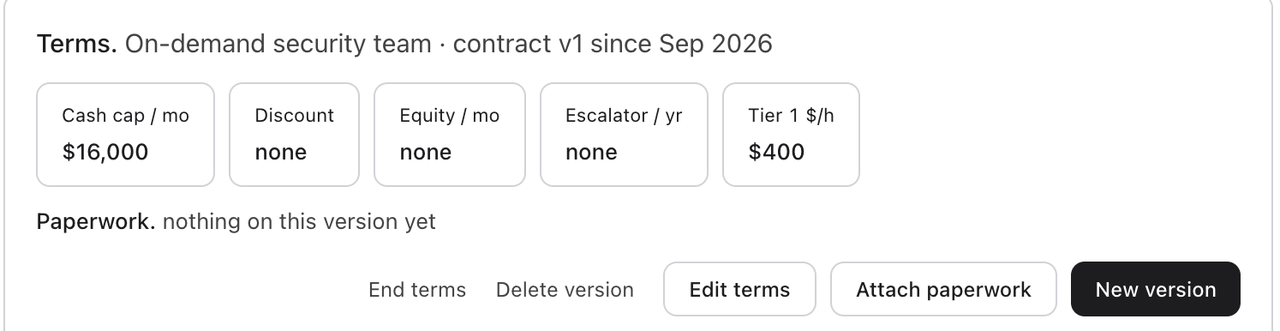
The agreement is a versioned terms card: the monthly cap or budget, rates by tier, the discount, the yearly escalator and equity taken as payment, with the signed paperwork attached to the version. A renewal at 20% less is a new version of the terms, dated from the day it starts. Every invoice is computed from the version in force, never typed.
The team logs hours against each client’s budget whatever the fee, from one Slack reminder a day that takes under a minute. Each entry carries the person, the date and a line in their own words. The client sees one line on the invoice. The firm sees every hour behind it, which is where the first of the five numbers comes from.
An hour that would push a client past its budget is saved and marked pending approval the moment it is logged. It waits in the row where it happened for a named person, an owner or the account leader, to approve or decline, with the reason they type. Approved goes on the invoice at the agreed rate. Declined stays on the record, unbilled. On a fixed fee this is the bet placed again, by a person, on the day, and the record keeps the answer for the renewal.
42.0 of 40 h
Tue 20 Oct · 2 h · Second review of the vendor risk assessment, asked for on Monday’s call · Tomás A.
Pending approval. 2 h over the client’s budget.
Revenue, cost and margin for every client are there every morning, from the hours as they are logged, so three clients on the same fee look different in the first week of the month and not at the close. Rates and margin are visible only to the owners and the people they name, enforced on the server. Everyone sees their own hours.
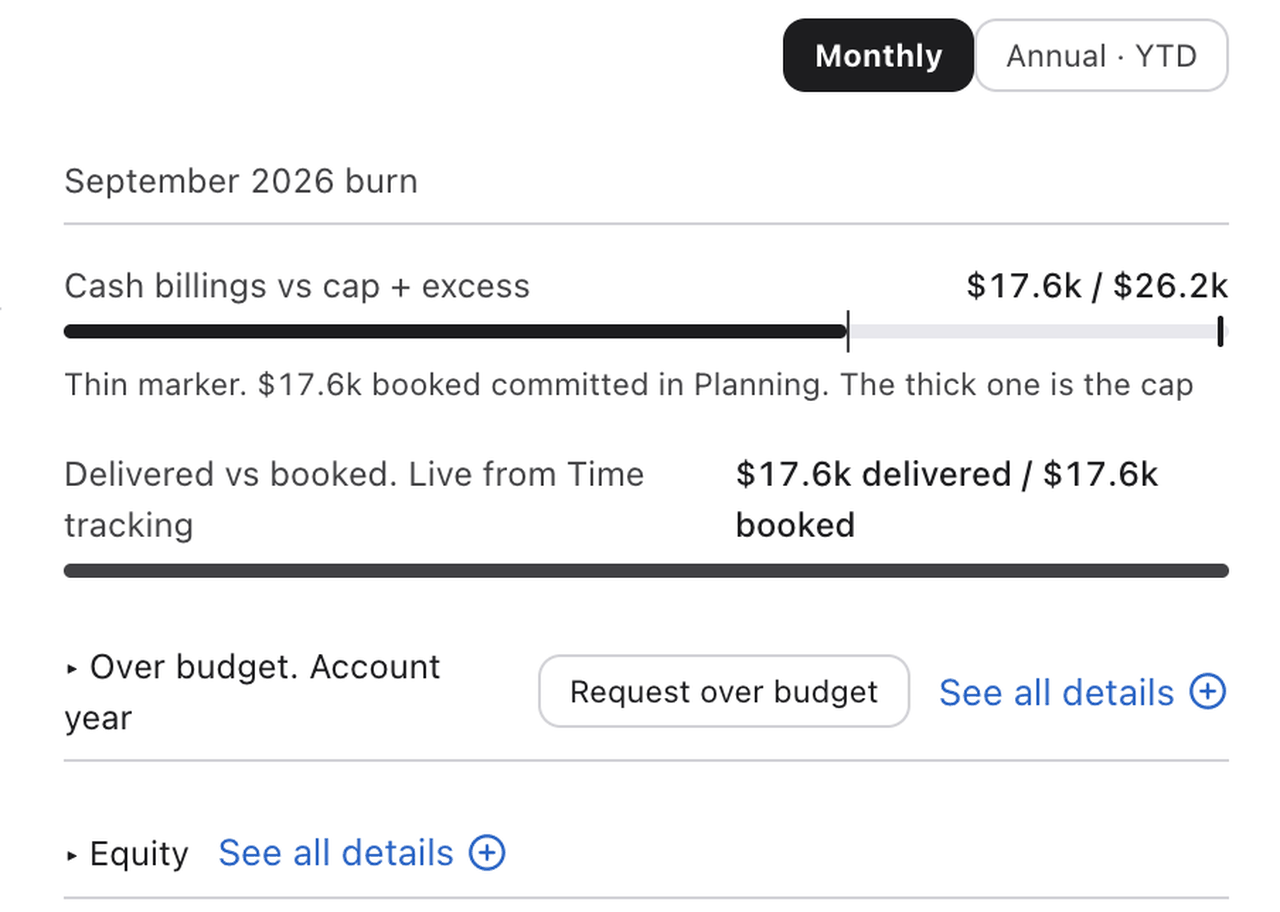
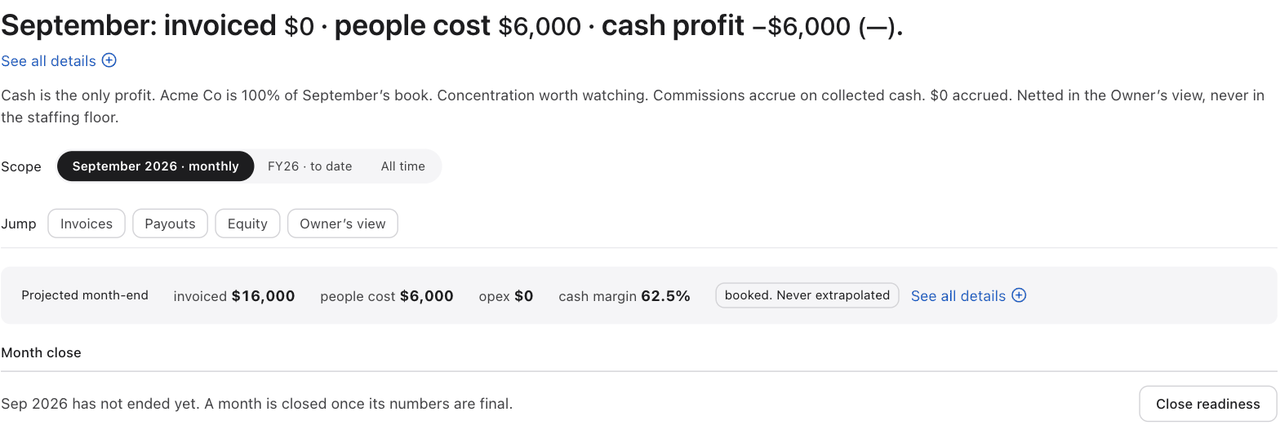
Each month closes as a record. Invoices, statements and margin freeze, and nothing in a closed month changes. Every change is on an append-only trail with the actor, the action and the value before and after, and separate tabs show what people did and what Ceed Intelligence did. Twelve closed months are the reference class for next year’s renewal: the hours per outcome, the worst month, and every hour that waited for a decision and how it was answered. A buyer of the firm would read the same record, in the monthly routine we described in October.
Ceed Intelligence reads a firm’s paper into the record, the signed agreements included, and proposes the terms it finds. A person confirms. Every act shows its price first, in dollars and tokens, every record it adds is marked imported, and what the model cost is its own line on the firm’s statement. Ceed works without it.
Ceed costs 0.1% of what the firm invoices, with no seats, no tiers and no minimum, and nothing to pay until the first invoice. A renewal at 20% less lowers Ceed’s bill by the same 20%: $20 a month on a $20,000 fee becomes $16 on $16,000. Invoices and statements go to QuickBooks Online or Xero as documents. Our comparison page sets Ceed beside other tools, and our answers explain how an invoice and the close are computed.
What the books say.
Three books on why estimates run long, two on contracts that share risk, and one on where a services firm’s margin lives.
- How Big Things Get DoneBent Flyvbjerg and Dan Gardner, 2023. Reference-class forecasting: price the next job from the spread of your own past jobs, not from the plan for this one.
- Software EstimationSteve McConnell, 2006. The difference between an estimate, a target and a commitment, and why a fixed fee is the third made from the first.
- The Mythical Man-MonthFrederick P. Brooks Jr., anniversary edition, 1995. Why estimates run optimistic, and why adding people to a late job makes it later.
- Contracting in the New EconomyDavid Frydlinger, Kate Vitasek, Jim Bergman and Tim Cummins, 2021. How to write a contract that shares the risk of an outcome instead of moving it to one side.
- VestedKate Vitasek and Karl Manrodt with Jeanne Kling, 2012. Outcome-based deals built on shared incentives, and why contracts where the winner takes all tend to fail.
- Managing the Professional Service FirmDavid H. Maister, 1993. The economics of a services firm, and why its margin lives in its hours whatever the price says.
Five conversations about what an outcome costs.
The firm behind Ceed also hosts The Security Podcast of Silicon Valley, more than a hundred conversations since 2021. Five are about work sold as an outcome, and what it takes to deliver one.
- 65
Yaron Singer of CiscoMarch 2025 · Why trust, not technology, is the barrier to AI at scale, from a founder whose company passed SOC 2 Type 2 four months before Cisco bought it.
- 37
Jon McLachlan and Sasha Sinkevich, the hostsFebruary 2024 · Compliance as a deliverable with a what, a why, a when and a how, the kind of work a client buys as an outcome.
- 64
Daniel Marashlian, co-founder and chief technology officer of DrataMarch 2025 · How automating security audits built a billion-dollar company, the productized outcome in its plainest form.
- 7
Michael Brooks, virtual chief information security officer at TravaAugust 2021 · Risk measured by what a business can live without, where any fee priced on an outcome starts.
- 76
Michael Nov, co-founder and chief executive of Prime SecurityAugust 2025 · How skipping the design stage moves the cost to later, the hidden side of any fixed price.
Ceed is for firms that sell their team’s time: security consultancies, managed security providers, IT managed service providers, fractional CFO and accounting practices, fractional executives, management consultancies, engineering firms, law firms, software firms and agencies up to fifty people, and nineteen kinds of firm in all. If a client has asked for 20% off at the renewal, sign up and answer from your own hours. Nothing to pay until your first invoice.
Sign upOr write to hello@ceed.so.
Questions.
How much should I discount a renewal because of AI?
Only as much as your own hours on that client’s work have fallen, and less if the work now carries new costs. Bain found buyers asking for as much as 20% at renewal in 2026. But a client paying $20,000 a month at a 52.5% margin, renewed at 20% less with $400 a month of new tool costs, needs 24.2% fewer hours just to keep the rate. Compare last year’s hours with this year’s, month by month, before you agree to a number. If the hours rose, the renewal is the day to say so.
Who bears the risk in a fixed-price contract?
The firm. The Federal Acquisition Regulation says a firm-fixed-price contract “places upon the contractor maximum risk and full responsibility for all costs and resulting profit or loss.” Under time and materials the client carries the overrun instead. A fixed price renewed at a discount the buyer assumed adds one more risk, the saving the firm promised, and an outcome fee adds the result itself. What differs is who finds out when the hours run long. This is not legal advice.
If I price per project, do I still need to track hours?
Yes, though the client never has to see them. The hours are the cost of a fixed price and the evidence for the next one. The largest firms keep them in their own accounts: KPMG and PwC in the UK measure progress on fixed-fee work by the actual inputs of time against the total expected. With the hours, a firm can see which fixed-fee clients make money, find its break-even before a renewal and price the next bid from its own record.
When should I use time and materials instead of a fixed price?
When the work cannot be estimated with confidence. The federal rule allows time and materials only when it is “not possible at the time of placing the contract to estimate accurately” how far the work will go or how long it will take, and the economists Patrick Bajari and Steven Tadelis found cost-plus contracts preferred as projects grow more complex. Your own hours by kind of work show which jobs you can estimate and which you cannot.
Should tax preparers charge less if they use AI?
The Internal Revenue Service says the saving should reach the client. Its Office of Professional Responsibility wrote in June 2026 that practitioners should “fairly credit to the client’s account any cost reductions”. The American Institute of Certified Public Accountants pushed back in September, saying professional services are increasingly priced on value delivered and not just time spent. Either way, a firm needs its hours before and after the tools to show what changed. This is not tax advice.
Should managed service providers move off per-user pricing?
Many are reconsidering it. A poll of 255 providers, cited in July 2026 in the notes of a Business of Tech episode with Jessica Davis of Omdia, found 40% keeping per-user pricing and 60% reevaluating it or moving toward hybrid, outcome or consumption models. A price per user is a fixed fee on a seat, and what it costs to serve the seat is hours and tools. Whichever model you choose, price it from your own hours and tool costs per client, so that a client who asks why the seat costs the same gets an answer from evidence.
 Sasha Sinkevich is a co-founder of Ceed and of YSecurity, which bills its security work by the quarter hour with an optional monthly cap and keeps every hour on the record, whatever the fee. Published 22 October 2026. Corrections to hello@ceed.so, and they are dated when made.
Sources
- Accenture’s results call. Accenture, “Fourth quarter fiscal 2026 conference call transcript”, 1 October 2026, https://investor.accenture.com/~/media/Files/A/accenture-v4/investors/earnings-reports/2026/fourth-quarter-fiscal-2026-conference-call-transcript.pdf, read again on 18 October 2026. The Motley Fool’s transcript of the same call, for the bookings figure, https://www.fool.com/earnings/call-transcripts/2026/10/01/accenture-acn-q4-2026-earnings-call-transcript/. Every source below was read on 12 October 2026 unless another date is given, and those marked as read again were checked against the page on 18 October 2026.
- Accenture’s shares. Alexander Schneider, Adanos, on 18 June 2026, published 19 June 2026, https://adanos.org/insights/data-in-action/accenture-ai-consulting-selloff/. Michael Abadha, InvestingCube, on 1 October 2026, published 2 October 2026, for the close on 1 October, https://www.investingcube.com/shares/accenture-stock-in-record-daily-jump-but-are-the-latest-earnings-hiding-something/, read again on 18 October 2026.
- BCG. Christoph Schweizer’s interview with The Wall Street Journal, as republished on BCG’s site, undated, https://www.bcg.com/about/expertise/ai-changing-consulting-and-pricing-models, read again on 18 October 2026. BCG revenue release, 23 April 2026, https://www.bcg.com/press/23april2026-bcg-revenue-22nd-consecutive-year-growth.
- McKinsey & Company, Daniel Ahmoye, Erik Sjödin, Jose Luis Blanco and colleagues, “How AI is reshaping the future of the AEC industry”, 15 July 2026, https://www.mckinsey.com/industries/engineering-construction-and-building-materials/our-insights/how-ai-is-reshaping-the-future-of-the-aec-industry, read again on 18 October 2026.
- Posts from X, as recorded in a browser on 12 September 2026, each date confirmed from the post’s own number: Financial Times, 24 May 2026, an opinion piece, https://x.com/FT/status/2058402289178558670. Thierry Borgeat, 18 June 2026, 199 likes as recorded on 12 September 2026, https://x.com/ThierryBorgeat/status/2067612087325544726.
- Bain & Company, Megha Chawla, Mark Brinda, Sushant Khandelwal and Sandeep Nayak, “Tech Services: Cracking the Code on AI-led Growth”, Technology Report 2026, 29 September 2026, https://www.bain.com/insights/tech-services-cracking-the-code-on-ai-led-growth-technology-report-2026/, read again on 18 October 2026.
- Tata Consultancy Services, second quarter call of fiscal 2027, transcript published by Investing.com, 8 October 2026, https://www.investing.com/news/transcripts/earnings-call-transcript-tcs-posts-steady-q2-2026-growth-as-ai-revenue-tops-31b-93CH-4939361. Stanton Jones, ISG Index recap for the third quarter, 9 October 2026, https://isg-one.com/articles/index-insider-3q26-isg-index-recap.
- The buyer’s side. Stephanie Overby, InformationWeek, “CIOs move to reclaim value as AI shakes up outsourcing contracts”, 28 April 2026, https://www.informationweek.com/ai-innovations/outsourcing-contracts-weren-t-built-for-ai-cios-are-renegotiating-now. Serge Tkach, CIO.com, “Your service vendors are being rebuilt around AI”, 14 July 2026, https://www.cio.com/article/4196348/your-service-vendors-are-being-rebuilt-around-ai.html, read again on 18 October 2026. The providers’ promised gains of 40% to 70% are from the InformationWeek article.
- Federal contract types. Federal Acquisition Regulation 16.202-1, https://www.acquisition.gov/far/16.202-1, read again on 18 October 2026, and 16.601, https://www.acquisition.gov/far/16.601, text in force from 13 March 2026. The proposed rule, FAR Case 2026-006, published 18 September 2026, https://www.federalregister.gov/documents/2026/09/18/2026-19160/federal-acquisition-regulation-revolutionary-federal-acquisition-regulation-overhaul-parts-16-17-and. Department of War, “Contracts for Sept. 10, 2026”, https://www.war.gov/News/Contracts/Contract/Article/4596373/contracts-for-sept-10-2026/, read again on 18 October 2026: the maximum value is a ceiling, and the face value of the award is $388,273,413.
- Fishbowl, “Do clients ask for fixed price or T&M contracts or do you as PPD negotiate them into one or the other?”, a principal’s answer and a manager’s reply in a thread of about 2021, read on 12 September and again on 18 October 2026, https://www.fishbowlapp.com/post/do-clients-ask-for-fixed-price-or-tm-contracts-or-do-you-as-ppd-negotiate-them-into-one-or-the-other.
- Who carries the risk. Benjamin Alarie, chief executive of Blue J, Accounting Today, “The billable hour is a trust contract. AI just broke the terms”, 8 July 2026, https://www.accountingtoday.com/opinion/the-billable-hour-is-a-trust-contract-ai-just-broke-the-terms, which also cites Ignition’s 2025 Accounting and Tax Pricing Benchmark Report, read again on 18 October 2026. Business Insider, “In the AI age, clients are now asking consulting firms to have ‘skin in the game’”, 29 June 2026, https://www.businessinsider.com/consulting-industry-pricing-outcome-based-ai-risk-2026-6. Business Insider’s page could not be opened from here, so the article was read in a syndicated copy that names it as the original, on 12 October and again on 18 October 2026, https://dnyuz.com/2026/06/29/in-the-ai-age-clients-are-now-asking-consulting-firms-to-have-skin-in-the-game/.
- The AICPA and the IRS. Internal Revenue Service, Office of Professional Responsibility, Issue Number 2026-19, “Introductory Guidelines for Responsible AI Use in Federal Tax Practice”, 24 June 2026, https://www.irs.gov/pub/opr-taxpros/issue-number-2026-19-introductory-guidelines-for-responsible-ai-use-in-federal-tax-practice.pdf, read again on 18 October 2026. Martha Waggoner, Journal of Accountancy, 8 September 2026, https://www.journalofaccountancy.com/news/2026/sep/aicpa-seeks-irs-clarity-on-ai-guidelines-cpa-fees/, read again on 18 October 2026. Adrienne Gonzalez, Going Concern, 9 September 2026, https://www.goingconcern.com/aicpa-pushes-back-on-irs-suggesting-cpas-should-charge-less-if-theyre-using-ai/.
- Overruns and estimates. Bent Flyvbjerg and Alexander Budzier, “Why Your IT Project May Be Riskier Than You Think”, Harvard Business Review, September 2011, https://papers.ssrn.com/abstract=2229735. Michael Bloch, Sven Blumberg and Jürgen Laartz, McKinsey & Company with the University of Oxford, “Delivering large-scale IT projects on time, on budget, and on value”, 1 October 2012, https://www.mckinsey.com/capabilities/mckinsey-digital/our-insights/delivering-large-scale-it-projects-on-time-on-budget-and-on-value. Kantata’s survey of 200 professional services leaders, run by Censuswide, Business Wire, 8 January 2026, https://www.businesswire.com/news/home/20260108295161/en.
- Contract theory. Thomas Kern, Leslie Willcocks and Eric van Heck, “The Winner’s Curse in IT Outsourcing”, California Management Review, Winter 2002, https://cmr.berkeley.edu/2002/02/44-2-the-winners-curse-in-it-outsourcing-strategies-for-avoiding-relational-trauma/. Patrick Bajari and Steven Tadelis, “Incentives versus Transaction Costs: A Theory of Procurement Contracts”, RAND Journal of Economics, Autumn 2001, https://ideas.repec.org/a/rje/randje/v32y2001i3p387-407.html.
- Hacker News, read through the Algolia items endpoint: “McKinsey wonders how to sell AI apps with no measurable benefits”, 9 October 2025, https://news.ycombinator.com/item?id=45526589. “Ask HN: Is $300/HR too low these days for custom full stack?”, 23 May 2026, https://news.ycombinator.com/item?id=48245259. “Tell HN: I’m making 1K USD per hour with AI”, 13 June 2026, https://news.ycombinator.com/item?id=48511828.
- Jonathan Stark’s daily emails: 11 September 2026, https://jonathanstark.com/daily/20260911-2359-how-do-consultants-manage-to-get-over-the-budget-funds-covered-by-the-client. 14 September 2026, https://jonathanstark.com/daily/20260914-2359-have-you-been-burned-by-giving-fixed-prices. 10 August 2026, https://jonathanstark.com/daily/20260810-2359-hourly-billing-feels-safe.
- Renewal pricing. Michael Zipursky, Consulting Success, “When The Work Outgrows The Fee”, 14 July 2026, https://www.consultingsuccess.com/raise-fees-mid-engagement. Blair Enns and David C. Baker, 2Bobs, “Productization (Again)”, 15 July 2026, quoted from the transcript on the page, https://2bobs.com/podcast/productization-again.
- Tax firms. Thomson Reuters Institute, “2026 State of Tax Professionals Report”, June 2026, pages 5, 19, 21 and 22, https://www.thomsonreuters.com/en-us/posts/wp-content/uploads/sites/20/2026/06/2026-State-of-Tax-Professionals-Report.pdf, read again on 18 October 2026.
- Managed service providers, from the episode pages of Business of Tech with Dave Sobel, which are notes and not transcripts: Jessica Davis, 24 July 2026, https://businessof.tech/podcast/jessica-davis-how-ai-usage-models-are-disrupting-msp-revenue-predictability/, read again on 18 October 2026. Those notes credit the poll of 255 providers to “Omnia”, and we found no published poll under that name or Omdia’s, so the post names only the guest’s firm. Her title is from the show’s page of 24 April 2026, https://businessof.tech/podcast/what-the-data-actually-shows-about-msps-in-2025-jessica-davis-omdia/, read on 18 October 2026. Gleb Tsipursky, 26 September 2026, https://businessof.tech/podcast/ai-margins-and-msp-growth-dr-gleb-tsipursky-on-passing-savings-vs-competing-away-profit/, read again on 18 October 2026. David Primor of Cynomi, which sells software to the providers, 28 September 2026, https://businessof.tech/podcast/ai-driven-vciso-platforms-create-pricing-and-liability-shifts-for-msps-david-primor-of-cynomi/.
- Security leaders on retainer. Brian Haugli, SideChannel, “vCISO Pricing in 2026”, 22 April 2026, https://sidechannel.com/blog/the-ultimate-guide-to-vciso-pricing-everything-you-need-to-know. Fractional CISO, pricing page, modified 8 June 2026, https://fractionalciso.com/vciso-pricing/.
- Fractional executives. Jonathan Grana, Go Fractional, “How to Become a Fractional Executive”, 5 October 2026, https://www.gofractional.com/blog/how-to-become-a-fractional-executive. Go Fractional, rates, as read on 12 October 2026, https://www.gofractional.com/insights/rates, and the 2026 State of Fractional Work, 213 responses collected in April 2026, https://www.gofractional.com/insights. Taylor Crane, Fractional Jobs, “What Fractional Executives Cost by Role in 2026”, 5 October 2026, https://www.fractionaljobs.io/blog/what-fractional-executives-cost-by-role-2026. Umbrex, Fractional Executive Playbook, chapters 4, 5 and 15, modified 14 August 2025, https://umbrex.com/resources/fractional-executive-playbook/engagement-mechanics-and-integration/ (its list of common red flags, read again on 18 October 2026), https://umbrex.com/resources/fractional-executive-playbook/building-a-career-as-a-fractional-executive/ and https://umbrex.com/resources/fractional-executive-playbook/fractional-chief-information-security-officer-playbook/.
- Boutiques and agencies. Joe O’Mahoney on LinkedIn, 17 August 2026, as recorded in a browser on 12 September 2026, https://www.linkedin.com/posts/joeomahoney_consulting-boutiqueconsulting-privateequity-share-7495117443061714945-hGxE/. Drew McLellan, Agency Management Institute, 27 May 2026, https://agencymanagementinstitute.com/ai-is-the-means-not-the-mission/. Promethean Research, Digital Agency Industry Report, undated, https://prometheanresearch.com/digital-agency-industry-report/.
- Fixed fees in the large firms’ accounts. KPMG Holding LLP, members’ report and financial statements 2025, page 25, https://assets.kpmg.com/content/dam/kpmgsites/uk/pdf/2026/05/members-report-and-financial-statements-2025.pdf.coredownload.inline.pdf, year to 30 September 2025, read again on 18 October 2026. PricewaterhouseCoopers LLP, financial statements 2025, note 2, page 22, year to 30 June 2025, https://www.pwc.co.uk/annualreport/assets/2025/pwc-uk-financial-statements-2025.pdf, read again on 18 October 2026. Kailash Ganesh, Rocketlane, on SPI Research’s 2026 Professional Services Maturity Benchmark, 19 March 2026, https://www.rocketlane.com/blogs/professional-services-maturity-index-2026.
- Value per lawyer. Alex Chan, Thomson Reuters Institute, analysis of the Law Firm Financial Index for the first quarter of 2026, 30 June 2026, https://www.thomsonreuters.com/en-us/posts/legal/q1-2026-lffi-analysis-productivity-puzzle/.
- YSecurity. Jon McLachlan, “Is Your SOC 2 Real? What Buyers Will Check Now”, 5 October 2026, https://ysecurity.io/blog/is-your-soc-2-real/. Sasha Sinkevich, “SOC 2 Type 1 vs Type 2: Which Report Enterprise Buyers Require”, 6 October 2026, https://ysecurity.io/blog/soc-2-type-1-vs-type-2/, read again on 18 October 2026. Jon McLachlan, “Pentest Once a Year? What Enterprise Buyers Expect From AI Startups in 2027”, 7 October 2026, https://ysecurity.io/blog/pentest-once-a-year/. Jon McLachlan, “What Is a vCISO? What They Cost, What They Do, and When a Startup Needs One”, 28 September 2026, https://ysecurity.io/blog/what-is-a-vciso/. Service pages: https://ysecurity.io/services/soc-2-type-2/, https://ysecurity.io/services/penetration-testing/ (read again on 18 October 2026) and https://ysecurity.io/services/sales-support/. Case study, “How Robust Intelligence turned SOC 2 Type 2 into a $400M Cisco exit with YSecurity at the wheel”, dated 22 September 2024, https://ysecurity.io/case-studies/soc-2-type-2-robust-intelligence/, read again on 18 October 2026. MicroConf US 2027, https://microconf.com/us-flagship.
- Recordings on YouTube, with view counts as read on 28 September 2026: The AI Daily Brief, 6 November 2025, https://www.youtube.com/watch?v=9osIWH69P_4. Private Equity FunCast, 24 June 2026, https://www.youtube.com/watch?v=-ZduWqKHeH4. Management Consulted, 30 May 2025, https://www.youtube.com/watch?v=Oam9tIlr9sE. Anders Virtual CFO, 12 May 2026, https://www.youtube.com/watch?v=LfEc9kMCGhg. Business of Tech, episode pages dated 26 and 28 September 2026, https://www.youtube.com/watch?v=yhv_qpqjBxg and https://www.youtube.com/watch?v=MVLW6LYJG04. AI Engineer, 23 July 2025, https://www.youtube.com/watch?v=Wv1tAxKYLeE. Bloomberg Law, 15 November 2022, https://www.youtube.com/watch?v=n_TQOzsTiJo. Brand Master Academy, 7 July 2026, https://www.youtube.com/watch?v=qrss_6KWhpI. Y Combinator, 25 July 2024, https://www.youtube.com/watch?v=4hjiRmgmHiU.
- The figures are ours, drawn from the sources above. The three clients, the renewal and the bid are worked examples with invented numbers, and their arithmetic is shown beside them.
- Product pictures are of Ceed’s staging environment in September 2026, showing a demo account with invented names and figures. The drawn card uses the same demo account, and its entry is ours.
- The Security Podcast of Silicon Valley, a YSecurity production, quoted from the episode notes: episode 65 with Yaron Singer, 26 March 2025, https://ysecurity.io/podcast/65-yaron-singer-cisco-the-hard-truth-about-deploying-ai-today/. Episode 37 with Jon McLachlan and Sasha Sinkevich, 25 February 2024, https://ysecurity.io/podcast/37-founders-guide-to-compliance-the-introduction-soc2-iso-nist-pci/. Episode 64 with Daniel Marashlian, 11 March 2025, https://ysecurity.io/podcast/64-building-a-billion-dollar-security-company-lessons-from-dratas/. Episode 7 with Michael Brooks, 10 August 2021, https://ysecurity.io/podcast/7-michael-brooks-vciso-and-director-of-cyber-risk-services-at/. Episode 76 with Michael Nov, 26 August 2025, https://ysecurity.io/podcast/76-the-critical-security-stage-every-startup-skips/.