Blog · 29 October 2026 · Sasha Sinkevich
One senior. Three agents.
For a century a firm that sells its people’s time made its margin from a pyramid: a partner sells the work, juniors deliver it, and the spread on many junior hours pays for everything else. Agents now do much of the junior work. This post follows what that does to the largest firms, which are changing shape in more than one direction, and to a firm of ten: the blended rate and the invoice, who is paid from a client’s hours, who trains the next senior, and what the partners keep. With ten recordings, a post from X, the Hacker News threads, six figures, a month you can staff five ways, pictures of the product, six books and five episodes of The Security Podcast of Silicon Valley. Correct as far as we know on 18 October 2026.
On the keynote stage at CES in Las Vegas on 6 January, at a live taping of the All-In podcast, Bob Sternfels described McKinsey in a new unit of count. The firm had 40,000 human employees and 25,000 personalized agents, he said, and he expected about as many agents as people by the end of the year. Its client-facing roles were growing by 25%. The roles that do not face clients had shrunk by about 25%, while “output from that side has grown 10%”, in Business Insider’s account. Then he said the sentence this post is about. “Our model has always been synonymous that growth only occurs with total head count growth.” And then: “Now it’s actually splitting.”
In July he told Bloomberg Television that the rest of the decade could be “a golden age for us”. The French trade site Consultor.fr, reporting that interview, quoted him further: McKinsey was hiring client-facing consultants in record numbers, and each had about three AI agents. In a post on LinkedIn, Consultor.fr added, he set an aim of 20% more consultants, mainly in entry-level positions. That aim is his own, and it has no period attached.
Put those numbers beside a firm of ten. Two seniors sell the work and lead it, and eight juniors do most of it, in two teams of five. On a typical client, call it Acme Co, one senior and four juniors log 200 hours in a month. The senior bills at $300 an hour and the juniors at $150, and of the $21,200 the month leaves the firm on that client, $15,200 comes from the juniors’ hours. That firm is the pyramid in miniature, and this post comes back to it. Its numbers are ours, and the arithmetic is shown wherever they appear.
Sternfels’s sentence is the change in a line. The largest firms are changing shape, though not into one shape. Consulting is keeping its base and cutting its back office. Accounting is narrowing its entry level. Big Law is growing its middle. What moved everywhere is the mix of hours by role, and for a firm of ten that moves three numbers at once. If it bills by the hour, its blended rate rises while its invoice falls. Its payouts and commissions come from different people’s hours. And the cost of training the next senior becomes a choice made on purpose, or a cost found at the end of the month. One set of hours still has to pay everyone.
On YSecurity’s blog in September I put the human side of it in one line: “AI is taking the first rung of the ladder rather than the ladder.” This post is about the rung, and about what a firm pays for it.
We run a security consultancy, YSecurity. It started as just the two of us, Jon McLachlan and me, and now has more than 45 operators. Ceed, the record we built to run its money side, has never had an engineer on staff. It is built with agents that people at YSecurity run and answer for, so we work in this shape from both ends.
One line before the rest: none of this is legal, tax or financial advice. Billing rules differ by profession, state and contract, so ask your attorney or accountant before you change how you bill a client or pay a person.
Four juniors. One partner.
The arithmetic of the pyramid has a name, and the name is David Maister’s. In Managing the Professional Service Firm, published in 1993, the multiplier is “leverage”, the ratio of junior and middle-level people to senior ones. In Maister’s terms the partners are the finders, who win the work and keep the client. The managers are the minders, who supervise the work day to day. The staff are the grinders, who do the tasks. Profit per partner, in his account, is the product of three numbers: margin, productivity and the ratio of staff to partners. And the ratio is set by the work. A firm can carry as many juniors per partner as its work allows, which is how the largest firms grew.
The Financial Times described the shape at the top of the market in December 2025 as “the traditional pyramid, in which a firm employs thousands of junior-level employees” and “thins out the ranks with an ‘up or out’ promotion culture.” Every level of it has a price. In 2024, as Slideworks read McKinsey’s schedule with the US General Services Administration, a senior partner’s hour was priced at $1,193.57, an engagement manager’s at $834.40, and the analysts’ and associates’ between $327.41 and $498.23. McKinsey prefers to sell a team: “We do not deploy individual people at an hourly rate,” it told the Department of the Interior in 2011, as Slideworks quotes it. The team is a pyramid with a price on each level.
A firm of ten runs the same arithmetic on smaller numbers. Ours bills its seniors at $300 an hour and its juniors at $150. Counting salary and benefits, a senior costs it about $150 for every hour worked on a client, and a junior about $55. So each senior hour leaves $150 and each junior hour $95. One senior and four juniors on Acme Co for a month, 40 hours and 160, invoice $36,000, cost $14,800 and leave $21,200. The senior’s 40 hours leave $6,000 of it. The juniors’ 160 leave $15,200. That is the pyramid in one client’s month: the senior’s time sells the work, and the spread on the juniors’ time is most of the margin.
An anonymous account on X read the same arithmetic less kindly in April.
The partner doing narrative wasn’t worth $10,000 an hour either. The partner was worth maybe $2,000 an hour for actual judgment and relationship work. The rest of the rate was extracted because the partner could point at the pyramid of associates and justify the price through billable hours that were themselves marked up four or five times over actual cost.
Take out the hostility and the account is Maister’s: the client pays for a pyramid of hours, at a rate set by role, and the margin lives in the hours at the bottom. Two things keep that working. The junior hour has to be one a client will pay for. And the junior has to become a senior, which means somebody pays for the years in between. Agents now touch both.
Agents on the roster. People on the invoice.
McKinsey’s numbers have a history, and the history is the argument. Bloomberg reported in December 2025 that the firm grew from 17,000 people in 2012 to about 45,000 at its peak and has since “slid to around 40,000”, while revenue has “hovered around $15 billion to $16 billion in the last five years”. Its leaders had discussed cutting about 10% of the people in departments that do not face clients, and a spokesperson said “It’s early to gauge the net impact on headcount.” In January Sternfels gave two counts of agents, 20,000 on Harvard Business Review’s podcast and 25,000 at CES, and a spokesperson told Business Insider that 25,000 is the accurate figure.
The firm’s own research says how far the new ratio can go. In “The agentic organization”, published in September 2025, eight McKinsey authors wrote that “a human team of two to five people can already supervise an agent factory of 50 to 100 specialized agents”. They described the agents in the language of a career, moving “from an intern-level employee requiring constant supervision to a mid-tenure employee”. That is a junior’s career, written as a product roadmap. On Hacker News, in a thread on why AI was making seniors stronger rather than juniors, lodovic put the same forecast in the trade’s own words: “Senior devs will get 5-10 times as productive, wielding an army of agents comparable to junior devs.”
Kate Smaje asked the questions that matter to anyone who puts agents on a roster, on McKinsey’s own podcast in August.
“How many agents do I actually have? Who is responsible or accountable for their performance? What value are they creating?”
“The rise of AI doesn’t mean we all suddenly delegate our responsibilities for quality control and critical thinking.”
Kate Smaje, on McKinsey Talks Talent, “Your AI agents need performance management, too”, 26 August 2026.
Her second question is the one a firm of ten can answer today. An agent is software that someone chose, someone prompted and someone ran. It answers for nothing. The person who ran it answers, the way a senior has always answered for a junior’s draft, and Smaje’s own view on the same episode was that “The head of finance who’s looking after the humans in that process should also be looking after the agents”. The agent goes on the roster. The person who answers for it stays on the invoice.
In security, our own field, the split is already written into the scope of work. YSecurity’s guide to AI penetration testing says what stays with a person when an autonomous agent runs the test: “Someone decides what is in bounds, which environment, which techniques are off limits, and what an acceptable outage looks like.” Its rule for code that agents write is shorter: “the agent drafts, a human merges.” On our podcast in October, Yair Grindlinger, co-founder and chief executive of Surf AI, named the work agents do well: “A lot of what agents are very good at is following up on people, escalating, opening tickets”. The analysts, he said, were glad first of all to be rid of the work they never wanted. Much of that list is a junior’s week. Even where the reviewer is an agent, as in Paddy Roberts’s account of agentic code review under a SOC 2 audit, his first clause says it all: “The human is accountable”. Paddy leads governance, risk and compliance at Augment Code, and YSecurity’s people have worked inside Augment Code, where Jon was chief security officer, so weigh it with that in mind. The work moved. The name on the result did not.
Accenture reported the market’s version on 1 October. Julie Sweet told analysts that “we increased revenue per person this year”, “which is what you would expect in part due to AI, but we’re also in growth mode.” By our arithmetic from its own figures, revenue per person rose about 1.9%, from about $89,400 in fiscal 2025 to about $91,200, approximate because the firm counts “more than 814,000 reinventors”. Describing a client, the Greek electricity company PPC, she gave the new shape a name: “people in the lead and agents on task”. Bryan Keane, an analyst at Citi, had asked how a growing firm fit with “this non-FTE kind of commercial model”, one not priced by the full-time person: “I thought with agentic, we’d be probably decreasing headcount.”
Put the two firms side by side and the pattern is the same at the largest firms. The agents are counted, deployed and paid for by the firm. What a client’s invoice shows is people, by role, or a fee, and the agents change which people and how many of their hours. Who pays for an agent’s run, the firm or the client, was the subject of our post of 27 October, The agent worked. The meter ran. This post is about the people who are left on the invoice, and what they cost.
The base thins. The middle swells.
The largest firms are not moving to one new shape, and the people who drew the new shapes say so. PwC, whose paper on the workforce of the agentic era proposed the diamond, warned against it in the same paper: “But it should be a choice, not a default, because for many companies, this diamond structure can carry medium- and long-term risks.” Harvard Business Review’s authors proposed “a new leaner consulting model, the ‘obelisk,’ which features fewer layers and smaller teams.” Bain’s technology report says only that “The pyramid is flattening, but the successor is uncertain.”
Software. The base went first.
The cleanest number comes from software engineering, not consulting, and it should be read that way. Bain’s Technology Report 2026, published on 29 September from a survey of software companies with 155 responses, found that “Fewer engineering organizations report traditional pyramid structures, down from 66% to 29%.” Junior engineers “used to make up one-third of teams on average” and are now “less than a fifth while senior ranks swell.” Bain’s verdict: “The base of the pyramid is disappearing faster than anyone expected.” A software team is not a consulting firm, but for a software firm that sells its engineers’ time it is the nearest view of a base where the junior work is the work an agent does best.

Accounting. Fewer places at the start.
The four largest accounting firms in the United Kingdom took fewer graduates in 2024 than in 2023, as The Telegraph reported in June 2025. The newspaper put KPMG’s fall at 29%. Its own figures give 32.7%.
| Firm | 2023 | 2024 | Change | Change, % |
|---|---|---|---|---|
| KPMG | 1,399 | 942 | −457 | −32.7% |
| Deloitte | 1,700 | 1,400 | −300 | −17.6% |
| EY | 1,800 | 1,600 | −200 | −11.1% |
| PwC | 1,600 | 1,500 | −100 | −6.3% |
| All four | 6,499 | 5,442 | −1,057 | −16.3% |
None of the four blamed AI. KPMG said “We recruit around 1,000 graduates and apprentices a year”, EY that it was “actively hiring”, and PwC and Deloitte declined to comment. The link to AI was the newspaper’s.
In the United States the plan was written down. A PwC slide that Business Insider reported in August 2025 set the hiring goal for junior tax and assurance associates at 3,242 for the year to June 2025 and 2,197 for fiscal 2028, 1,045 fewer, or 32%. PwC gave its reason as people staying, “the historically low levels of attrition our business has faced the past few years”. Jennifer Kosar, its AI assurance leader, described the new first day: “People are going to walk in the door, almost instantaneously becoming reviewers and supervisors”.

EY chose a longer apprenticeship. On 17 August it announced the EY Career Residency, a paid program “spanning eight to 12 months”, “ahead of a January 2028 launch”, which Going Concern reported replaces the eight-week internship in assurance first. At KPMG in the United Kingdom, the cut proposed in April 2026 was not at the base at all. Of more than 500 roles, “some 440 assistant manager roles in the audit business” were to go, the middle of the ladder, and the reason KPMG gave was that people were staying: “current market conditions mean our attrition rates are very low within certain parts of our audit population”.
Consulting. The back office goes first.
The strategy firms are keeping their base and not paying it more. The Financial Times reported in December 2025 that McKinsey, BCG and Bain had frozen undergraduate starting packages at $135,000 to $140,000 for a third year. Namaan Mian of Management Consulted told the paper “It is harder to staff a 23-year-old on those kinds of projects versus someone with experience.” Yet McKinsey’s cuts fell on the roles that do not face clients, and its stated aim is more consultants, mostly at the entry level. So far consulting looks less like a diamond than an hourglass: a base kept, a thinner back office, and a middle whose job is review.
Law. The middle grows.
Big Law kept the billable hour and grew its middle. The Thomson Reuters Institute counts the hours worked by everyone who is not an equity partner for each hour an equity partner works. For associates the count reached 1.55 in the fourth quarter of 2025, a record, above the 1.44 of 2008, and it was 1.47 in the first half of 2026. For non-equity partners it reached “an unprecedented 0.91” in the second quarter of 2026, against an average of 0.50 in the financial crisis, and Thomson Reuters stressed that this was “not because of layoffs, but happened while firms kept hiring.”

The change shows at the base. NALP reported in August that firms of more than 500 lawyers “hired about 540 fewer graduates this year”, and Bloomberg Law put the total at 6,588. In Citi’s survey of 57 large firms this summer, two-thirds expected fewer first-year associates in 2028 than in 2025. In December 2025, Citi and Hildebrandt had found 86% of large firms planning to grow their associate ranks through 2027 and only 35% planning larger first-year classes. More associates, fewer of them new. Law firms are growing the middle while the entry narrows.
Put the four side by side and the shapes differ. Software lost its base fastest. Accounting narrowed its entry level, and KPMG in the United Kingdom set out to thin its middle. Consulting kept its base and cut its back office. Law grew its middle and is shrinking its first-year classes. What is the same in all four sits under the shape. The mix of hours by role changed, and every rate, payout and margin computed from that mix changed with it.
Higher blend. Smaller invoice.
A firm that bills by the hour keeps two prices. One is the rate card by role. The other is the blended rate, the invoice divided by the hours, which is the number a client compares across firms. A court record shows both side by side. When Delta Air Lines went through bankruptcy, Deloitte Tax filed its fees by level for the work from September 2005 to April 2007, $525 an hour for a partner, principal or director down to $205 for staff. Deloitte & Touche, the auditor in the same case, for the same period, billed every one of its people at $213.00 an hour, 15,811.8 hours and $3,367,915.53 in all before a voluntary reduction. A blended rate is a rate card folded into one number by a mix of hours. When the mix moves, the number moves, whether or not any rate did.
Agents move the mix. Take the firm of ten’s month on Acme Co again, and let three agents draft what the four juniors drafted. The senior spends 50 hours instead of 40, because more of the work is now review and judgment. A reviewer billed at $225 an hour spends 60 hours checking what the agents produced. Nobody’s rate changes. The month bills 110 hours instead of 200, the invoice is $28,500 instead of $36,000, and the blend rises from $180 an hour to $259.
The arithmetic
The blended rate is the invoice divided by the hours billed. The rate card is the same in both months: $300 an hour for the senior, $225 for the reviewer, $150 for a junior.
- Pyramid, 40 h × $300 and 160 h × $150$36,000
- Pyramid blend, $36,000 ÷ 200 h$180.00
- Agents, 50 h × $300 and 60 h × $225$28,500
- Agents blend, $28,500 ÷ 110 h$259.09
- The blend+43.9%
- The invoice−20.8%
- Hours billed−45.0%
- Margin, $21,200 to $14,100−33.5%
Margin is the invoice less the cost of the people and agents on the client: $14,800 in the pyramid month (40 h × $150 and 160 h × $55) and $14,400 in the agent month (50 h × $150, 60 h × $95 and $1,200 of agents). Our numbers, illustrative.
So the blend rose 44% and the invoice fell 21% in the same month, on the same work, with the same rate card. A client who reads the blend sees a firm that raised its prices. A client who reads the invoice sees a firm that cut them. Both are reading the same hours. The firm, reading its margin, sees a third thing: $21,200 became $14,100, a third less, because the hours that left the bill were the ones with the widest spread.
On Hacker News in April 2025, tqi predicted of the strategy firms that “Initially, I imagine they will staff smaller teams at a higher hourly rate”, mostly by replacing analysts and associates with automation. Joe O’Mahoney, who advises consulting firms on their value and their sale, wrote on LinkedIn in August that “Consulting firms could lose 30-50% of their billable hours to artificial intelligence within three years.” Our firm of ten lost 45% of its billable hours on one client and 21% of the invoice, because the hours it lost were its cheapest.
Rates by role do not fade when the mix changes. They matter more, because each role’s rate now prices a different kind of hour. The senior’s hour is judgment and the client’s trust. The reviewer’s hour is the checking of work nobody on the client’s side saw being made. A client buys people and their hours, and the rate card says which people. We wrote in September that the hour is splitting, with prices falling for work a tool can repeat and rising for judgment, and in October that the people who buy firms price the same split, intelligence against judgment. The blend is that split, read off one invoice.
A firm on a fixed fee sees no blend at all. It sees the hours behind the fee, and the people paid from them.
Same client. New names on it.
Every hour on a client’s budget pays someone, and when the mix changes, the list of names changes with it. In the pyramid month Acme Co’s $36,000 paid for a senior’s 40 hours and four juniors’ 160, and, if the firm pays its closer 10% of what clients pay, $3,600 of commission. In the agent month the juniors’ $8,800 of cost on this client is gone. The senior’s grows from $6,000 to $7,500. A reviewer appears, at $5,700. A vendor appears, at $1,200 for the agents’ runs. And the closer’s commission falls to $2,850, because it was written on an invoice that shrank.
If the reviewer is a contractor, the firm now writes a payout statement from hours that did not exist on this client a year ago, at a pay rate set against a bill rate it has to defend, the spread we took apart in markup is not margin. Paid from one sheet and billed from another, the same 60 hours exist twice.
On the client’s side the change has a rule, and lawyers wrote it first. The American Bar Association’s Formal Opinion 512, in July 2024, said lawyers have a duty to charge “reasonable fees consistent with time spent using GAI”, its abbreviation for generative AI. For a draft that takes fifteen minutes of input into the tool, the lawyer “may charge for that time as well as for the time necessary to review the resulting draft”, but “in most circumstances, the lawyer cannot charge a client for learning how to work a GAI tool.” Outside the law the contract is the rule, and the same default is the safe one: bill the time people actually spent, the review included, and not the hours an agent saved. In the agent month the reviewer’s 60 hours are billable. The 90 hours nobody worked are not, which is the question we took apart in whose hour it is.
One client. Five shapes.
Acme Co’s month of work, one rate card, five ways to staff it and bill it. Pick a shape.
Pyramid, hourly
- Senior, at $300 an hour40 h
- Four juniors, at $150 an hour160 h
- Blended rate, $36,000 ÷ 200 h$180
- Invoice$36,000
- People cost, $6,000 and $8,800−$14,800
- Agents’ runs$0
- Margin$21,200 · 58.9%
The month the firm of ten was built for. Of the $21,200, the juniors’ 160 hours leave $15,200.
Agents, hourly
- Senior, at $300 an hour50 h
- Reviewer, at $225 an hour60 h
- Blended rate, $28,500 ÷ 110 h$259
- Invoice$28,500
- People cost, $7,500 and $5,700−$13,200
- Three agents’ runs−$1,200
- Margin$14,100 · 49.5%
Nobody’s rate changed. The blend rises 44%, the invoice falls 21%, and the margin falls by a third, because the cheapest hours had the widest spread.
Agents, fixed fee
- Senior50 h
- Reviewer60 h
- Per hour worked, $36,000 ÷ 110 h$327
- Fixed fee$36,000
- People cost, $7,500 and $5,700−$13,200
- Three agents’ runs−$1,200
- Margin$21,600 · 60.0%
The client pays what it paid for the pyramid, and the firm keeps the saving, because the fee was set on the result.
Fixed fee, with a trainee
- Senior50 h
- Reviewer60 h
- Trainee, the client pays nothing more80 h
- Per hour worked, $36,000 ÷ 190 h$189
- Fixed fee$36,000
- People cost, $7,500, $5,700 and $4,400−$17,600
- Three agents’ runs−$1,200
- Margin$17,200 · 47.8%
The trainee costs $4,400 of the month’s margin and the client pays nothing more. That is the price of the next senior, paid on purpose.
Hourly, with a trainee
- Senior, at $300 an hour50 h
- Reviewer, at $225 an hour60 h
- Trainee, at $150 an hour, 40 of 80 h billed80 h
- Blended rate, $34,500 ÷ 150 h$230
- Invoice$34,500
- People cost, $7,500, $5,700 and $4,400−$17,600
- Three agents’ runs−$1,200
- Margin$15,700 · 45.5%
Forty trainee hours the client would pay for bill $6,000 against $4,400 of cost. Margin dollars rise while the margin rate falls.
Our numbers, illustrative. Bill rates: senior $300, reviewer $225, junior or trainee $150 an hour. Cost per hour worked on a client: senior $150, reviewer $95, junior or trainee $55. A $200,000, $120,000 and $75,000 salary with 30% on top for benefits and taxes, over 1,700, 1,650 and 1,750 hours a year, comes to about $153, $95 and $56, rounded here to $150, $95 and $55. Three agents cost $1,200 on this client this month. Margin is the invoice or fee less the cost of the people and agents on this client, before the firm’s overhead and before commission. A closer paid 10% of what the client pays earns $3,600 in the first, third and fourth shapes, $2,850 in the second and $3,450 in the fifth. In the fifth, half of the trainee’s 80 hours are work the client would pay for, and the other half is training.

Read across the five and three things show. Under hourly billing the firm that uses agents bills less and keeps less, even as its blend rises. Under a fixed fee the same firm keeps the saving, $21,600 against $21,200, but only because the fee was set on the result, and the client sees the fee while the firm sees the hours. A fixed fee is a bet on those hours, as we wrote in Fixed price. Hourly cost. And a trainee is a decision in either case, priced differently by each. Under hourly billing the client pays for part of the trainee’s month. Under a fixed fee the firm pays for all of it.
Commissions follow the same arithmetic. A closer paid on invoices loses $750 on the agent month billed by the hour and nothing on the fixed fee. A firm that wants its closer to sell fixed fees can write the plan that way. A firm that writes nothing has decided by default. And the agents’ $1,200 sits on the client’s budget like an hour, whoever ends up paying it.
No juniors. No seniors.
The fourth and fifth shapes are the ones a firm is most tempted to skip. “Building expertise in the age of AI: Who trains the next generation?”, by Bryan Hancock and Charlotte Seiler, appeared in McKinsey Quarterly on 14 July 2026 and was third on McKinsey’s list of its most-read articles of the third quarter. A firm can hire seniors and automate juniors, which, as the authors read Mark Russinovich and Scott Hanselman in Communications of the ACM, “quietly dismantles the bottom of the talent pyramid on which every senior role depends.” The recommendation they take from the same paper is the cost line in the fourth shape: “Keep hiring early-career employees, accept that they initially reduce capacity”.
Their own design is what they call the answer key: “The employee attempts first, the AI grades the attempt”, shifting “the mentor’s job from answering questions to teaching judgment.” And the article’s conclusion is the right one for a firm of ten: “The durable bet, in other words, is judgment, not tool fluency.”
Guess how far employment fell for 22 to 25 year olds in the jobs most exposed to AI, against where it would otherwise be.Show the answer
19%
About 19% below where it would be had it kept pace with less exposed jobs, as of June 2026, up from 15% at the July 2025 data. From the Stanford Digital Economy Lab’s revision of 12 August 2026, by Erik Brynjolfsson, Bharat Chandar and Ruyu Chen, who call it a descriptive pattern, not a causal estimate.

The gap, the authors write, “appears to operate primarily through reduced hiring of young workers rather than increased separations.” The door narrowed. “Experienced workers show no comparable gap.” And they are careful about cause: these are “descriptive patterns, not causal estimates of the effect of AI”, and they find “no evidence of widespread, economy-wide job displacement.” A firm of ten should read the numbers the same way. The narrower door is real. Its cause is still argued.
The entry-level jobs that remain ask for more than they did. PwC’s 2026 AI Jobs Barometer, from 2.4 million entry-level jobs in the United States, found that the entry-level roles most exposed to AI are “seven times more likely to require traditionally senior-level ‘human-intensive’ skills”: 52% of the skills in those postings were experienced workers’ skills, against 7% in the least exposed. “Job openings for these ‘seniorised’ entry-level roles have grown 35% since 2019, while other entry-level roles shrank 10%.” Bruno Manno named the trap in Stanford Social Innovation Review: “This means that entry-level jobs today require experience that entry-level roles no longer supply.”

Small firms are already choosing seniors. BambooHR’s survey of 1,248 small and midsize US businesses this spring showed “a 3:1 senior- to entry-level hiring ratio”, Fortune reported. Its chief financial officer, Justin Judd, asked “What do I do in an entry level role?”, and answered for his own team: “I actually need someone with judgment still, the ability to discern”. At the smallest firms the second person is very often a contractor, as we wrote in Not so solo.
The argument against stopping there is about the school, and Mathilde Henry made it in August.
“The pyramid was never only a margin engine. It was the school. Juniors were how we manufactured seniors, and three years of unglamorous analysis was the tuition the client paid without ever seeing the line item. Take away the base and you lose more than a profit pool. You lose the mechanism that produces the people you plan to sell at premium rates in 2032.”
Mathilde Henry, a former professional services delivery lead at Adobe, on LinkedIn, 20 August 2026, as read on 12 September 2026.
Matt Beane makes the same case at book length in The Skill Code: “you achieved mastery by working with someone who knew more than you did”, and now “we are separating junior workers from experts in workplaces around the world.” PwC’s own paper warned that reducing early-career workers “could limit apprenticeship and starve your organization of its future.” Matt Garman, the chief executive of Amazon Web Services, called replacing junior staff with AI “the dumbest thing I’ve ever heard” in August 2025, in a report that drew 1,697 points on Hacker News, because juniors are “probably the least expensive employees you have”, and asked “How’s that going to work when ten years in the future you have no one that has learned anything”. Justin Smestad put the cost in one sentence in April: “Every junior you don’t hire today is a senior you’ll have to overpay for in three years.”
The fourth and fifth shapes put a price on all of it. Under a fixed fee, one trainee working 80 hours on Acme Co costs the firm $4,400 of the month’s margin, and 60.0% becomes 47.8%. Under hourly billing, if half the trainee’s hours are work the client would pay for, those 40 hours bill $6,000 against the same $4,400, and the margin rises in dollars, from $14,100 to $15,700, while it falls as a share, from 49.5% to 45.5%. That is why firms that bill by the hour kept juniors for a century: the client paid the tuition, line by line, without seeing it. A firm that moves to fixed fees pays the tuition itself, so it has to choose to, put a number on it, and see the number every month. Hancock and Seiler put the choice in one line: the question “is no longer how many entry-level roles to hire, but what those roles are designed to do.”
Partners first. Promotions later.
At the top of the pyramid, the numbers are strong. The Thomson Reuters Institute’s law firm index for the end of 2025 reported profits up 14.1% for the year and an average profit margin of 40.7%, and its index for the second quarter of 2026 found “profit growing faster than revenue across the board.” Deloitte’s partners in the United Kingdom and Switzerland received an average rise of 4% for the year to 31 May 2025, with pay expected to reach as much as £1.05 million, while the firm began a review of its UK internal services teams that may cut jobs, the International Accounting Bulletin reported. James O’Dowd, who recruits for professional services firms, wrote in August that the clearest evidence of AI productivity in professional services may not be lower prices: “It will be higher revenue per professional, higher profit per partner and fewer junior people required to produce the same amount of work.”
The partnership is also narrowing. The Financial Times reported in April that KPMG and EY had “removed members of their equity partnership in the UK and instead offered them ‘salaried partner’ roles”, that the firms were moving “to concentrate profits among top performers”, and that “Equity partner promotions across the Big Four hit a five-year low in 2025.” At KPMG, where average equity partner pay was £880,000, the firm has reallocated the units that set partner pay, “placing less weight on tenure and more on rewarding partners who bring in business”.
Read in Maister’s terms, the firms are paying their finders more and their minders less. When the grinding is cheap, selling the work is the scarce skill, and the minder’s job, the daily supervision of juniors, is turning into the review of drafts. PwC’s paper describes firms that are “repurposing the middle tier to train, oversee, and manage agents.” EY’s Jeff Wong said in 2023 that his firm was “trying to take years off of the time it takes for somebody from when they’re hired to when they become a partner.” Faster for a few and slower for most still makes a pyramid. A steeper one.
In a firm of ten the two seniors are the partners, and the same change shows on one page. In the pyramid month their margin on Acme Co came mostly from the juniors’ hours. In the agent month it comes from their own hours and the reviewer’s, and the senior spends 50 hours on the client instead of 40. The agents made the junior work cheaper and the senior’s week the limit. For a firm of ten, more clients now means more seniors, or seniors who review faster, and both are decisions about people, not tools.
Not dead. Redrawn.
The first objection is that the giants are hiring more juniors, not fewer. Christoph Schweizer, BCG’s chief executive, told the Wall Street Journal “we have not reduced our junior intake, and we are very happy with that.” Christophe De Vusser, Bain’s chief executive, told Bloomberg that Bain will grow its consultants by nearly 12% this year and its graduate intake by more than 10% this year and next, Consultor.fr reported. McKinsey’s stated aim is more consultants, mostly at the entry level. Julie Sweet, on Accenture’s call of 1 October: “But very importantly, we still expect to hire more entry level”, though in fiscal 2027, which began in September, its hiring “will be below what we’ve been hiring this year.” Nickle LaMoreaux, who leads IBM’s people function, told Fortune in February: “We are tripling our entry-level hiring, and yes, that is for software developers and all these jobs we’re being told AI can do.” And Deloitte’s UK firm said its intake of 1,353 graduates, apprentices and industrial placements in 2026 is “consistent with previous years, including 2025”. All true. This post does not say the base is gone at the strategy firms.
Read the same people closely, though, and the hours inside the base are different hours. LaMoreaux’s reason for hiring more was not that the work stayed the same. “The entry level jobs that you had two to three years ago, AI can do most of them,” she said, as Axios reported it the same day, and “You have to rewrite every job.” Sweet spoke of “really changing sort of what our entry-level workers do”. Schweizer said of his new hires, “They are so AI native, they use these tools as if the world had never existed without them.” The base is kept. The job inside it was rewritten. Vinciane Beauchêne made the same turn at TED@BCG in October 2025, in a talk called “Will AI take your job in the next 10 years? Wrong question”: as agents take over more of the tasks at work, the question is how people make their impact count. It had 398,056 plays on ted.com by 12 October 2026.
The second objection is that it isn’t AI. KPMG’s UK firm gave people staying as its reason, and PwC said the same of its American campus plan. Martin Jones, a partner at UHY Hacker Young, wrote on LinkedIn, as Consultancy.uk reported, that “KPMG, as they have always done in a downturn, is cutting staff due to simple economics.” A report in December 2025 on McKinsey’s cuts, citing the recruiter James O’Dowd, said the firm had shrunk from its peak “not necessarily because of AI.” Going Concern called EY’s new residency “mostly offshoring changing how the ladder works these days”. The Financial Times asked in May “What if remote working, not AI, is to blame for weak junior hiring?” Conceded, in part. Some of the narrowing is attrition, offshoring and the end of a hiring boom, and nobody has separated the causes cleanly. Stanford’s authors, whose numbers are the strongest, call them descriptive, and in a note in February they found that the decline in exposed jobs “becomes significant only in 2024” once they accounted for each firm’s own shocks, though interest rates are not “a good explanation for the disproportionate decline in entry-level hiring.”
The third is that the pyramid is growing where hours are still sold. Big Law’s record ratios came “while firms kept hiring”, and 86% of large firms planned to grow their associate ranks. True, and it is this post’s point from the other side. Law grew its middle and is shrinking its first-year classes, so the mix of hours moved toward more senior people even as the total grew.
The fourth is that the new shape is not a diamond at all. Florian Smeritschnig of StrategyCase, a former McKinsey consultant, wrote in July that “Firms are cutting the middle and building the base”. KPMG’s UK cut fell on assistant managers. PwC prefers an hourglass for firms like these, Harvard Business Review’s authors proposed an obelisk, and Bain says the successor is uncertain. Conceded in full. This post’s claim is narrower than any shape.
The fifth is that small firms never needed the pyramid. Promethean Research found that “Studios with fewer than 10 full-time employees averaged 19% after-tax net margins in 2025”, and that “Agencies with 50 or more FTEs averaged 8%.” That is right, and it is good news for a firm of ten. It also means the pyramid was one route to margin among several, and a firm of ten can choose its shape on purpose.
The sixth is that demand is rising, so one client’s month misses the point. Sternfels thinks this may be “a golden age for us”. In the Strada Education Foundation’s survey that McKinsey cites, employers expecting AI to increase entry-level hiring in 2026 “outnumbered those expecting it to decrease hiring by nearly three to one”. If there is more work, fewer hours on each client need not mean fewer hours. That may be so. A firm with more clients still prices each one, and the margin on each still comes from its mix.
So the shape varies by industry, the causes are mixed, and much of the data is descriptive. What does not vary sits underneath. In every one of these firms the mix of hours by role changed, and every rate, payout and margin computed from that mix changed with it. A firm of ten cannot wait for the giants to settle on a shape. It can see its own mix every month.
Ten people. One record.
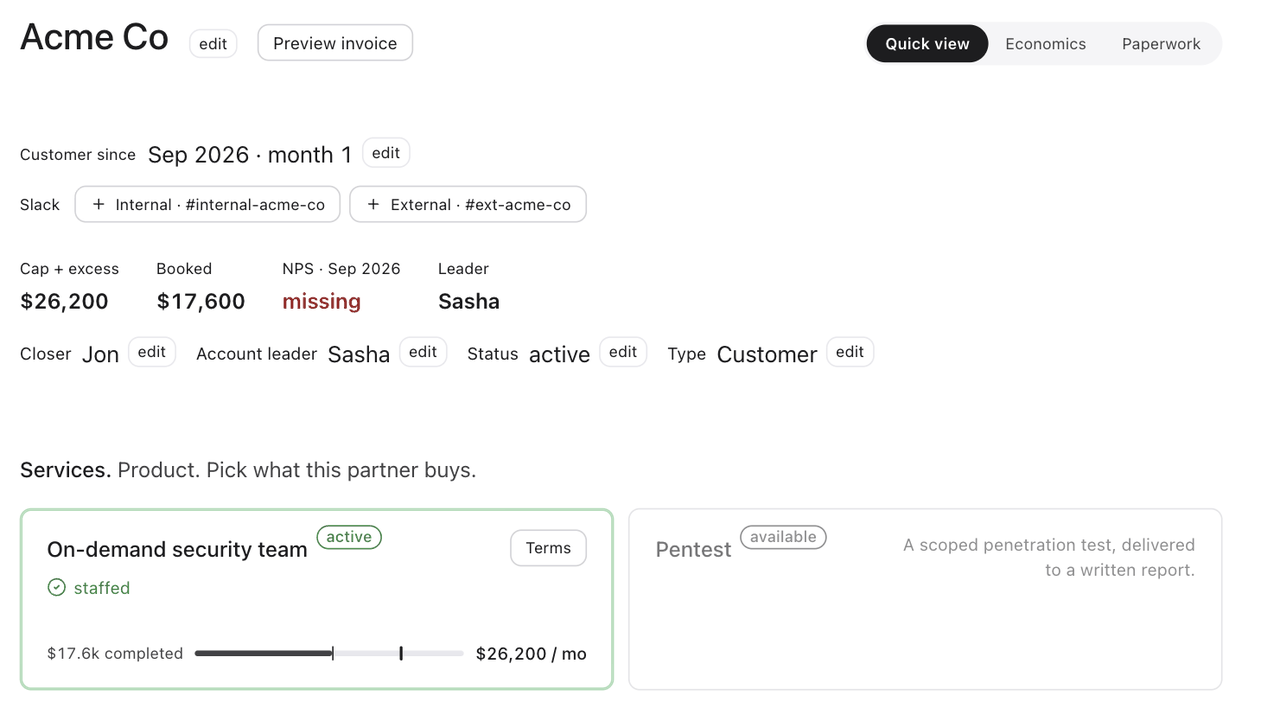
Every shape in this post comes back to a firm’s own hours: who worked them, at what rate, on which client, and who was paid from them. The largest firms keep whole departments for that. A firm of ten keeps a record, and the record is the part of a firm Ceed keeps.
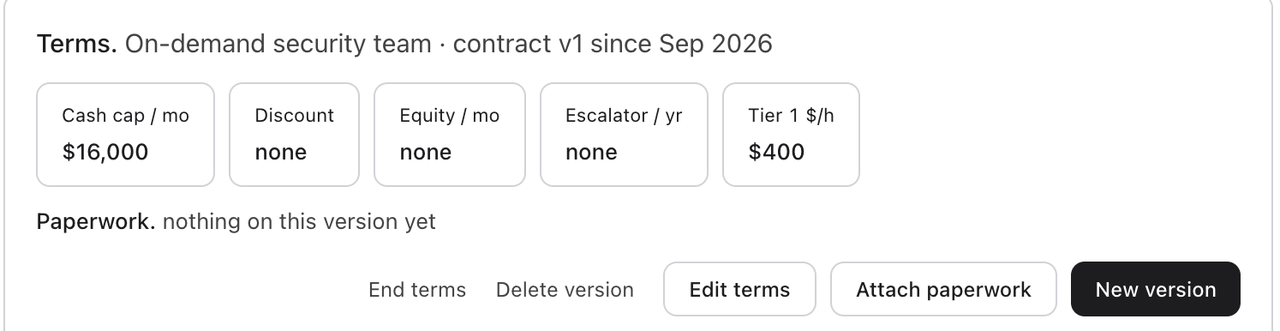
The rates by role live in the agreement. In Ceed each client’s agreement is a versioned terms card: the monthly cap or budget, the rates by role or tier, the discount, the yearly escalator and any equity taken as payment, with the signed paperwork attached to the version. A firm that moves a client from four juniors to one reviewer writes the reviewer’s rate in as its own tier, and a change of terms is a new version, dated. Every invoice is computed from the version in force, never typed, so the blend on the invoice is the arithmetic of the agreement and the hours.
Every hour carries a name. The senior, the reviewer and the trainee log their hours against Acme Co’s budget from one Slack reminder a day, in under a minute, and each entry carries the person, the date and a line in their words about what moved forward. A reviewer’s line can say what the agents drafted, what the reviewer checked and what the run cost: the firm’s own account of the agent’s work, kept beside the hour a person billed.
The trainee’s hours are a decision, made on the day. An hour that would push a client past its agreed budget is saved and marked pending approval the moment it is logged. It waits in the row where it happened for a named person, an owner or the account leader, to approve or decline, with the reason they type. Approved goes on the invoice at the agreed rate. Declined stays on the record, unbilled. So when the trainee’s practice hours would carry Acme Co past its budget, Sasha, as the account leader, declines them for billing with the reason “training”, and they stay on the record as that month’s cost of the next senior. Nothing disappears and nothing is billed quietly. It is a decision with a name and a reason, more than a click, as we argued of the approve button.
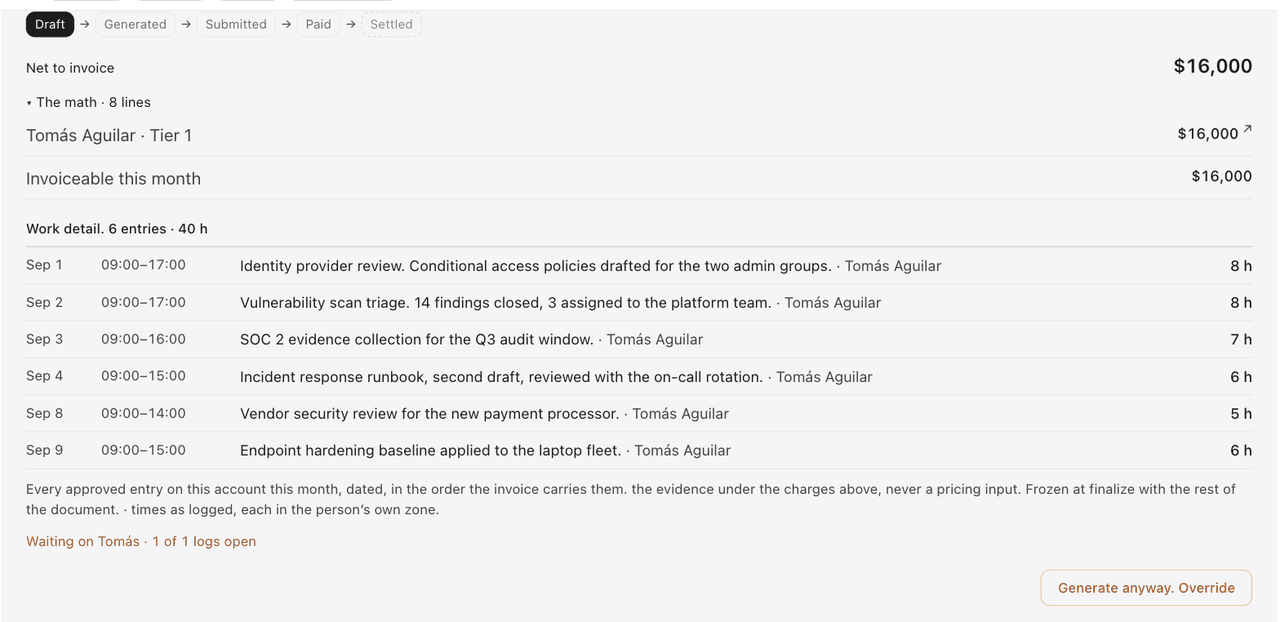
Payouts and commissions come from the same hours. The invoice to Acme Co, the reviewer’s payout statement if the reviewer is a contractor, and Jon’s commission as the closer are computed from the same approved entries, so there is no second sheet to reconcile, the rows we went through in Ten rows. One engagement. Ceed computes payouts. Your bank and your payment rails move the money, and Ceed never touches it, as the answers on our about page set out.
Invoice $34,500.00 · 150 h billed · 40 h of training declined for billing, on the record
The invoice, Dana’s payout statement and Jon’s commission come from the same approved entries.
Your bank moves the money. Ceed never touches it.
The margin is there every morning. Revenue, cost and margin for every client are computed each morning from the hours as they are logged, and the month reads invoiced, people cost, operating cost and cash margin side by side, as in margin per client, this morning. That is where the three numbers in this post are read together: the blend in the hours and the invoice, the payouts and the commission in the people cost, and the trainee in both. Rates and margin are visible only to the owners and the people they name.
The invoice carries the work beneath the number: each role’s line, and under the charges the approved entries, dated, with each person’s name and words, for anyone who asks what the money bought.
Ceed Intelligence works under the same rule as every agent in this post. It reads a firm’s paper into the record, from the people list, the W-2s and 1099s and the signed agreements to the timesheets and invoice books, and proposes the people, clients, budgets and rates by role it found. A person confirms, and the money terms wait for a yes one by one. Every act shows its price before it is confirmed, every record it adds is marked imported, and what the model cost is its own line on the firm’s statement. On the append-only trail, one tab shows what people did and another what Ceed Intelligence did, which answers Kate Smaje’s second question for a firm’s own books. Ceed works without it, and every number on an invoice is computed from the agreement and the record. Who may approve what an agent entered is the subject of our post of 20 October, The agent enters. A person approves.
When the month closes, the invoices, the statements and the margin freeze, and nothing in a closed month changes. Next year, when the firm decides whether its next hire is a trainee or a reviewer, it reads twelve closed months of its own mix.
Ceed costs 0.1% of what you invoice, with no seats, no tiers and no minimum, and nothing to pay until your first invoice. A trainee costs nothing to add, and an agent is not a seat. Invoices and statements go to QuickBooks Online or Xero as documents, Slack connects, and your project tool and the people who run your pay stay where they are. Where Ceed stands beside the time trackers and the suites is on the comparison page.
We built Ceed the way this post describes a firm of ten working now, with people at YSecurity answering for the agents that build it, as YSecurity’s page on business modernization describes, and we ran our own books on it first. For a firm of ten, five things can start this month.
- Write each role’s rate into each client’s agreement, the reviewer’s included, and decide which roles the invoice shows.
- Decide how work an agent drafted is billed: the time people spent, the review included, not the hours the agent saved. Put it in the agreement.
- Name the person who answers for each agent the firm runs, and log that person’s review against the client, saying what the agent did.
- Give each client a budget of training hours before the month, and let a named person decide on any hour past it, with a reason, on the record.
- Read the blended rate, the invoice and the margin on each client together every month, with the payouts and commissions they pay.
What the books say.
Six books: one on how a firm of experts makes its money, one on the partnership at its top, one on what a small firm sells instead, and three on what happens to expertise when machines do the junior work.
- Managing the Professional Service FirmDavid H. Maister, 1993. The economics of a firm of experts, the finders, minders and grinders of this post, and profit per partner as margin, productivity and the ratio of staff to partners.
- Leading ProfessionalsLaura Empson, 2017. Power and politics inside a partnership, the part of the model the largest firms are now rewriting with salaried partners and units.
- The Business of ExpertiseDavid C. Baker, 2017. Why a small firm sells senior judgment rather than bodies, the case for the firm of ten that never built a pyramid.
- The Skill CodeMatt Beane, 2024. How people learn a craft by working beside someone who knows more, and what happens when intelligent machines separate them.
- Co-IntelligenceEthan Mollick, 2024. A working view of AI as co-worker, co-teacher and coach, the answer-key model seen from the person learning.
- The Future of the ProfessionsRichard Susskind and Daniel Susskind, updated edition, 2022. The long view of what professionals sell once machines can produce the work.
Five conversations about the junior’s work.
The firm behind Ceed also hosts The Security Podcast of Silicon Valley, more than a hundred conversations since 2021 with the people who build and run security. Five of them are about the work juniors used to do, and who does it now.
- 104
Yash Kosaraju, chief information security officer at a16zSeptember 2026 · Why “Your first security hire is a staff engineer”, a senior who can work alone, and not a junior.
- 84
Jack Cable, chief executive and co-founder of CorridorDecember 2025 · What gets missed when “Code ships faster than anyone can review it”, the reviewer’s hours as the new bottleneck.
- 85
Channi Greenwall, founder and chief executive of OlympixDecember 2025 · What it looks like to automate 60% to 80% of what human auditors do today, and what is left for the auditor.
- 74
Scott Dietzen, board member at Augment CodeJuly 2025 · Agents built for real codebases, on the premise that “AI isn’t just writing code…”. YSecurity’s people have worked inside Augment Code, and Jon was its chief security officer.
- 97
Alexis Lingad, founder of KinosecJune 2026 · An autonomous system that chains exploits the way a real attacker would, already sold as AI pen testing to enterprise security teams.
Ceed is for firms that sell their team’s time: practices inside the global consulting firms, management consultancies, fractional chief financial officer practices, law firms, security consultancies, software firms, data and AI consultancies, staff augmentation firms, engineering firms and agencies up to fifty people, and nineteen kinds of firm in all. If your next hire could be a junior, a reviewer or an agent, sign up and read the mix in your own hours before you choose. Nothing to pay until your first invoice.
Sign upOr write to hello@ceed.so.
Questions.
Will AI replace junior consultants and junior accountants?
Not wholesale, on the evidence so far, but it is replacing much of their work. Some of the largest firms are hiring more juniors: BCG says it has not reduced its junior intake, Bain plans a larger graduate intake, and IBM says it is tripling entry-level hiring. Others are taking fewer. The four largest UK accounting firms took 16.3% fewer graduates in 2024 than in 2023, and PwC US plans 32% fewer junior associates by 2028. The juniors who remain are asked to review and judge sooner, and PwC finds their job postings asking for senior skills.
Who trains the next generation if AI does the entry-level work?
The firm does, on purpose, or nobody does. McKinsey’s Bryan Hancock and Charlotte Seiler recommend hiring early-career people while accepting that they reduce capacity at first, and an answer-key model in which the person attempts the work first and the AI grades the attempt. Firms that bill by the hour once had clients pay for training inside the invoice. Under a fixed fee the firm pays. In our worked example one trainee costs a fixed-fee client month $4,400 of margin, so the cost belongs in the plan, decided before the month starts.
How should a firm bill for work an agent did in place of a junior?
Bill the time people actually spent, the review included, and not the hours the agent saved, unless the agreement prices the result instead. That is the rule the American Bar Association set for lawyers in Formal Opinion 512 in July 2024: a lawyer may charge for the time spent with the tool and the time needed to review its draft, and in most cases not for learning the tool. Other professions have no such opinion, but clients read an invoice the same way. A fixed fee avoids the question by pricing the outcome. This is not legal advice.
Does AI raise or lower blended rates?
When a firm bills by the hour, it usually raises the blended rate and lowers the invoice at the same time. The blend is the invoice divided by the hours, so when the cheapest hours leave the bill, the average rises even though no rate changed. In our worked example one senior and four juniors bill $36,000 at a blend of $180 an hour, and one senior and one reviewer working with agents bill $28,500 at $259. The blend rose 44% while the invoice fell 21% and the margin fell by a third. Read the margin, not the blend.
Should a small firm still hire juniors?
Yes, if it wants seniors in five years, and only if it prices them on purpose. Under hourly billing a trainee’s billable hours can pay for themselves. Under a fixed fee they cost margin, $4,400 a month on one client in our worked example. The chief executive of Amazon Web Services called replacing them with AI the dumbest idea he had heard, because a firm with no juniors has no one learning. A small firm can hire fewer juniors and train each one deliberately, with a budget of training hours per client.
How many juniors should each partner have now?
There is no new standard, and the largest firms are moving in different directions. In Big Law, associates worked a record 1.55 hours for every equity partner hour at the end of 2025, while Bain found that the share of software organizations with a traditional pyramid fell from 66% to 29%. The strategy firms say they are keeping their junior intake. For a firm of ten the useful number is not a ratio of people but the mix of hours by role on each client, and the margin each mix leaves.
 Sasha Sinkevich is a co-founder of Ceed and of YSecurity, where the partners who once wrote every page now review what agents draft, and every hour a client pays for still carries the name of the person who worked it. Published 29 October 2026. Corrections to hello@ceed.so, and they are dated when made.
Sources
- McKinsey’s people and agents. Kelsey Vlamis, Business Insider, via Yahoo Finance, “McKinsey’s CEO breaks down how AI is reshaping its workforce: 25% growth in some roles, 25% cuts in others”, 7 January 2026, https://finance.yahoo.com/news/mckinseys-ceo-breaks-down-ai-100301404.html. CES, “Keynote: All-In Interview at CES Featuring McKinsey and General Catalyst”, 6 January 2026, the session on CES’s own site, https://www.ces.tech/videos/keynote-all-in-interview-at-ces-featuring-mckinsey-and-general-catalyst/, and its announcement of the keynote, 18 November 2025, https://www.ces.tech/press-releases/all-in-interview-at-ces-featuring-mckinsey-and-general-catalyst-on-the-keynote-stage, both read on 18 October 2026. Money Times on the 20,000 and 25,000 figures, 13 January 2026, https://themoneytimes.media/2026/01/13/mckinsey-ceo-bob-sternfels-says-the-firm-now-has-60-000-employees-25-000-of-them-are-ai-agents/. Sridhar Natarajan and Ambereen Choudhury, Bloomberg, via Insurance Journal, 16 December 2025, https://www.insurancejournal.com/news/national/2025/12/16/851200.htm. O’Ryan Johnson, The Register, 16 December 2025, https://www.theregister.com/2025/12/16/mckinsey_may_cut_staff/. Every source below was read on 12 October 2026 unless another date is given.
- Sternfels in July. James Booth, Bloomberg, via Bloomberg Government, “McKinsey Boss Says AI Could Mean Golden Age for Consultancy Firm”, 15 July 2026, https://news.bgov.com/artificial-intelligence/mckinsey-boss-says-ai-could-mean-golden-age-for-consultancy-firm. Consultor.fr, in French, 20 July 2026, https://www.consultor.fr/articles/bob-sternfels-annonce-un-age-dor-du-conseil-en-strategie-et-20-de-consultants-en-plus, which reports from his LinkedIn post that the firm aims for growth of 20% in its consultants, mainly in entry-level positions, with no period given, and, after its account of the Bloomberg interview, that the firm is hiring client-facing consultants in record numbers, each with about three AI agents, in his words. The translations are ours.
- McKinsey’s research. Alexander Sukharevsky and coauthors, “The agentic organization: Contours of the next paradigm for the AI era”, 26 September 2025, https://www.mckinsey.com/capabilities/people-and-organizational-performance/our-insights/the-agentic-organization-contours-of-the-next-paradigm-for-the-ai-era. McKinsey Talks Talent, with Kate Smaje, Brooke Weddle, Bryan Hancock and Lucia Rahilly, “Your AI agents need performance management, too”, 26 August 2026, https://www.mckinsey.com/capabilities/people-and-organizational-performance/our-insights/your-ai-agents-need-performance-management-too, and the audio, https://omny.fm/shows/mckinsey-talks-talent/your-ai-agents-need-performance-management-too. Bryan Hancock and Charlotte Seiler, “Building expertise in the age of AI: Who trains the next generation?”, McKinsey Quarterly, 14 July 2026, https://www.mckinsey.com/capabilities/people-and-organizational-performance/our-insights/building-expertise-in-the-age-of-ai-who-trains-the-next-generation, which is also the source for the Strada Education Foundation survey, and McKinsey’s Top Ten for the third quarter of 2026, 27 September 2026, https://www.mckinsey.com/~/media/mckinsey/email/top-ten/2026/2026-09-27a.html.
- Maister and the rate card. David H. Maister, Managing the Professional Service Firm, Free Press, 1993, whose argument we paraphrase, with Tyler DeVries’s summary of the book, https://tylerdevries.com/book-summaries/managing-the-professional-service-firm/. Alexandra Hazard Kampmann, Slideworks, on how McKinsey prices projects, published 7 December 2024 and updated 20 April 2026, https://slideworks.io/resources/management-consulting-fees-how-mc-kinsey-prices-projects, which groups the analysts’ and associates’ rates as one range. Deloitte Tax LLP, fourth interim and final fee application in In re Delta Air Lines, Inc., US Bankruptcy Court for the Southern District of New York, dated 22 June 2007, https://www.lopucki.law.ufl.edu/Professional_Fees/Fee%20applications%20and%20orders/Delta%20Air%20Lines/Deloitte%20Tax%20final%20application.pdf, and Deloitte & Touche LLP’s fifth interim and final fee application, dated 21 June 2007, which lists $3,367,915.53 of fees before a voluntary reduction of $195,555.30, https://www.lopucki.law.ufl.edu/Professional_Fees/Fee%20applications%20and%20orders/Delta%20Air%20Lines/Deloitte%20%26%20Touche%20final%20application.pdf, both from the UCLA-LoPucki Bankruptcy Research Database. The $213.00 is the rate on every line of the second application’s exhibit. Stephen Foley and Ellesheva Kissin, Financial Times, via The Irish Times, “Top consultancies freeze starting salaries as AI threatens ‘pyramid’ model”, 1 December 2025, https://www.irishtimes.com/business/2025/12/01/top-consultancies-freeze-starting-salaries-as-ai-threatens-pyramid-model/.
- Accenture. Fourth quarter and full year fiscal 2026 call, 1 October 2026, transcript via The Motley Fool, https://www.fool.com/earnings/call-transcripts/2026/10/01/accenture-acn-q4-2026-earnings-call-transcript/. Fiscal 2025 results, for revenue of $69.67 billion and about 779,000 people, https://newsroom.accenture.com/content/4q-full-fy25-earnings/accenture-reports-fourth-quarter-and-full-year-fiscal-2025-results.pdf. The revenue per person is our arithmetic, $69.67 billion over about 779,000 people and $74.2 billion over “more than 814,000”, approximate because neither is an exact year-end count.
- The new shapes. Shebani Patel, Brad Herndon, Danielle Phaneuf and Bob Woods, PwC, “No more pyramids: Rethinking your workforce for the agentic AI era”, 29 January 2026, https://www.pwc.com/us/en/tech-effect/ai-analytics/agentic-ai-workforce-redesign.html. David S. Duncan, Tyler Anderson and Jeffrey Saviano, Harvard Business Review, “AI Is Changing the Structure of Consulting Firms”, 10 September 2025, https://hbr.org/2025/09/ai-is-changing-the-structure-of-consulting-firms, from its summary. Jonathan Frick, Purna Doddapaneni and Arun Ganti, Bain, “The Half-Finished Redesign: How AI Reshapes Software Organizations”, Technology Report 2026, 29 September 2026, https://www.bain.com/insights/the-half-finished-redesign-how-ai-reshapes-software-organizations-technology-report-2026/.
- Accounting. Scottish Financial News, citing The Telegraph of 22 June 2025, 23 June 2025, https://www.scottishfinancialnews.com/articles/big-four-slash-graduate-jobs-as-ai-takes-over-entry-level-tasks. Business Insider’s report on PwC’s slide, 21 August 2025, as reported by Sherin Shibu, Entrepreneur, https://www.entrepreneur.com/business-news/pwc-plans-to-reduce-entry-level-hiring-over-the-next-3-years/496198, and Adrienne Gonzalez, Going Concern, https://goingconcern.com/pwc-confirms-theyre-majorly-cutting-campus-recruiting. EY US, “From intern to leader: EY US introduces Career Residency program”, 17 August 2026, https://www.ey.com/en_us/newsroom/2026/08/from-intern-to-leader-ey-us-introduces-career-residency-program. Going Concern, 20 August 2026, https://www.goingconcern.com/ey-is-giving-audit-interns-8-to-12-months-to-prove-theyre-useful/. Consultancy.uk, on KPMG’s UK cuts and Martin Jones’s post, 2 April 2026, https://www.consultancy.uk/news/43655/kpmg-to-shave-more-than-500-roles-from-uk-headcount. Consultancy.uk, on Deloitte UK’s intake, 10 September 2026, https://www.consultancy.uk/news/45536/2026-intake-of-early-career-staff-to-hit-1500-at-deloitte.
- Law. Zoe Miranda, Thomson Reuters Institute, “Q2 2026 LFFI analysis: Law firm leverage just broke a 17-year record, and this time it’s not because of layoffs”, 18 August 2026, https://www.thomsonreuters.com/en/institute/articles/q2-2026-lffi-analysis-law-firm-leverage. Thomson Reuters, Law Firm Financial Index for the fourth quarter of 2025, 10 February 2026, https://www.thomsonreuters.com/en-us/posts/wp-content/uploads/sites/20/2026/02/2025-Q4-Law-Firm-Financial-Index.pdf, and for the second quarter of 2026, 10 August 2026, https://www.thomsonreuters.com/en/institute/reports/lffi-q2-2026-heavy-load-picking-up-speed. NALP, Class of 2025 Selected Findings, 5 August 2026, https://www.nalp.org/uploads/PressReleases/Classof2025SelectedFindings_PressRelease.pdf. Roy Strom, Bloomberg Law, 10 September 2026, https://news.bgov.com/business-and-practice/big-law-first-year-hiring-set-to-plunge-as-history-ai-collide. Matt Perez, Law360 Pulse, on Citi and Hildebrandt’s report, 15 December 2025, https://www.law360.com/pulse/articles/2422148.
- Young workers and the entry level. Erik Brynjolfsson, Bharat Chandar and Ruyu Chen, Stanford Digital Economy Lab, revision of 12 August 2026, https://digitaleconomy.stanford.edu/news/canariesaug26/, the paper, https://digitaleconomy.stanford.edu/publication/canaries-in-the-coal-mine-six-facts-about-the-recen, and the note of 9 February 2026, https://digitaleconomy.stanford.edu/news/canaries-interest-rates-and-timinga-more-on-recent-drivers-of-employment-changes-for-young-workers. Federal Reserve Bank of New York, The Labor Market for Recent College Graduates, data through the second quarter of 2026, https://www.newyorkfed.org/research/college-labor-market. PwC, 2026 Global AI Jobs Barometer, 15 June 2026, https://pwc.com/gx/en/news-room/press-releases/2026/pwc-2026-ai-jobs-barometer.html. Nick Lichtenberg, Fortune, 18 June 2026, https://fortune.com/2026/06/18/entry-level-work-ai-pwc-seniorization-report/. Bruno V. Manno, Stanford Social Innovation Review, “A New AI Career Ladder”, 30 October 2025, https://ssir.org/articles/entry/ai-entry-level-jobs. Adam McCulloch, Personnel Today, on Adzuna’s data, 30 June 2025, https://www.personneltoday.com/hr/fall-in-entry-level-jobs-linked-to-rise-of-ai-tools/. Demi Lawrence, Fortune, on BambooHR’s survey, 12 May 2026, https://www.fortune.com/2026/05/12/ai-entry-level-accounting-jobs-disappearing-bamboohr-survey/.
- Who trains. Matt Beane, The Skill Code, Harper Business, 2024, from the author’s page, https://www.mattbeane.com/book/. Matt Garman of Amazon Web Services, The Register, 21 August 2025, https://www.theregister.com/2025/08/21/aws_ceo_entry_level_jobs_opinion/. Justin Smestad, “If You Stop Hiring Juniors, Your Senior Engineers Own You”, 26 April 2026, https://evalcode.com/posts/if-you-stop-hiring-juniors-your-seniors-own-you/.
- Partners. Ellesheva Kissin, Financial Times, via The Irish Times, “KPMG and EY demote partners in end of job-for-life model in UK”, 24 April 2026, https://www.irishtimes.com/business/work/2026/04/24/kpmg-and-ey-demote-partners-in-end-of-job-for-life-model-in-uk/. Vidhya Edwards Munnangi, International Accounting Bulletin, 1 October 2025, citing Bloomberg on the review, read on 18 October 2026, https://www.internationalaccountingbulletin.com/news/deloitte-uk-job-cuts/. Fortune, on EY’s Jeff Wong, 4 December 2023, https://fortune.com/2023/12/04/big-4-consulting-giants-pwc-kpmg-ai-trim-years-path-partner.
- The case against. Christoph Schweizer, interviewed by Chip Cutter of the Wall Street Journal on how AI is changing how consultants get paid, republished by BCG, 2026, https://www.bcg.com/about/expertise/ai-changing-consulting-and-pricing-models. Consultor.fr on Bain, in French, 4 September 2026, https://www.consultor.fr/articles/bain-va-augmenter-ses-recrutements-de-consultants-de-12-en-2026. Emily Peck, Axios, 13 February 2026, https://www.axios.com/2026/02/13/ai-ibm-tech-jobs, and Preston Fore, Fortune, 13 February 2026, https://fortune.com/2026/02/13/tech-giant-ibm-tripling-gen-z-entry-level-hiring-according-to-chro-rewriting-jobs-ai-era/. Florian Smeritschnig, StrategyCase, 20 July 2026, https://strategycase.com/consulting-job-market/. Promethean Research, “How Profitable are Digital Agencies?”, 19 April 2026, https://prometheanresearch.com/how-profitable-are-digital-agencies/. Vinciane Beauchêne, “Will AI take your job in the next 10 years? Wrong question”, TED@BCG, October 2025, on ted.com, with its description and its plays as read on 12 October 2026, https://www.ted.com/talks/vinciane_beauchene_will_ai_take_your_job_in_the_next_10_years_wrong_question.
- The billing rule. American Bar Association, “ABA issues first ethics guidance on a lawyer’s use of AI tools”, on Formal Opinion 512, 29 July 2024, https://www.americanbar.org/news/abanews/aba-news-archives/2024/07/aba-issues-first-ethics-guidance-ai-tools/. We quote the news page, not the opinion itself.
- Hacker News, comments quoted as posted, read through the Algolia API: “How AI is creating a rift at McKinsey, Bain, and BCG”, 1 April 2025, 103 points, https://news.ycombinator.com/item?id=43549099, with tqi, https://news.ycombinator.com/item?id=43551865. “AWS CEO says using AI to replace junior staff is ‘Dumbest thing I’ve ever heard’”, 21 August 2025, 1,697 points and 744 comments, https://news.ycombinator.com/item?id=44972151. “AI was supposed to help juniors shine. Why does it mostly make seniors stronger?”, 21 September 2025, 461 points, https://news.ycombinator.com/item?id=45319062, with lodovic, https://news.ycombinator.com/item?id=45320681. “What if remote working, not AI, is to blame for weak junior hiring?”, from the Financial Times, 29 May 2026, 260 points, https://news.ycombinator.com/item?id=48326721.
- Posts on LinkedIn, read in a browser on 12 September 2026: Mathilde Henry, 20 August 2026, https://www.linkedin.com/feed/update/urn:li:activity:7496099393931161600/. James O’Dowd, 20 August 2026, https://www.linkedin.com/feed/update/urn:li:activity:7496115838916263936/. Joe O’Mahoney, 17 August 2026, https://www.linkedin.com/posts/joeomahoney_consulting-boutiqueconsulting-privateequity-share-7495117443061714945-hGxE/. Martin Jones’s post is quoted as Consultancy.uk reported it.
- Post on X, read in a browser on 12 September 2026, an excerpt from an anonymous account: SightBringer, 20 April 2026, https://x.com/_The_Prophet__/status/2046024820526067971.
- Recordings on YouTube, with view counts as read on 28 September 2026, or on 12 September 2026 where the post says so: Pursuing Results, 15 September 2016, https://www.youtube.com/watch?v=U8WbFKsYRC8. The Invisible Game, 6 November 2025, https://www.youtube.com/watch?v=ysEAIIHzvXo. Bloomberg Television, 15 December 2025, https://www.youtube.com/watch?v=qmIaRVEaRH0. Ramin J. Imani, 4 February 2026, https://www.youtube.com/watch?v=UxVRrorZ4RM. The Accounting Podcast, episode 500, 8 August 2026, https://www.youtube.com/watch?v=d3v1hG_0-as, with its page, https://accounting.show/500. McKinsey & Company, 1 August 2026, https://www.youtube.com/watch?v=u76xdhpF474. ET Digital, 20 August 2026, https://www.youtube.com/watch?v=EghX7r3oisk. Rapid Response, 10 March 2026, https://www.youtube.com/watch?v=XA-Ogmz8REQ. Harkirat Singh, 26 February 2026, https://www.youtube.com/watch?v=Wb83Y6fjJr8. YSecurity, episode 105 of The Security Podcast of Silicon Valley, 6 October 2026, https://www.youtube.com/watch?v=E1wyHhMKGXk.
- YSecurity. Sasha Sinkevich, “The Art and Zen of Adopting AI”, 17 September 2026, https://ysecurity.io/blog/the-art-and-zen-of-adopting-ai/. “AI Penetration Testing: Can Autonomous Agents Replace Human Pentesters?”, 19 June 2026, https://ysecurity.io/blog/ai-penetration-testing/. “Vibe Coding Security: How to Stop AI Agents From Shipping Vulnerable Code”, 25 March 2026, https://ysecurity.io/blog/vibe-coding-security/. Paddy Roberts, “It’s Like a Self-Driving Car: Agentic Code Review and Your SOC 2 Type 2 Audit”, 10 September 2026, https://ysecurity.io/blog/agentic-sdlc-code-review-soc-2/. Agentic Engineering, https://ysecurity.io/services/agentic-engineering/. Business Modernization and Agentic Transformation, https://ysecurity.io/services/business-modernization/. About, https://ysecurity.io/about/.
- Product pictures are of Ceed’s staging environment in September 2026, showing a demo account with invented names and figures. The drawn card uses the same demo account, with names and numbers from the worked example, which is ours.
- The Security Podcast of Silicon Valley, a YSecurity production: episode 104 with Yashvier Kosaraju, 22 September 2026, https://ysecurity.io/podcast/104-why-a16zs-ciso-doesnt-trust-the-approve-button/, quoted from its key takeaways. Episode 84 with Jack Cable, 16 December 2025, https://ysecurity.io/podcast/84-what-gets-missed-when-nobody-reviews-the-code/. Episode 85 with Channi Greenwall, 30 December 2025, https://ysecurity.io/podcast/85-how-companies-lose-197-million-in-seconds/. Episode 74 with Scott Dietzen, 29 July 2025, https://ysecurity.io/podcast/74-augment-code-ai-agents-engineered-to-ship/. Episode 97 with Alexis Lingad, 16 June 2026, https://ysecurity.io/podcast/97-the-god-level-hacker-how-one-founder-is-building-the-worlds-most/. Episode 105 with Yair Grindlinger, 6 October 2026, https://ysecurity.io/podcast/105-shrink-what-a-breach-can-reach/, quoted from its transcript as read on 18 October 2026. The other episodes are quoted from their show notes.