Blog · 3 September 2026 · Jon McLachlan
The rate was set on day one. The client grew.
An $1,800-a-month client that went from twenty users to forty-five. A $1,000 retainer while the client’s months went from $10,000 to $100,000. A contract that said $40 an hour while the invoices said $45, for eighteen months, and nobody noticed. Undercharging is rarely a pricing decision. It is a number nobody re-read. What the threads say, what the pricing people say, and how a firm sees margin per client before the invoice does. With nine recordings, three quotes from X, two figures and nine books.
Undercharging is a rate that no longer covers the cost of delivering the work at the margin the firm needs. The definition is dull and the mechanism is not. A rate is set once, on the day the client signs, when the firm is smallest and the client is most in doubt. The client then grows, or the work does, or the firm’s own costs do, and the rate stays where it was because it lives in a document nobody re-opens. The effective rate, the fee divided by the hours it now takes, falls a little every month, and nothing in the firm is built to notice.
She has one of these clients. Probably three. The fractional CFO whose first client is now four times the company it was. The security boutique whose oldest retainer predates half the team. The agency principal who knows, without opening the numbers, which logo on the website is costing her money. She is not bad at pricing. She priced correctly, once, and then the world moved.
The client that doubled.
In June 2026 an MSP owner posted in r/msp that he had lost a client of ten years without a single complaint. The client paid $1,800 a month, had grown from twenty users to forty-five, and had woken the owner at four in the morning more than once. The thread drew 140 points and 197 comments, and the top reply, with 268 points, did not offer condolences. “You were doing all of that for an $1800/month client who has 45 users? You are way better off without them. You should be billing at a minimum 4-5x that per head.”
The same month, in r/agency, an owner asked whether a $1,000 monthly retainer was too low. The clients they had signed at that rate had grown from $10,000 months to $80,000 and $100,000 months. “You are severely undercharging,” said the first reply, and another, from a business owner who had done exactly this, advised raising the price on new clients first. Nobody had changed. The client had, and the rate had been set for the client that no longer existed.
When a long-term client told an MSP owner in February 2026 that they could no longer afford the contracted price, the detail that mattered was how it surfaced: the owner had “finally decided to look at one of his invoices (his admin usually does and just pays it).” The most useful reply was not about the client at all. “Look at the gross margin on the account,” wrote u/Revolutionary-Bee353. “If it’s > 60% you should have some room to negotiate.” Everything in that thread turned on a number the owner could not see: what that client, specifically, was worth to the firm after the hours it consumed.
The correction goes wrong when it arrives as a surprise. In a May 2026 r/agency thread about losing retainer clients without warning, one owner described losing a business-to-business client after raising the monthly retainer 60% at the six-month mark. The client’s objection was the timing more than the number, that “you cannot raise 60% price after 6 month,” and the owner’s reason was the one in every thread here: “we weren’t saving the enough margin on our side.” The rate was wrong on day one and the client was told on day 180. Another reply in the same thread gave the client’s side in a sentence: “clients dont care how many hours you worked they care if their number moved.”
A bookkeeper’s pricing guide in r/Bookkeeping, 114 points in April 2025, gets at why the first number is so often wrong: “It’s not enough to know the number of accounts and number of transactions. You need to know the COMPOSITION of those transactions.” The rate is set on a count. The work is set by a composition. The two drift apart as the client changes, and nothing in the firm is built to notice.
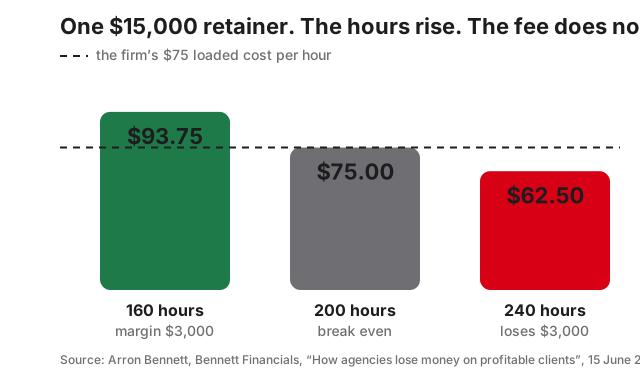
Arron Bennett, who does the books for agencies, described the mechanism in June 2026: “The extra hours get logged under the client, the retainer fee stays fixed, and the effective hourly rate on the account drops month by month.” Rayhaan Moughal of Sidekick Accounting put numbers on the slope in July 2026: ten unbilled hours a month at £50 takes a retainer’s margin from 60% to 52%, twenty takes it to 43%. Promethean Research’s 2026 survey of 119 digital agencies found after-tax margins of 19% for firms under ten people and 9% for firms of twenty-five to forty-nine, and that only 59% tracked margin by project at all. The firm gets bigger, the rate stays put, and the margin goes where nobody is looking.
The 40 percent raise.
A post in r/smallbusiness this year, with 1,235 points and 217 comments, is from an owner who ran a small marketing firm for three years on rates set when the owner had no experience and needed any client at all. In October the owner did the arithmetic: after the hours, software, taxes and three years without a raise, the business was paying its owner about $14 an hour. The owner emailed all twenty-two clients that rates would rise 40% in January, with three months’ notice. Seven left at once, most of them the ones who haggled over everything. Two negotiated a smaller increase. Thirteen stayed. Monthly revenue rose about 12% and the workload fell by roughly a third, because the clients who left had been the most demanding and the least profitable. “I kept it really simple,” the owner wrote of the email. “No long justification or apology.” The scariest part, the post said, was not the increase but “the 3 months of waiting between sending the email and the new rates kicking in.”
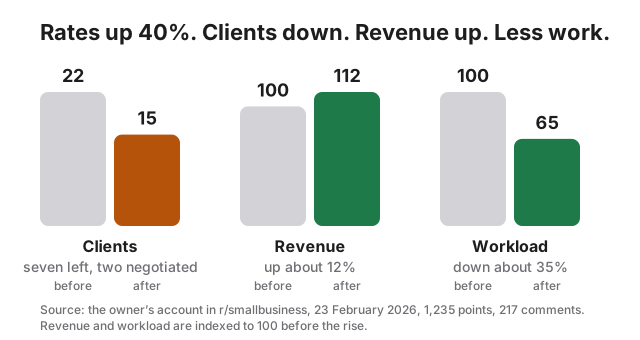
The thread’s 217 comments were mostly people who had done the same and wished they had done it sooner. The top one, at 627 points: “If you’re selling $2 beers, expect a $2 beer crowd.” Another, at 298: “the clients who leave are usually the ones you’re better off without anyway.” McKinsey measured why the arithmetic works so well back in 2003, in a piece that pricing consultants have quoted ever since: for the average company, “a price rise of 1 percent, if volumes remained stable, would generate an 8 percent increase in operating profits,” an effect the authors found nearly 50 percent greater than a 1 percent cut in variable costs and more than three times the effect of 1 percent more volume. A firm that sells time has almost no variable cost to cut. Price is the lever it has.
Alex Hormozi, who writes about pricing for owners of small companies, compressed the finding into one line in June 2025, and 4,100 people agreed.
Until customers tell you your prices are too high, they’re probably too low.
The market moved without asking, too. In February 2022 CNBC reported a survey in which 47% of small businesses said they would have to raise prices because of inflation. Whatever those firms did next, a firm whose rate card still says what it said in 2021 has cut its price in real terms every year since, without deciding to.
Blair Enns, whose Win Without Pitching Manifesto is the pricing text many agency owners keep on a shelf, is blunter: what you do does not matter to the market if you cannot command a premium for it. Eight minutes of him on the point are below. Alex Hormozi’s walk-through of the price-rise letter he actually sent to customers is the practical companion.
And when the client says the price is too high, Chris Do’s role-play of the conversation has been watched two million times for a reason.
The invoice nobody re-read.
Sometimes the number that drifts is not the rate but the record of it. A technical writer in r/freelance discovered, on going to raise their rate, that the contract said $40 an hour and the invoices had said $45 for at least eighteen months. The writer had charged $40 for the first few months, then changed it, then “just used the last invoice as the template going forwards. Nobody noticed.” The 266-point thread split on whether to refund the difference, and the most useful comment asked the question that decides it: “Do your invoices show the hourly rate x the hours or are you just sending them a bill for the full amount?”
The mirror image is in r/msp, where an owner found the firm had been under-billing a client for a long time and asked whether to recoup it. The 52-point answer: “correct the billing for future invoices but consider the past mistakes my mistakes and let it go.” Another owner had eaten eighteen months of it: “we under billed you by x thousand but we will not be billing this, here’s your new msa.” Both firms found the gap the same way, by reading an invoice against a contract, months late, because the invoice was copied from the last one rather than computed from the agreement.
These are not pricing failures. They are record failures. The rate lived in a PDF, the hours lived in a timesheet, the invoice lived in a template, and the three met once a month in a person who was tired. The month our own spreadsheet did that to us is in The invoice told us last. Why we built Ceed.
Eating hours is a price cut made by the wrong person.
The quietest form of undercharging is the hour that never reaches the invoice. In August 2026 an accountant in r/Accounting asked how common it was to eat hours and said he had eaten close to 200 that year after being “explicitly asked not to bill time.” The top reply, at 236 points, refused: “I bill what I work. Partners have a problem with that? Quit selling an audit that takes 2.5 months as a 6 week audit for 30k.” The reply that explained the damage came from u/Background_Map6056: “eating hours to avoid going over budget is poisoning the data you are trying to collect.” Every eaten hour tells next year’s budget that the work takes less than it does, so next year’s price is set on a lie.
The people doing the eating know exactly what is happening. In June 2025 an associate in r/Accounting wrote that they had followed the firm’s instruction not to eat hours, recorded thirty extra hours honestly on an engagement that took longer than it was sold for, and were written up for “lack of efficiency and time management.” The thread reached 1,271 points and 225 comments. The top reply, at 1,081 points: “everyone eats hours but tells you not to… timesheets are definitely more art than science.” Another, at 318: “You get yelled at for eating hours, then you get yelled at for billing your actual time. It’s a lose lose.” And the translation, from u/Curveoflife: when they say do not eat your hours, “They mean dont ever mention that you are eating your hours.” A budget maintained that way is not a budget. It is a story the firm tells itself about how long the work takes, and the price is set on the story.
David C. Baker’s measurement of the same thing across creative firms, 42% of hours captured against the 60% a well run firm captures, is in our first post. Ignition’s 2022 survey of 506 American accounting firms found 43% absorbing out-of-scope work rather than raising it with the client. An eaten hour is a discount, decided by the most junior person in the room, recorded nowhere, and repeated next year because the record says the work was cheap.
What the pricing people say.
The pricing literature for firms like these is large and mostly agrees with itself. Ron Baker has argued for thirty years that professional firms should price the value and abandon the timesheet, and his hour with Chris Do is the best introduction to the argument there is.
Harvard Business Review’s IdeaCast had Rafi Mohammed, founder of the consulting firm Culture of Profit, on the question of when to raise prices and how to be transparent with customers when you do. The player below starts at his section on knowing when to raise them.
Boston Consulting Group’s pricing practice frames the same move for larger companies as leaving the cost game for the value game, and Rohan Kadakia’s four minutes on it below are the clearest short statement of what changes when a firm stops pricing from its costs.
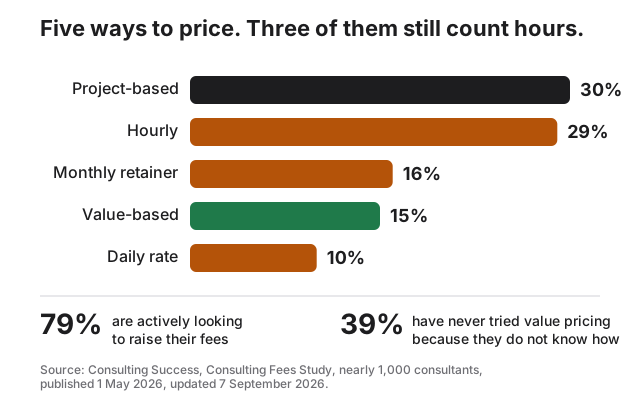
The market has heard all of this and mostly still sells hours. Consulting Success surveyed nearly a thousand consultants for its 2026 fees study: 30% price by project, 29% by the hour, 16% by monthly retainer, 15% by value, and 10% by the day. Seventy-nine percent said they were actively looking to raise their fees, and 39% had never tried value pricing because they did not know how. The Fractional Work Report 2026, from 1,733 fractional executives, found 46% billing primarily on a monthly retainer, and an average rate of $223 an hour. Even the retainers are sized in hours. Blair Enns declared in March 2026 that “labor-based pricing is dead,” and in the same conversation David C. Baker allowed that “selling your time by the hour, I don’t think it’s a sin necessarily. It’s just more the whole system around it that doesn’t allow for you to capture some of the value.” Jonathan Stark, who agrees with Enns, warned in August 2026 that for consultants who switch to fixed fees “the hours almost always sneak back in.”
David C. Baker and Blair Enns have argued about all of this on their podcast, 2Bobs, for the better part of a decade. Their May 2026 episode on pricing resentment is the one for the owner with a client that outgrew the rate. Resentment, they point out, only arises in existing client relationships, because it is the gap between the value you now deliver and the price you agreed when you did not yet know. One line from the episode, about a deal that had gone wrong for the speaker, is this whole post in one sentence: “I should have structured the deal so that my pay was highest when my value was.”
Their February 2025 episode asks who in a firm should set prices at all, and answers against the org chart: “Pricing responsibility should not be tied to title or seniority. It really should be tied to aptitude.” Which is a polite way of saying that the founder who set the day-one rate is not automatically the right person to reset it.
Jonathan Stark’s position fits in a post on X, and has since 2018.
Q: What’s your rate?
A: I don’t have one.
Q: So how do you price?
A: I give you a price.
Six months later he added the reason: “Your time is the most valuable thing you have. Stop selling it like it’s sack of onions.” His eleven minutes on the hourly trap are the argument in full. Harvard Business Review had Rafi Mohammed back on the IdeaCast in May 2025 to rethink pricing amid economic uncertainty, the follow-up to the episode above, which was first broadcast in July 2020.
We take the last two seriously. However a firm prices, the hours are its cost. A fee with no hour count under it is a rate nobody can check, and a rate nobody checks is the one in every thread above. The question is not whether to count the hours but who sees the count, and when.
What the books say.
The shelf for this post is the pricing shelf. Most of these authors appear above, and they disagree with each other less than their titles suggest.
- Implementing Value PricingRonald J. Baker, Wiley, 2010. The book-length case against the timesheet, from the accountant who has made it longest.
- The Win Without Pitching ManifestoBlair Enns, 2010. Twelve proclamations, one of which is We Will Charge More. His fuller pricing text, Pricing Creativity, is sold from his own site, and his newest, The Four Conversations, is about the four a firm has with a client, the one about the price included.
- Hourly Billing Is NutsJonathan Stark. Short and blunt, and the source of the argument in the two recordings above.
- Value-Based FeesAlan Weiss, third edition, Wiley, 2021. The consultant’s version, with the scripts for the conversation.
- Confessions of the Pricing ManHermann Simon, 2015. The founder of the pricing consultancy Simon-Kucher on how price actually works, including why one percent matters so much.
- The 1% WindfallRafi Mohammed, 2010. From the IdeaCast guest above, on the same one percent.
- Monetizing InnovationMadhavan Ramanujam and Georg Tacke, Wiley, 2016. Price before you build, which for a firm means price before you staff.
- The Psychology of Graphic Design PricingMichael Janda, 2019. The agency owner from the recordings in our other posts, on the numbers a creative firm quotes and why.
- The Business of ExpertiseDavid C. Baker, 2017. Why positioning comes before price, from the other half of 2Bobs.
Margin per client, this morning.
We ran a security consultancy for years with the rate in a contract, the hours in a spreadsheet and the margin in nobody’s head, and we built Ceed so that the three numbers live in one place and meet every day instead of once a month.
The rate lives in the agreement, by role. When the hours are logged against a client, Ceed computes what that client cost and what it earned, and margin per client is visible this morning to the owners and to whoever they name. The account with the 60% margin and the account with the 11% margin are both on one screen, and the conversation about raising the rate starts with the hours in hand rather than with a feeling.
Computed from the hours and the agreements. The account that pays $1,800 for 26.5 hours is the one to talk to.
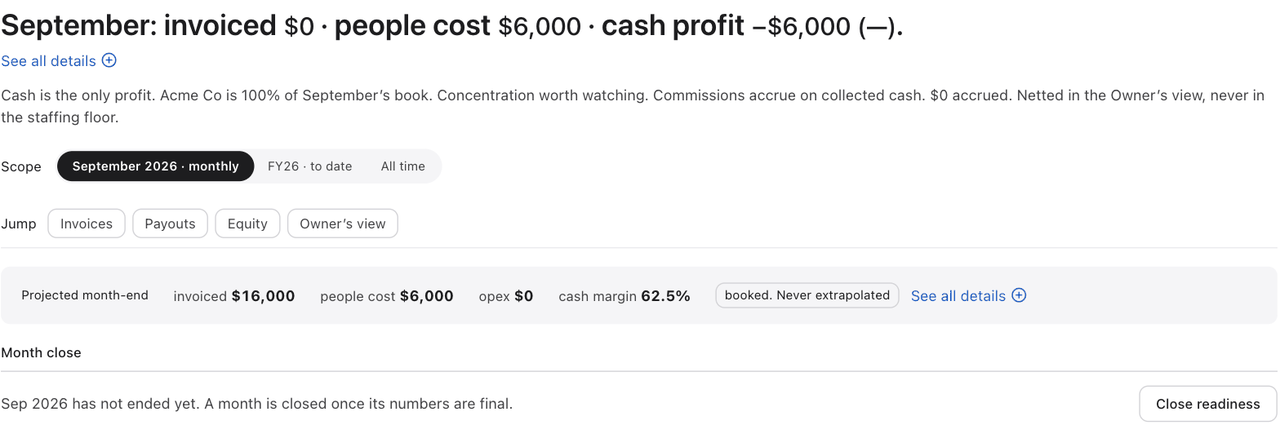
When the hours cross a client’s budget, Ceed holds the hour for approval rather than letting it slide onto the invoice or into the eaten pile. The person who logged it knows at once, the account leader decides that day, and the client hears about the extra before the invoice. That is where the rate conversation actually happens: not in a yearly letter, but in the month the client outgrows the agreement, with the specific hours that prove it. Held. Not hidden. shows the hold from the inside, and They see the fee. You see the hours. is about the private hour budget under a flat retainer.
The invoice is computed from the agreement, so the $40 that became $45 by copy-and-paste cannot happen: the rate on the invoice is the rate in the agreement, or it is an approved change with a name and a date on it. The same hours produce the contractor’s payout statement, so a rate change for the client and a rate change for the person doing the work are one record, not two spreadsheets. And when the month closes, the margin is frozen with it, so the 11% is a fact about August rather than an argument in October. Ceed shows you, every morning, which clients the prices no longer fit.
Three conversations with people who set a price.
The firm behind Ceed also hosts The Security Podcast of Silicon Valley, 102 conversations since 2021 with the people who build and run security. Three of them are with people who have had to put a number on their own work.
- 7Michael Brooks, vCISO and Director of Cyber Risk Services at TravaAugust 2021 · The fractional CISO model from someone who runs it, and what a fraction of a CISO is worth.
- 28David Carpe on how to networkMay 2023 · Where the clients come from before there is a price to set. Every practice in the threads above was built on referrals.
- 102Chris Kirschke, founder of Kyberis AIAugust 2026 · Twenty-seven years in security operations, then a venture studio asked him to run a company, revenue included.
Ceed is for firms that sell their team’s time: fractional CFO, CISO, CMO and CTO practices, security and engineering boutiques, consultancies and agencies up to fifty people. If you have a client whose rate was set for a company that no longer exists, sign up and see the product with your own numbers. Nothing to pay until your first invoice.
Sign upOr write to hello@ceed.so.
Questions.
How do I know if I am undercharging?
Divide each client’s monthly fee by the hours that client actually consumed, including the unbilled ones, and compare the result with your loaded cost per hour and the rate you would quote a new client today. If the effective rate is below either, the client has outgrown the agreement. Most firms cannot do this arithmetic because the hours are not recorded per client, which is why the discovery usually happens at the invoice or when the client leaves.
How do I raise rates with existing clients?
The owners who have done it agree on the shape: raise the price on new clients first, give existing clients written notice of two to three months, keep the letter short with no apology, and expect the clients who haggled most to leave. The owner who raised rates 40% in r/smallbusiness lost seven of twenty-two clients and saw revenue rise 12% with a third less work. McKinsey’s classic finding is that a 1 percent price rise, at stable volume, lifts operating profit by about 8 percent.
What is margin per client?
What a client paid in a month, less what the hours logged against that client cost the firm at the loaded rate of the people who worked them, expressed as a share of the fee. Promethean Research found in 2026 that only 59% of digital agencies track margin by project. In Ceed it is computed from the hours and the agreement and visible to the owners the morning after the close, and it is frozen when the month closes.
How often should a consultancy raise its rates?
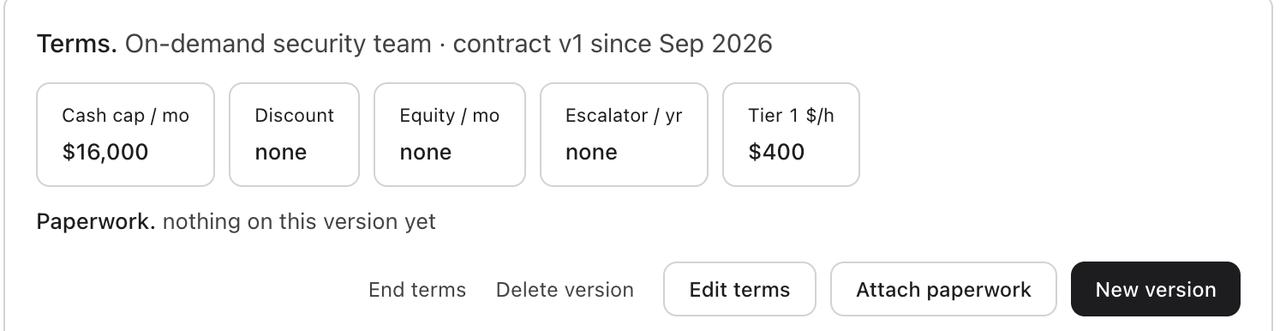
The pricing writers quoted here converge on once a year at minimum, written into the agreement as an escalator so the rise is a clause rather than a negotiation, plus a re-price whenever the client’s size or the scope changes materially. The owners in the threads who waited three years or ten paid for the wait in margin, and the ones who raised prices with two to three months’ written notice mostly kept the clients worth keeping. Ceed keeps the escalator and the rate by tier on the agreement, versioned, and shows margin per client every morning, so the question comes up when the numbers move rather than when a client leaves.
 Jon McLachlan is a co-founder of Ceed and of YSecurity, which set a few rates on day one too. Published 3 September 2026, updated 11 September 2026. Corrections to hello@ceed.so, and they are dated when made.
Sources
- u/SuccessfulMix6814, “Lost a decade old client without a single complaint”, r/msp, 4 June 2026, 140 points, 197 comments. https://www.reddit.com/r/msp/comments/1twy2le/. u/HLim12, “Am I undercharging”, r/agency, June 2026. https://www.reddit.com/r/agency/comments/1u9a1bu/. u/RKenshin2020, “Long term clients tell me they can no longer afford contracted price”, r/msp, 10 February 2026. https://www.reddit.com/r/msp/comments/1r1be1j/ (all read 11 September 2026).
- u/Crescitaly, “I finally raised my prices by 40% after 3 years of undercharging. Lost 30% of my clients. Revenue went UP.”, r/smallbusiness, 23 February 2026, 1,235 points, 217 comments. https://www.reddit.com/r/smallbusiness/comments/1rcbykx/ (read 11 September 2026).
- u/Illustrious-Art2471, “I’ve been overcharging a client for at least 18 months”, r/freelance, 20 March 2024, 266 points. https://www.reddit.com/r/freelance/comments/1bjg3ng/. “Under-billing invoices and recouping lost revenue”, r/msp, February 2026. https://www.reddit.com/r/msp/comments/1qwslsx/. u/Lazydude121, “How common is it for you to eat hours?”, r/Accounting, 18 August 2026, 128 points. https://www.reddit.com/r/Accounting/comments/1vrbumo/ (all read 11 September 2026).
- u/OkContract6063, “have you ever lost a retainer client without seeing it coming?”, r/agency, 28 May 2026. https://www.reddit.com/r/agency/comments/1tq0t22/. u/TheMostFluffyCat, “Pricing: a guide(ish)”, r/Bookkeeping, 7 April 2025, 114 points. https://www.reddit.com/r/Bookkeeping/comments/1jter5u/. u/whitedaisies827, “‘Don’t eat your hours.’ So I didn’t. And I got burned.”, r/Accounting, 21 June 2025, 1,271 points, 225 comments. https://www.reddit.com/r/Accounting/comments/1lh18ii/ (all read 11 September 2026).
- Posts on X: @AlexHormozi, 4 June 2025, https://x.com/AlexHormozi/status/1930268623098261787. @jonathanstark, 11 October 2018, https://x.com/jonathanstark/status/1050603472238796800, and 6 April 2019, https://x.com/jonathanstark/status/1114753148751626242. Like counts as read 11 September 2026.
- Arron Bennett, “How agencies lose money on profitable clients, and how to spot it”, Bennett Financials, 15 June 2026. https://bennettfinancials.com/how-agencies-lose-money-on-profitable-clients-and-how-to-spot-it/. Rayhaan Moughal, “Retainer pricing, wrong”, Sidekick Accounting, July 2026. https://www.sidekickaccounting.co.uk/insights/retainer-pricing-wrong. Promethean Research, “How profitable are digital agencies?”, 19 April 2026, 119 agencies. https://prometheanresearch.com/how-profitable-are-digital-agencies/ (all read 11 September 2026).
- Michael V. Marn, Eric V. Roegner and Craig C. Zawada, “The power of pricing”, McKinsey Quarterly, 1 February 2003. https://www.mckinsey.com/capabilities/growth-marketing-and-sales/our-insights/the-power-of-pricing (read 11 September 2026).
- Consulting Success, “Consulting Fees Study”, nearly 1,000 consultants, published 1 May 2026, updated 7 September 2026. https://www.consultingsuccess.com/consulting-fees. Fractional Jobs, “The Fractional Work Report 2026”, 1,733 respondents. https://www.fractionaljobs.io/the-fractional-work-report. Ignition, “Putting off awkward client conversations is costing accountants over $76K each year”, 23 August 2022, 506 US firms. https://www.ignitionapp.com/news/putting-off-awkward-client-conversations-is-costing-accountants-over-76k-each-year (all read 11 September 2026).
- Blair Enns and David C. Baker, 2Bobs, the episode of 25 March 2026 on whether AI ends labor-based pricing. https://2bobs.com/podcast/is-ai-going-to-kill-labor-based-pricing. Jonathan Stark, “Trojan Hours”, 5 August 2026. https://jonathanstark.com/daily/20260805-2359-trojan-hours. 2Bobs, “Pricing Resentment”, 20 May 2026, https://2bobs.com/podcast/pricing-resentment, and “Who Should Set Prices?”, 26 February 2025, https://2bobs.com/podcast/who-should-set-prices. Harvard Business Review, “Rethink Your Pricing Strategies Amid Economic Uncertainty”, HBR IdeaCast, 28 May 2025. https://hbr.org/podcast/2025/05/rethink-your-pricing-strategies-amid-economic-uncertainty (all read 11 September 2026).
- The Futur, “How Do I Raise Prices Without Losing Clients?”, 26 August 2018. https://www.youtube.com/watch?v=gIw-PBNXWgE. The Futur, “Why You Must Raise Your Price (Clubhouse WWPM XI w/ Blair Enns)”, 1 April 2021. https://www.youtube.com/watch?v=sfyHSbfUCrQ. The Futur, “What Makes People Buy? Price & Value Masterclass w/ Ron Baker”, 22 September 2022. https://www.youtube.com/watch?v=TB54_6bEP-A. Harvard Business Review, “Pricing Strategies for Uncertain Times”, HBR IdeaCast, 22 February 2023. https://www.youtube.com/watch?v=aR-xxF4-vMU. Boston Consulting Group, “Moving from the Cost Game to the Value Game”, 20 May 2024. https://www.youtube.com/watch?v=XUS4UyvTNt8. The Futur, “When Client Says Your Price Is Too High”, 26 December 2019. https://www.youtube.com/watch?v=RFk8ZmIDrFM. CNBC Television, “47% of small businesses say they will have to raise prices due to inflation”, 14 February 2022. https://www.youtube.com/watch?v=PHh_spidewQ. 2Bobs, “Pricing Resentment”, YouTube, 20 May 2026. https://www.youtube.com/watch?v=991j7GkAhWc. Jonathan Stark, “The Hourly Trap”, 10 February 2022. https://www.youtube.com/watch?v=9aHZDLMW4U4. View counts as read 11 September 2026.
- Product pictures are of Ceed’s staging environment on 11 September 2026, showing a demo account with invented names and figures.
- The Security Podcast of Silicon Valley, a YSecurity production: episode 7 with Michael Brooks, 10 August 2021, https://ysecurity.io/podcast/7-michael-brooks-vciso-and-director-of-cyber-risk-services-at/. Episode 28 with David Carpe, 19 May 2023, https://ysecurity.io/podcast/28-david-carpe-how-to-network-and-the-myth-of-the-great-silent/. Episode 102 with Chris Kirschke, 25 August 2026, https://ysecurity.io/podcast/102-ciso-does-not-spell-ceo/.