Blog · 8 October 2026 · Sasha Sinkevich
The buyer calls. The close answers.
In 2026 the money that prices a services firm arrived from three directions at once: venture funds building AI roll-ups, private equity finishing its move into accounting, and investors consolidating the managed service providers. They ask the same short list of questions, and the answers live in the month close: which clients the revenue depends on, how much of it recurs, the margin by client, earnings that survive an accountant’s test, the money not yet collected, the share of the work done by contractors, and whether the firm runs without its founder. This post is about that list, why signed deals died on it in 2025, what the last wave of roll-ups teaches, what AI changes about the answers, and why the list is worth running every month in a firm that never plans to sell. With twelve recordings, three posts from X, the Hacker News threads, six figures, pictures of the product, six books and three episodes of The Security Podcast of Silicon Valley. None of it is advice to sell, or legal, tax or financial advice.
On 5 March 2026 Julien Bek of Sequoia Capital published an essay called “Services: The New Software”. Its arithmetic is simple, “For every dollar spent on software, six are spent on services,” and its best sentence is about the end of the month.
A company might spend $10K a year for QuickBooks and $120K on an accountant to close the books. The next legendary company will just close the books.
Bek meant a new kind of company, one that sells the finished work instead of the tool, and the essay says nothing about buying firms to prove it. The sentence reads differently from inside a firm of ten or twenty people. The close is where a firm’s month becomes a record, and in 2026 more people than ever wanted to read that record: venture funds building roll-ups of services firms, private equity finishing its move into accounting, and investors consolidating the managed service providers. They ask the same short list of questions, in roughly the same order. This post is about that list, and about the month close that answers it.
One thing first, so nobody reads this the wrong way. This is not a post about selling any firm, and it is not advice to sell. It is about the questions buyers ask, because they are the best questions an owner can ask of their own month, and because a firm that can answer them has choices, whether it ever uses them or not. None of it is legal, tax or financial advice, and the people to ask about your own situation are your accountant and your attorney.
The money arrived. From three directions.
The first direction is venture capital, which spent 2025 and 2026 buying the kind of firm its portfolio companies used to sell software to. General Catalyst raised $1.5 billion for what it calls its Creation strategy in 2024, PitchBook reported, and its largest company, Long Lake, “has acquired 30 businesses since its founding”. On 4 May 2026 Long Lake agreed to take American Express Global Business Travel private for $9.50 a share in cash, about $6.3 billion, in a deal expected to close in the second half of the year. We found no report that it had closed by 28 September. Marc Bhargava, a managing director at General Catalyst, told PitchBook: “These services businesses...haven’t got a lot of attention from VC investors. That’s going to change.” Hemant Taneja, General Catalyst’s chief executive, put the fund’s side of it: “The role of the companies has fundamentally changed. The role of venture capital has to change as well”.
How General Catalyst chose where to buy says as much as the money. Molly O’Shea, who interviewed Bhargava for her show Sourcery, put the method in one line.
General Catalyst ran a screener of 70 industries for their AI Roll-Up strategy.. they only selected 10.
In the conversation she posted, Bhargava gave the arithmetic: “around 10-15% EBITDA-margin businesses can become 30% EBITDA-margin businesses. You can roughly double the free cash flow”. The discipline was in the other number: “we decided not to go forward with 60 of the 70”. His longer account is the clearest explanation of the strategy we found.
A second venture approach went straight for accounting. OpenAI took an ownership stake in Thrive Holdings in December 2025, and Joshua Kushner described the bet: “We believe this paradigm shift will happen from the inside out as domain experts and practitioners use AI as a native tool.” Thrive’s accounting group, Crete Professionals Alliance, renamed itself Current in June 2026 and counted nearly 30 firms, more than 2,000 staff and more than $500 million of revenue, by its own release. Forbes counted nearly 50 practices, and a later report more than 50 firms, which is probably the difference between the firms it bought first and the smaller practices folded into them. Current’s chief executive, Steve Stagner, told Forbes how he sees the firms it buys: “We aren’t here to run their business. We want to arm the rebels.” In August Thrive Holdings raised $2 billion at a $12 billion valuation, TechFundingNews reported, with SoftBank, D1 Capital and Altimeter as its first outside investors.
Other investors followed with the same reasoning. Elad Gil, an early investor in AI companies, told TechCrunch in June 2025: “If you own the asset, you can [transform it] much more rapidly than if you’re just selling software as a vendor”. Khosla Ventures’ Samir Kaul said the companies it was looking at “are very unlikely to lose money”, and added, “We wouldn’t do it alone, we don’t have that expertise”. Newcomer asked the question the funds’ own investors will ask, “whether the more PE-like strategy might yield more PE-like returns, i.e. 2X or 3X rather than the 10X or more that’s typically the goal for VCs.”
The second direction is private equity, which spent a decade buying into accounting and finished the job in 2026. CPA Trendlines counts 22 private equity transactions in accounting in 2023, 65 in 2024 and more than 100 in 2025, though Cherry Bekaert counts “more than 50” for 2025, and the two define a deal differently. Cherry Bekaert adds that “Almost half of the top 30 CPA firms in the U.S. have some form of PE investment or alternative practice structure (APS).” The largest names moved this summer. KKR agreed in June to invest in Crowe, in a deal consulting.us put at nearly $3 billion, and the investment closed on 7 August, with the tax, advisory and other non-audit work in Crowe Advisory LLC and the audit practice left in Crowe LLP. On 29 July Grant Thornton, backed by New Mountain Capital since 2024, agreed to buy CBIZ for $55 a share in cash, about 54% above its 30-day average price, for a combined firm of more than 34,500 people and more than $7.5 billion of revenue, expected to close in the fourth quarter. In June Eide Bailly agreed to sell a majority stake to Reverence Capital Partners in a deal valuing it at about $1.8 billion, expected to close in the third quarter, and we found no report of the close by 28 September.
The first owners have started to sell to the second. In January 2025 New Mountain sold its stake in Citrin Cooperman to Blackstone at “approximately 15x EBITDA, outpacing the 11x EBITDA New Mountain paid for its share,” CFO Brew reported, noting that private equity firms “typically hold investments for only three to five years (maybe seven at the outside)”. Allan Koltin, who advises accounting firms on these deals, expects more of the same: “there’s going to be more in 2027 than 2026, and there’s going to be a lot more in 2028”. On LinkedIn in April, Sasha Orloff made the bull case in two sentences, and a reply made the bear case in one.
“Private equity is buying accounting firms like crazy. They don’t buy dying industries.”
“PE doesn’t pay 15x EBITDA for businesses they think AI will destroy.”
Sasha Orloff, on LinkedIn, 24 April 2026, 801 reactions.
Dave Sellick’s reply: “No … they don’t buy dying industries, they create them”. Both can be true of different firms, and the rest of this post is about telling, from your own month, which kind of firm yours is. In July, Linda Biek posted Petar Petrov’s summary of the market: “Nearly half of America’s 20 largest accounting firms now have private equity behind them.” And the reason, in four words: “The clients don’t move.”
The third direction is the managed service providers, the IT and security firms that bill by the month. Omdia counted 169 publicly announced deals in 2025 and private equity in 69% of the disclosed ones, a share it says “likely overstates true PE participation, since smaller MSP-to-MSP transactions are less frequently announced”. Seventeen had managed security targets. In the first quarter of 2026 Omdia counted 64 deals, up 73%, with outside investors behind 80% of them and managed security providers the target of 22%. Omdia’s Jessica Davis explained the attraction to Channel Dive: “ARR is what attracted private equity to the managed services space. It’s nice because it’s so predictable.” And the other side of the same market: “It’s been a great help to MSPs who reached retirement age and were looking for an exit.” For IT managed service providers and managed security providers, the buyer is no longer a rumour.

Equiteq, which advises on the sale of consulting firms, asked buyers in February what they wanted from the year. Over 60% of private equity investors expected more deals, and “94% of strategic acquirers and 82% of private equity investors rate AI as important or very important to their strategy.” The worries were in the same report: “Valuation risk, uncertain ROI, and rapid technological obsolescence are now the most frequently cited concerns in AI-related acquisitions.” And what buyers said they prioritise is a list any owner could have written: “Management quality and leadership strength,” “Revenue growth and resilience,” and “Profitability and margin sustainability.”
Sequoia’s essay, for the record, is not a buyer’s. It backs new firms and says nothing about acquiring old ones. We come back to it for its sorting rule, which turns out to be the most useful idea in this whole market for an owner who is not selling anything.
What they check. In order.
Read the buyers’ own reports, the advisers who prepare sellers, and the accountants who test the numbers, and the same list comes back in roughly the same order. It is worth reading slowly, because every line on it is a question an owner can answer, or not, from the month that just closed.
First, who pays. CT Acquisitions, an adviser to consulting firm owners, sets the line at “No single client above 10% of revenue. Top 5 clients below 30%”, and says that concentration “above 20% triggers buyer pushback”, and above 25% a discount of 15% to 30% of the price. The Crossing Report, writing about accounting firms, draws the line further out: “If one client represents 30% or more of your revenue, that’s a concentration risk”. Buyers of managed service providers, in CT’s guide to that market, want no customer above a fifth of revenue. The thresholds differ. The question does not, and a firm whose largest client is a third of its revenue knows it without a report.
Second, what recurs. CT again: “40% or higher is the line between commodity and premium”. The Crossing Report wants “A firm where 70%+ of revenue renews automatically”, through retainers, annual engagements and recurring services. Jessica Davis’s line about managed service providers applies to any firm with retainers: “ARR is what attracted private equity”. A retainer is recurring revenue in a contract. Whether it is recurring margin depends on the hours behind it, which is the subject of our post They see the fee. You see the hours.
Third, the margin, by client and by service. The buyers want to know which clients make money and which only make revenue, and the adviser’s calendar puts a profit and loss by service line in the monthly routine two years before any sale. The benchmarks for firms of more than fifty people give a sense of scale: SPI Research’s 2026 survey, as Deltek reported it, found project margins of 37.7% and earnings before interest, tax, depreciation and amortisation of 9.9%, with billable time at its lowest in the survey’s history. A small firm’s margin by client can sit far from its average, which is the argument of The rate was set on day one. The client grew.
Fourth, the working capital. CT’s targets are collections within 45 to 60 days and unbilled work under 30 days, with retainer revenue paid in advance tracked and reconciled every month. The retainer line matters more than it looks: “The unearned portion is a balance sheet liability (deferred revenue), and it is debt-like at close”, CT writes, and “poorly managed working capital can cost 2% to 5% of enterprise value”. A firm that is paid late, and bills late, carries both costs, as we wrote in Profitable. Not paid.
Fifth, who does the work. CT wants “Under 15% of delivery hours done by 1099”, and it names the reason: “Consulting firms that run sub-consultants as 1099 to dodge payroll tax expose themselves to multi-year IRS, DOL, and state DOL liability”. That line is not a verdict on contractors. It is a buyer pricing a risk, and the risk is documented or it is not, which is what our post on paying contractors, Bill rate. Pay rate., calls the file they will ask for.
Sixth, the founder. The Crossing Report’s sentence is the one owners remember: “If every client relationship runs through the founding partner and no documented handoff protocol exists, the platform acquires relationships that walk out the door”. CT says a single person carrying more than 40% of revenue “triggers earnout”, and that moving a firm of $2 million to $5 million of earnings “from concentrated to distributed lifts multiple from the 6x to 8x band into the 9x to 12x band”. In accounting the founder question has a second edge. Allan Koltin, as a vendor’s blog quotes him from CPA Trendlines, says accounting firms have “zero EBITDA” because they “clear out the register every year”: the partners take the profit as pay, and a buyer has to cut that pay to create the earnings it pays a multiple for. His summary of how partners take it: “Partners 55 and older love it. Partners who are 35 are not so sure.”
Seventh, the close itself. CT’s calendar for a consulting firm asks for a monthly close in 15 days and a service-line profit and loss every month two years out, and a close disciplined enough for an accountant’s review one year out. Its guide for managed service providers asks for a real general ledger close within 15 days, and explains why: “Platforms underwrite the financial-systems maturity heavily because mid-market and platform-tier deals require GAAP-compliant audits.” A buyer reads the close because the close is where every other line on the list becomes a number that does not move.

John Warrillow, whose show Built to Sell interviews owners about how they built and sold their firms, put the number every seller in this market hopes for in the title of an episode last December.
The test. Source and persistence.
The list is tested by a quality of earnings review, an accountant’s report that a buyer, and more and more often a seller, pays for before a deal closes. Michael Lipschutz of Kreischer Miller describes it as an analysis of “the source and persistence of earnings”, which is the best short definition we found: where the earnings come from, and whether they will still be there next year.
CT Acquisitions lists what the review runs: “revenue recognition testing (T&M cut-off, fixed-fee percent-completion, retainer earnings), expense normalization, add-back validation, working capital trends”. It “Often includes proof-of-cash testing (reconciling reported revenue to actual bank deposits).” And the finding that moves prices most: “Revenue recognition errors are the most common QoE finding and can shift reported EBITDA by 10-25%.” The cost, by the same adviser, starts at “$50K to $100K for QoE if revenue is below $15M with simple structure”. Carolyn Debaca of Windes tells sellers to “Reconcile all bank accounts and credit cards to the penny for the last 24 months”, and lists the red flags that end deals: “Unrecorded Liabilities, Pro-Forma Fluff, Inventory Obsolescence, Proof of Cash Gaps.”
For a firm that sells time, most of that list is about the hours. Cut-off on time and materials asks whether the hours on each invoice were worked in the month they were billed. Retainer earnings asks how much of a retainer paid in advance was earned by the hours delivered against it. Add-back validation asks for “Every potential add-back documented as it happens with the underlying invoice or payroll record”. And the review reads the monthly profit and loss two or three years back, which is only as good as the closes that produced it. A close that was reopened and edited every quarter is a record the reviewer has to rebuild, and a rebuilt record is the one whose numbers move.
Signed. Then dead.
A signed letter of intent is not a sale, and the numbers on what happens between the two are sobering. Axial, which runs a marketplace for lower middle market deals, reviewed 75 signed deals that failed in 2025 and published the reasons in January. “Non-QoE diligence findings accounted for 25.3% of failed transactions,” it wrote, while “QoE EBITDA discrepancies followed closely at 21.3%.” Renegotiation ended 14.7%, and sellers walked away from 13.3%.

The individual cases read like a warning label. In one business services deal with a private equity buyer, “The company was missing key assumptions agreed to in the LOI and failed to provide necessary financial info needed to complete QoE.” An independent sponsor: “After spending a hefty sum on QoE, the EBITDA was off by between $265k and $594k.” Another buyer found that “The banker had overstated EBITDA by 25%.” CT Acquisitions, reading the same data, puts the share of signed letters that never close at “roughly one third”, and its guide to the review says “Roughly 25-35% of LMM deals signed at LOI fail to close, often due to diligence surprises.”
Craig Hamm of BPM described in July how the surprise happens: “When the numbers don’t reconcile cleanly, when GAAP hasn’t been followed consistently, or when the financials depend on owner adjustments that are hard to document and defend, the buyer’s confidence drops, and so does the offer.” The common problems, in his list, are “revenue recognized too early, expenses run through the business that reflect personal use, and working capital balances that don’t reflect how the business operates.” None of them requires bad faith. All of them are the difference between a month that was closed and a month that was assembled later.
The data room is where that difference shows. Capital Founders, writing for sellers weighing an AI roll-up, described the end of the process: “You’ve answered 847 questions in the data room. You’ve produced three years of financials, client lists sorted by revenue, employee contracts, and a narrative explaining every revenue fluctuation since 2019.” The Crossing Report’s version is shorter: “Three years of consistent top-line growth signals a replicable business, not a founder-driven revenue stream”. Three years is thirty-six closes. The firm that kept them does not have to write the narrative. It hands over the months.
The last wave. And how it ended.
Services roll-ups are not new, and the last wave is recent enough that people who worked in it still write about it. USWeb, founded in 1995, “bought more than three dozen other companies” in a model built on buying small web design firms and their clients “with the company’s public stock as payment”. It announced a merger with CKS in 1998, and on 1 March 2000, after a further merger, the combined company was renamed marchFIRST. In April 2001 it filed for bankruptcy in Delaware, with more than a thousand creditors and 1,700 staff laid off a little more than a week before. A Morningstar analyst called the merger “just a fiasco, basically”. Jason Fried, looking back in 2010, called marchFIRST “an example of what big money and power thought was a good idea just 10 years ago.”
On Hacker News, a former employee remembered it in 2016: “I worked at marchFirst back in the day.” The diagnosis: “M1’s number one problem was a culture of spending money without any thought of a return.” And the merger itself: “It really was a merger of two opposite cultures.” Another commenter listed the company it kept: “Scient, Viant, Razorfish, MarchFirst, and dozens of dotcom service companies were granted crazy valuations versus existing traditional peers”.
Accounting had its own wave in the same decade. The CPA Journal, reviewing it in 2000, wrote that consolidators had promised deals with “as many digits as telephone numbers”, and that “Ultimately, the offers were much lower and often featured tax-deferred stock rather than cash.” Century Business Services, now CBIZ, was one of them, and “Shares of CBIZ were as high as $25 and as low as $0.81,” Accountancy Daily recorded in 2003. American Express “bought about 130 CPA firms for its Tax & Business Services Group on a progressively larger scale through most of the 1990s”, and in 2005 sold the unit to H&R Block for about $220 million, on $385 million of revenue, after H&R Block had “invested about $2bn in acquisitions” of its own from 1998 to 2000. In Britain, Tenon’s share price “fell from 175p to 17p within a matter of months”, and “Integrating the practices acquired appears to have been a major problem.”

The same writers named what went wrong, and it was rarely the idea. “What has so far proved the most difficult for the consolidators is carrying out a successful integration programme,” Accountancy Daily concluded. Harvard Business Review’s Paul Carroll and Chunka Mui put it harder in 2008: “a rollup of almost any kind is a high-wire act in which a slight market downturn is all it takes to finish you off.” On Hacker News this September, jtrn added the rest of the list: “Loewen Group rolled up funeral homes and went bankrupt in 1999, the 1990s physician-practice rollups collapsed, Waste Management itself restated years of earnings in 1998”. And in the same thread tptacek wrote from the other side of a roll-up, as a founder whose firm was bought: “I cofounded a company that ultimately got rolled up (Matasano, into NCC Group US)”, adding that “Rollup strategy is interesting”.
The investors behind the new wave have read the same history. Elad Gil said of the technology-enabled roll-ups of the 2010s that they “ended up being not really that much of a user of technology. It was kind of like a thin veneer.” Euclid Ventures, writing about the Amazon seller aggregators: “The well-covered outcomes in this category have mostly been flame-outs.” Its prescription for doing it better is a warning in itself: “success requires building two separate industry-leading enterprises under one roof: an AI-driven software company and an operating company”.
The rhyme between the two waves is exact. CBIZ, the consolidator whose shares fell to 81 cents, bought Marcum in 2024 to move into the top ten, and in July 2026 agreed to be bought by Grant Thornton for $55 a share. The survivor of the last wave is the target of this one. The lesson for an owner is not that roll-ups fail. Some fail and some survive. It is that the failures in this history were paid for in stock and undone by integration, and that an owner offered stock or rollover equity in a buyer is being asked to read the buyer’s close as closely as the buyer reads theirs. Capital Founders gives sellers the question to ask of an AI roll-up in particular: “What percentage of promised automation has actually been achieved in your earliest acquisitions?”
Intelligence or judgement. By the hour.
Sequoia’s essay is not about buying firms, but it contains the most useful sorting rule we have read for anyone who sells time. “Writing code is mostly intelligence. Knowing what to build next is judgement.” Bek’s claim is that “AI has crossed the threshold where it can do most of the intelligence work autonomously and leave the judgement to humans.” His playbook for the new companies: “start with the outsourced, intelligence-heavy task. Nail distribution. Expand toward the insourced, judgement-heavy work as the AI compounds.” And the line that explains why services firms were first in line: “If a task is already outsourced, it tells you three things. One, the company has accepted that this work can be done externally.” A consultancy is the outsourced task.
The roll-up arithmetic turns the rule into a price. Capital Founders summarises the playbook: “buy services companies running at 5-15% margins, deploy AI to automate 30-70% of repetitive tasks, transform the economics to look more like software than services”. The targets have “fragmented ownership, labour-intensive operations, high automation potential, recurring cash flows, aging owners facing succession, and sticky client relationships”. Forbes reported the arithmetic from inside Current: an accountant whose annual preparation work fell from about 180 hours to about 15. Whether or not those numbers hold across a portfolio, they are claims about hours, by task.
That is the owner’s opening, and it is our argument, not a buyer’s stated practice. We found no buyer or adviser saying, in anything we could read, that diligence now asks for time by task. But every buyer in this post is pricing which of a firm’s hours are intelligence and which are judgement, because that is the whole bet: the first kind can be automated, and the second kind is what the client pays a premium for. A firm that records its hours by client, by person and by what moved forward is the only party at the table that can answer from evidence instead of from a model. A firm that cannot answer gets the buyer’s guess, and Equiteq’s buyers told it their expectations are “grounded in performance, not potential alone.”
The same arithmetic worries the people who already own firms. The Financial Times reported in June that private equity executives were warning about AI’s threat to their own bets on law and accounting.
Private equity bosses warn of AI threat to bets on law and accountancy
Private Equity Wire’s account of the worry named the firms most exposed: “firms charging by time-based billing structures may face the greatest pressure, as AI tools reduce the labour intensity of core tasks”. We took that pressure apart from the client’s side in Fewer hours. Same margin. It cuts the same way here. If AI takes hours out of a firm, a buyer pays for the hours that remain, and for the judgement in them, and the only record of which hours those are is the firm’s own. And a firm that uses AI in client work will be asked who did the work, which is the record in Who did the work. On the record.
There is a counter-argument worth hearing here. Guillermo Flor, answering Sequoia in July, warned that “Using AI for a task trains AI to do that task”, and that a firm’s workflows and prompts can become “training data for your own obsolescence”. Applied to the owner, it says that knowing your hours by task shows a buyer what to cut. It also shows the owner first, and the owner is the one who prices and staffs from it. A buyer who has to guess discounts for the guess.
Even if you never sell.
Most owners of firms that sell time will not sell to a roll-up, and many will never sell at all. The list is still worth running, for reasons that have nothing to do with a buyer. John Warrillow, the author of Built to Sell, built a questionnaire around eight drivers of value, from “Financial Performance” and “Recurring Revenue” to what he calls “Monopoly Control” and the “Hub and Spoke”, the founder at the center of every relationship. From 40,000 owners who took it, he said in a 2018 interview, the average score of 59 drew offers of about three to three and a half times profit, and scores of 90 and above about seven times. The figures are eight years old. His reason for caring is not.
“For your business to be valuable, it needs to run without you...it gives you lots of control. It gives you a multiple if you ever want to sell, but also gives you a lot more control of your time”
John Warrillow, on the Divestopedia podcast with Ryan Tansom, 2018.
The Exit Planning Institute’s research on American owners says how many will face the question anyway. In its 2023 national survey, as Project Equity reported it, “73% of privately held companies in the U.S. plan to transition ownership within the next decade”, and “nearly half (49%) of surveyed business owners plan to exit their company within the next five years”. A decade earlier the picture was worse: “83% of owners in 2013 did not have a documented business transition plan.” Among Baby Boomer owners in its generational report, “only 27% have completed a formal valuation” and “only 5% of Baby Boomer respondents report having a dedicated exit planning team”.

A transition is not always a sale to an outsider. On Hacker News in May, DangitBobby named the choices: “If you own a business and wish to retire, your options are pretty much to sell, pass it on to someone, or dismantle it.” a4isms, who had bought into a consulting firm with a loan from the firm repaid out of profit sharing, added that “little LBOs for succession purposes are remarkably common.” In another thread, about private equity and medical practices, w29UiIm2Xz put the demographic case: “Many first-world economies face a demographic cliff where boomers are retiring and there is nobody in the next generation who can afford to take over”. And apothegm said why owners sell at all: “They sell because it’s their retirement nest egg.”
An internal successor, a partner buying in, a lender and a key employee offered equity all need the same numbers a private equity buyer does: which clients the revenue depends on, the margin by client, the money not yet collected, and whether the firm runs without the person leaving. An owner who never plans to sell still borrows money, hires partners, prices renewals and decides which clients to keep. The list is the monthly report for all of it.
The list, as a monthly routine.
Here is the list turned into a routine a firm of five or fifty can run at every close, whether or not anyone ever asks for it. Each line is a number or a name, and each takes minutes once the month is kept properly and days when it is not.
- Compute the share of revenue from your largest client and from your top five, every month, from the invoices and not from memory. The advisers’ lines are 10% for one client and 30% for five, and The Crossing Report calls one client at 30% a risk. If you are above them, you do not need to act this month. You need to know it this month.
- Mark what recurs. List the retainers and renewals, and next to each, the hours it took to deliver this month against the hours you sized it with. A retainer that recurs at a thinner margin every month is recurring revenue and a shrinking business at the same time, which is the argument of what it costs to look away.
- Read the margin by client, including the clients you like. The one that surprises you is the one a buyer would find first.
- Count the money not yet in. Days to collect, hours worked and not yet invoiced, and any hour past a budget still waiting for a decision. Decide the waiting hours before the close, so unbilled work is a choice and not a leftover, as in A held hour waits.
- Reconcile the retainers paid in advance: the part of each one this month’s hours earned, and the part still owed to the client as work. The review calls the unearned part debt-like, and it is easier to show every month than to rebuild at the end.
- Know who did the work. The share of delivery hours done by contractors, and for each contractor the agreement, the invoices and the statements that paid them, which is the file in The file they will ask for.
- Count what runs through one person: the clients, approvals and invoices that need the founder. Name an account leader for each client who can say yes or no to the hour past the budget without you.
- Write the add-backs down when they happen. A personal or one-time expense noted with its invoice on the day is an add-back. The same expense remembered two years later is an argument.
- Close in fifteen days, and do not reopen. If something was wrong, correct it in the next month with a note, so every closed month stays the month it was.
Nothing on the list needs a buyer, a banker or a deal. It needs the hours, the agreements and the invoices in one place, and a close that holds. A firm that runs it every month knows which clients pay for the firm, and which clients the firm pays for, whether or not anyone ever calls.
The case against. In their words.
The strongest objections to this market come from people inside it, and they deserve a hearing before any owner takes a call.
The first is that services margins do not become software margins. Nathan Benaich of Air Street Capital and Nikola Mrkšić of PolyAI, writing in Fortune in June 2025: “Yes, AI can make workflows more efficient. No, that doesn’t turn a services company into a software company.” And the sharper version: “Services businesses aren’t inefficient by accident. They’re inefficient by design.” Their evidence is history: “Amazon proved them right by building a native digital retailer, not by acquiring and transforming Sears or Barnes & Noble.” On Hacker News in February, beernet put the same point briefly, “Consulting has weak margins compared to SaaS and scales poorly,” and avin01 in the same thread: “APIs scale but consulting doesn’t. Even with good models, delivering outcomes is still messy”.
The second is that the numbers are the buyers’ own. Capital & Clarity, a newsletter that studied General Catalyst’s strategy in April: “None have operated through a recession. The margin transformation numbers are reported by the firms themselves, not independently audited.” And: “The largest portfolio company, Long Lake, is less than three years old.” Its conclusion is the one a careful seller should carry into any meeting: “Services businesses have never traded like software companies for structural reasons, and those reasons have not disappeared.”
The third is about the professions themselves. When the Wall Street Journal reported in 2025 that doctors were warning accountants about private equity, quantified wrote on Hacker News that “The owners of the firms who get money on the sale are all that matters,” and ivape named the independence question: “If both the Hospital and Accounting firm are owned by Private Equity, then there is no independent body with the right incentives to do this.” Henrico Dolfing, in August, set out what private equity has not yet proved in accounting, among it that the resulting firms could “integrate repeated acquisitions, preserve professional quality, develop future leaders and remain coherent through successive ownership cycles.” And the arithmetic under it: “Interest must be paid regardless of whether growth slows, integrations take longer or acquired partners leave.” The Accounting Podcast made the profession’s own case against in 2024.
The fourth is that the advisers’ numbers are marketing, and some of them are. CT Acquisitions’ own pages disagree with each other on what small consulting firms sell for, and one of its figures, that most failed letters of intent cite key person risk, comes with no source at all, so we have left it out. That is why the numbers on failed deals in this post come from Axial’s own deal data and the numbers on managed service providers from Omdia’s own tracker. The advisers are useful for what they test, and we quote them for that.

None of that weakens the argument of this post, because the argument does not need the roll-ups to succeed. If the skeptics are right, the margin by client matters more, not less, because no software multiple is coming to rescue it. If the buyers are right, the firm that can prove its margin gets paid for it. Some owners should never sell, and some should never sell to these buyers. Every owner is better off with a month that can answer the list.
The close, kept. In Ceed.
Most of the list is a question about the hours: who worked them, for which client, at what rate, whether the client was billed for them, and whether the month they sit in has changed since it closed. That is the part of a firm Ceed keeps. It is not the ledger, and it is not an audit. Invoices and statements go from Ceed to the ledger you already use as documents, your bank moves the money, and Ceed never touches it. What Ceed keeps is the record under the revenue.
The margin by client is there every morning, computed from the hours as they are logged, and visible to the owners and whoever they name, as the home page shows under one set of hours.
Visible to the owners and whoever they name.
The concentration is named in words. On the Economics page of our demo account in September, the line under the month reads “Acme Co is 100% of September’s book. Concentration worth watching.” The projected month is what is booked, labeled “booked. Never extrapolated”, which is the kind of projection a reviewer can check.
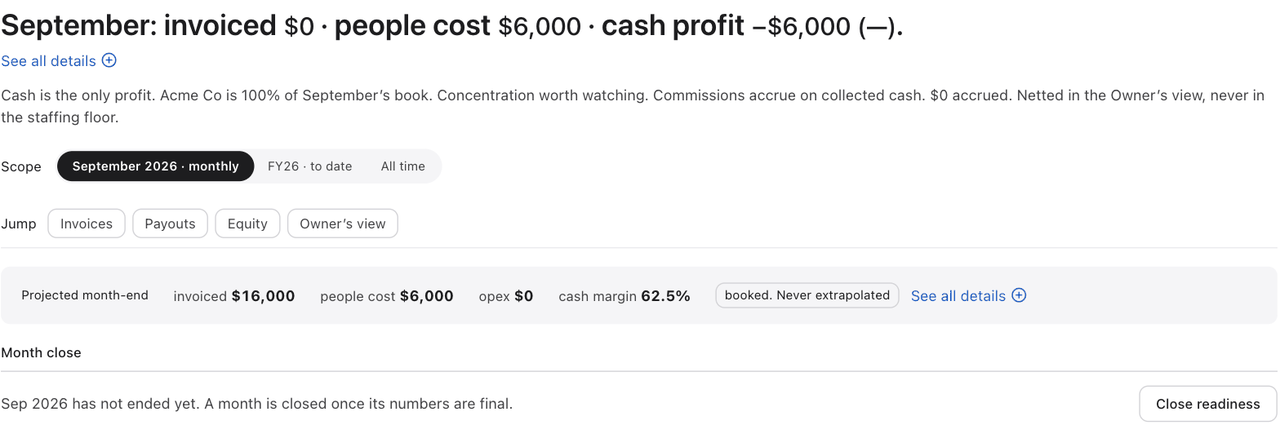
The invoice is computed from the agreement, with its retainer, budget and rates by role, and every approved entry sits beneath it, dated, in the words of the person who did the work, as we showed in Who did the work. On the record. That is the cut-off question answered at the source: the hours on each invoice are the hours worked in the month it bills, because the invoice was computed from them. An hour that would push a client past its budget is held the moment it is logged and waits, recorded and not billed, for a person’s yes or no, so unbilled work is a list with names on it and not a surprise in the review. The contractor’s statement comes from the same entries as the invoice, so the share of the work done by contractors, and what they were paid for it, comes from one record, as Bill rate. Pay rate. showed.
Then the close. Before a month becomes a record, Ceed lists what is still open: held hours and requests, cap positions, invoices still in draft, receivables overdue, and next month’s book. Each open item closes as a recorded decision.
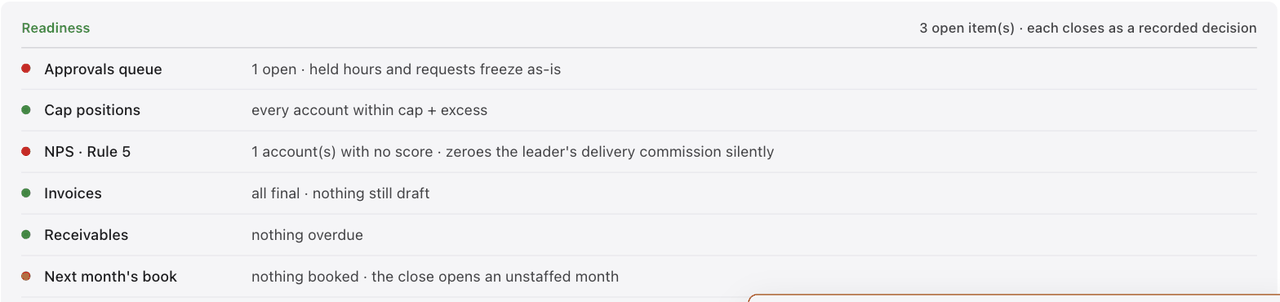
When the month closes, its invoices, statements and margin freeze, the close carries the name of the person who closed it and the date, and nothing in it changes after. That is the whole difference between thirty-six closes and thirty-six spreadsheets.
Closed by Dana K., Wed 2 Sep. Nothing in it changes.
Every edit before the close sits on an append-only trail with the actor, the action and the value before and after, so the question a reviewer asks about any number, where it came from, has an answer that nobody wrote afterwards. Rates and margin are visible only to the owners and the people they name, enforced on the server. And the firm you have can be brought in without retyping it: Ceed Intelligence reads your people list, your W-2s and 1099s, your client list and the agreements you signed, proposes the people, clients and budgets it found, and waits for your yes, with every money term confirmed one by one.
What Ceed does not do matters as much. It does not replace the ledger, the accountant or the review. It does not reconcile your bank, and it will not make a month look better than it was. It keeps the month the way it happened, which is what the review is trying to find out. We built it for our own firm first, our books first, because we wanted that list as a monthly report.
Ceed costs 0.1% of what you invoice, with no seats and no minimum. Where Ceed stands beside the time trackers and the suites is on the comparison page, and the row about who can reopen a closed month is in Ten rows. One engagement.
What the books say.
Six books: three on building a firm that runs without its founder, one on how capital reads a business, one on the failures of the last wave, and one on sharing the numbers inside the firm.
- Built to SellJohn Warrillow, 2011. The standard owner’s book on a firm that can run without its founder, by the author of the eight drivers in this post.
- The Automatic CustomerJohn Warrillow, 2015. Recurring revenue in any industry, which is the first thing on the buyer’s list after concentration.
- Finish BigBo Burlingham, 2014. Owners who left well and prepared for years, which is the argument for running the list whether or not you sell.
- The OutsidersWilliam N. Thorndike, 2012. How the best capital allocators read a business, which is how a buyer reads the close.
- Billion Dollar LessonsPaul B. Carroll and Chunka Mui, 2008. The failures the authors summarised in Harvard Business Review, the roll-up as a high-wire act among them.
- A Stake in the OutcomeJack Stack and Bo Burlingham, 2003. Open-book numbers and ownership inside the firm, the succession path the Hacker News thread described.
Three conversations about evidence.
The firm behind Ceed also hosts The Security Podcast of Silicon Valley, more than a hundred conversations since 2021 with the people who build and run security. Three of them are about the evidence outsiders check, and what software changes about gathering it.
- 37
Jon McLachlan and Sasha Sinkevich, a founder’s guide to complianceFebruary 2024 · SOC 2, ISO, NIST, PCI DSS and the rest, the evidence customers and investors check, explained by the two of us.
- 64
Daniel Marashlian, co-founder and chief technology officer of DrataMarch 2025 · He built a billion-dollar company by automating security audits, the gathering of evidence turned into software, with the judgement left to the auditor.
- 87
Venkat Thiruvengadam of DuploCloudJanuary 2026 · AI agents in operations work, and why the value is in the guardrails, permissions and people in the loop, not the model.
Ceed is for firms that sell their team’s time: management consultancies, IT consulting firms, IT managed service providers, managed security providers, security consultancies, accounting and fractional CFO practices, professional advisors, agencies, engineering firms and staffing firms up to fifty people, and nineteen kinds of firm in all. If you want a month that can answer the list, whoever asks, sign up and close the next one in Ceed. Nothing to pay until your first invoice.
Sign upOr write to hello@ceed.so.
Questions.
What does a small consulting firm sell for in 2026?
It depends on the firm, and the advisers’ own numbers disagree. CT Acquisitions quotes 2 to 3 times seller’s discretionary earnings for a founder-dependent solo practice, 3 to 5 times for a small team, and 4 to 7 times earnings before interest, tax, depreciation and amortisation for most consulting firms in 2026, with more for recurring revenue. Its exit guide quotes much higher ranges, probably for larger firms. These are adviser figures, not a valuation, and an accountant or banker who knows your firm is the one to ask.
What do buyers check first?
Who pays, what recurs, and what is left. Advisers put client concentration first, with no client above 10% and the top five below 30% as the line CT Acquisitions draws, then recurring revenue, margin by client and service line, earnings that survive a quality of earnings review, collections and unbilled work, retainers paid in advance, the share of delivery hours done by contractors, and whether client relationships run through the founder. The month close is where all of them become numbers.
What is a quality of earnings report, and what does it cost?
An accountant’s test of the source and persistence of a firm’s earnings, done before a deal closes. It tests how revenue was recognised, including the cut-off on hours and how much of a retainer was earned, checks every add-back, reviews working capital, and often reconciles revenue to bank deposits. CT Acquisitions puts the cost for a small consulting firm at $50,000 to $150,000. In Axial’s review of 75 failed deals in 2025, differences found by the review ended 21.3% of them.
What is an AI roll-up?
A buyer, usually funded by venture capital, that acquires services firms and uses AI to automate part of their work, aiming to lift margins toward those of software. General Catalyst’s Creation strategy with Long Lake, and Thrive Holdings with its accounting group Current, are the best known. Skeptics, Nathan Benaich and Nikola Mrkšić among them, argue that services margins do not become software margins, and the margin gains reported so far are the firms’ own numbers.
Why did the last services roll-ups fail?
Mostly integration, stock and timing. marchFIRST, the web consultancy roll-up of the late 1990s, went bankrupt about thirteen months after taking its name. The accounting consolidators often paid in stock, CBIZ’s shares fell from $25 to $0.81 and Tenon’s from 175p to 17p, and integration was the hardest part. Harvard Business Review called a roll-up a high-wire act that a slight downturn can finish. Some survived, and CBIZ itself agreed in 2026 to be bought by Grant Thornton.
I never plan to sell. Why should I care?
Because the same numbers run the firm. A partner buying in, a successor, a lender and a key employee offered equity all ask what a buyer asks, and most owners face a transition of some kind: in the Exit Planning Institute’s 2023 survey, 73% of privately held companies plan one within ten years. A month that can answer the list tells you which clients make money, what you are owed and whether the firm runs without you, sale or no sale.
 Sasha Sinkevich is a co-founder of Ceed and of YSecurity, where every month closes into a record that does not change afterwards. Published 8 October 2026. Corrections to hello@ceed.so, and they are dated when made.
Sources
- Julien Bek, Sequoia Capital, “Services: The New Software”, 5 March 2026, https://sequoiacap.com/article/services-the-new-software, and Jeremy Kahn, Fortune, 21 April 2026, https://fortune.com/2026/04/21/services-are-the-new-software-sequoia-venture-capital-julien-bek-ai-native-eye-on-ai/. Every source below was read on 27 or 28 September 2026 unless another date is given.
- General Catalyst and Long Lake. Jessica Hamlin, PitchBook, 6 May 2026, https://pitchbook.com/news/articles/general-catalysts-6-3b-amex-deal-puts-its-ai-roll-up-strategy-on-display. Long Lake’s release on Business Wire, 4 May 2026, https://www.businesswire.com/news/home/20260504231235/en/Long-Lake-Agrees-to-Acquire-American-Express-Global-Business-Travel-the-Worlds-Largest-Corporate-Travel-Platform-for-$6.3-Billion-With-Support-From-General-Catalyst-and-Alpha-Wave. Marc Bhargava and Kate Bender, General Catalyst, “The Future of Services”, 28 August 2025, https://www.generalcatalyst.com/stories/the-future-of-services.
- Thrive Holdings and Current. OpenAI, 1 December 2025, https://openai.com/index/thrive-holdings/. Current’s release on Business Wire, 2 June 2026, https://www.businesswire.com/news/home/20260602293257/en/Crete-Professionals-Alliance-Rebrands-as-Current-to-Equip-Independent-Accounting-Firms-to-Compete-at-Enterprise-Scale. Anna Tong, Forbes, 2 June 2026, https://www.forbes.com/sites/annatong/2026/06/02/thrive-holdings-to-bet-1-billion-on-ai-powered-accounting-roll-up/. Abhinaya Prabhu, TechFundingNews, 13 August 2026, https://techfundingnews.com/josh-kushners-thrive-holdings-raises-2b-at-a-12b-valuation-to-turn-ai-into-a-private-equity-strategy/.
- Other venture investors. Madeline Renbarger, Newcomer, 18 December 2025, https://www.newcomer.co/p/inside-the-vc-roll-up-craze-that. Connie Loizos, TechCrunch, on Elad Gil, 1 June 2025, https://techcrunch.com/2025/06/01/early-ai-investor-elad-gil-finds-his-next-big-bet-ai-powered-rollups. Marina Temkin, TechCrunch, on Khosla Ventures, 23 May 2025, https://techcrunch.com/2025/05/23/khosla-ventures-among-vcs-experimenting-with-ai-infused-roll-ups-of-mature-companies.
- Private equity in accounting. CPA Trendlines deal tracker, modified 28 August 2026, https://cpatrendlines.com/2026/02/16/cornerstone-pe-deal-tracker-pe-update-alan-whitman-plants-a-flag-in-the-private-equity-landscape-2020-2026/. Cherry Bekaert, Private Equity Report, 25 February 2026, https://www.cbh.com/insights/reports/private-equity-report-2025-trends-and-2026-outlook/. Courtney Vien, CFO Brew, 30 April 2026, https://www.cfobrew.com/stories/2026/04/30/accounting-enters-its-private-equity-flip-era.
- KKR and Crowe. Crowe’s release on PR Newswire, 11 June 2026, https://www.prnewswire.com/news-releases/crowe-accelerates-long-term-growth-trajectory-with-investment-from-kkr-302798523.html. consulting.us, 15 June 2026, https://www.consulting.us/news/13547/kkr-to-acquire-crowe-in-nearly-3-billion-deal. Crowe, on the close, 7 August 2026, https://www.crowe.com/news/crowe-closes-strategic-investment-from-kkr.
- Grant Thornton and CBIZ. Bryan Strickland, Journal of Accountancy, 29 July 2026, https://www.journalofaccountancy.com/news/2026/jul/a-new-top-5-firm-grant-thornton-acquiring-fellow-top-10-firm-cbiz/.
- Eide Bailly and Reverence Capital Partners. Private Equity Wire, 23 June 2026, https://www.privateequitywire.co.uk/eide-bailly-to-sell-majority-stake-to-reverence-capital-in-deal-valued-at-1-8bn/, and Eide Bailly’s release on PR Newswire, https://www.prnewswire.com/news-releases/eide-bailly-advances-growth-strategy-and-client-service-commitment-through-investment-from-reverence-capital-partners-302807934.html.
- Managed service providers. Omdia, first quarter 2026, https://omdia.tech.informa.com/om145542/global-msp-ma-1q26, and Jessica Davis, Omdia, 16 April 2026, https://omdia.tech.informa.com/blogs/2026/apr/msp-m-and-a-2025-deals-focus-on-cybersecurity-ai. Matt Ashare, Channel Dive, 19 August 2026, https://www.channeldive.com/news/channel-acquistions-consolidation-managed-services-omdia/828297/.
- Equiteq, Global Buyer Report 2026, 3 February 2026, https://www.equiteq.com/resources/global-buyer-report-2026.
- What advisers say buyers check. CT Acquisitions, consulting firm exit guide, updated April 2026, https://ctacquisitions.com/prepare-your-business-for-sale/consulting-firm-exit/, consulting business valuation, updated 15 September 2026, https://ctacquisitions.com/consulting-business-valuation/, private equity and managed service providers, 25 May 2026, https://ctacquisitions.com/guides/private-equity-msp-2026/, the sell-side quality of earnings report, modified 16 September 2026, https://ctacquisitions.com/quality-of-earnings-report-seller-deep-dive/, and why deals fall apart, 15 September 2026, https://ctacquisitions.com/guides/why-ma-deals-fall-apart-2026/. The Crossing Report, 14 March 2026, https://crossing.one/blog/private-equity-accounting-law-firms-ai-rollups-professional-services-2026. These are advisers’ marketing pages, quoted for what they test.
- SPI Research 2026 benchmarks, via Deltek, 30 July 2026, https://www.deltek.com/resources/articles/professional-services-benchmarks/. Allan Koltin, quoted from CPA Trendlines by Slava Akulov, Jupid, updated 2 September 2026, https://jupid.com/blog/who-is-buying-accounting-firms-2026.
- The quality of earnings review. Michael L. Lipschutz, Kreischer Miller, 10 April 2026, https://www.kmco.com/insights/7-benefits-of-a-sell-side-quality-of-earnings-report/. Carolyn Debaca, Windes, 9 February 2026, https://windes.com/quality-of-earnings-earnings-report/. Craig Hamm, BPM, 15 July 2026, https://www.bpm.com/insights/why-deals-fall-apart-in-due-diligence/.
- Kaitlinn Thatcher, Axial, “Dead Deal Report: Unpacking 2025’s Broken LOIs”, 27 January 2026, https://www.axial.net/forum/dead-deal-report-unpacking-2025s-broken-lois/.
- Capital Founders, the AI-enabled roll-up playbook, updated 2 July 2026, https://www.capitalfounders.io/playbooks/ai-enabled-roll-ups/, and “Due Diligence in Reverse”, 1 February 2026, https://www.capitalfounders.io/playbooks/ai-enabled-roll-ups/chapters/ai-rollup-due-diligence-questions/.
- The last wave. Wikipedia on USWeb, https://en.wikipedia.org/wiki/USWeb. Lori Enos, E-Commerce Times, 13 April 2001, https://www.ecommercetimes.com/story/marchfirst-files-for-bankruptcy-8940.html. Jason Fried, Signal v. Noise, 1 March 2010, https://signalvnoise.com/posts/2184-marchfirst. Max Krotman and Joel Sinkin, The CPA Journal, 2000, http://archives.cpajournal.com/2000/0800/features/f83100a.htm. August J. Aquila and Julian Hamilton, Accountancy Daily, 1 December 2003, https://www.accountancydaily.co/consolidators-practice-dont-count-them-out, and Julian Hamilton, 1 November 2005, https://www.accountancydaily.co/us-consolidators-consolidate. H&R Block’s release, 1 August 2005, https://investors.hrblock.com/news-releases/news-release-details/hr-block-acquire-american-express-tax-and-business-services. Paul Carroll and Chunka Mui, Harvard Business Review, September 2008, https://hbr.org/2008/09/seven-ways-to-fail-big. Euclid Ventures, 27 September 2024, https://insights.euclid.vc/p/the-ai-first-roll-up.
- The skeptics. Nathan Benaich and Nikola Mrkšić, Fortune, 27 June 2025, https://fortune.com/2025/06/27/ai-rollup-investment-strategy/. Capital & Clarity, 7 April 2026, https://capitalandclarity.substack.com/p/the-general-catalyst-behind-15-billion. Henrico Dolfing, 6 August 2026, https://www.henricodolfing.ch/en/the-institutional-test-what-private-equity-has-not-yet-proved-in-us-accounting/. Guillermo Flor, 30 July 2026, https://www.theaiopportunities.com/p/sequoia-is-wrong-services-arent-the. Private Equity Wire on the Financial Times’ report, 16 June 2026, https://www.privateequitywire.co.uk/pe-executives-flag-ai-disruption-risk-to-law-and-accounting-investments/. We did not read the Financial Times article itself.
- Owners and the decade. John Warrillow with Ryan Tansom, Divestopedia, 2018, updated 29 March 2024, https://divestopedia.com/podcast-8-key-drivers-to-increased-valuation-an-interview-with-john-warrillow/2/9574. Exit Planning Institute, 2 October 2023, https://blog.exit-planning-institute.org/are-owners-in-the-united-states-ready-for-exit-epi-launches-national-state-of-owner-readiness-research, and its generational report, https://exit-planning-institute.org/generational-state-of-owner-readiness. Michelle Philippon, Project Equity, 29 April 2025, https://project-equity.org/news/employee-ownership-insider/business-owner-statistics-exit-planning/.
- Hacker News, comments quoted as posted: “Ask HN: Who is firing?”, 2 November 2016, https://news.ycombinator.com/item?id=12851987, with nwenzel, https://news.ycombinator.com/item?id=12852341. adventured, 11 January 2018, https://news.ycombinator.com/item?id=16123654. “Invisible Companies”, 1 September 2026, 190 points, https://news.ycombinator.com/item?id=49521264, with tptacek, https://news.ycombinator.com/item?id=49552111, and jtrn, https://news.ycombinator.com/item?id=49557346. “Private equity bought America’s essential services”, 27 May 2026, 552 points, https://news.ycombinator.com/item?id=48292941, with DangitBobby, https://news.ycombinator.com/item?id=48293896, and a4isms, https://news.ycombinator.com/item?id=48294132. The thread on the bill to ban private equity from owning medical practices, 20 September 2026, 508 points, https://news.ycombinator.com/item?id=49780630, with w29UiIm2Xz, https://news.ycombinator.com/item?id=49781407, and apothegm, https://news.ycombinator.com/item?id=49782068. “Doctors Warn Accountants of Private-Equity Drain on Quality”, 7 May 2025, https://news.ycombinator.com/item?id=43921265, with quantified, https://news.ycombinator.com/item?id=43921479, and ivape, https://news.ycombinator.com/item?id=43921648. “Ask HN: Why LLM providers sell access instead of consulting services?”, 6 February 2026, https://news.ycombinator.com/item?id=46911911, with beernet, https://news.ycombinator.com/item?id=46911962, and avin01, https://news.ycombinator.com/item?id=46947635. We could not read Reddit for this post.
- Posts on LinkedIn, read in a browser on 28 September 2026: Sasha Orloff, 24 April 2026, with Dave Sellick’s reply, https://www.linkedin.com/posts/sashaorloff_private-equity-is-buying-accounting-firms-activity-7453416253219622913-sF-W. Linda Biek, on Petar Petrov, 8 July 2026, https://www.linkedin.com/posts/lindabiek_ifac-wcoa2026-activity-7480632327241392129-a1lC.
- Posts on X, read in a browser on 28 September 2026, dates in UTC: Julien Bek, 5 March 2026, https://x.com/JulienBek/status/2029680516568600933. Molly O’Shea, 6 December 2025, https://x.com/MollySOShea/status/1997100398298231237. Financial Times, 16 June 2026, https://x.com/FT/status/2066740236458050042.
- Recordings on YouTube, with view counts as read on 28 September 2026: Cognitive Revolution, 2 August 2025, https://www.youtube.com/watch?v=gT-qbKTHv6Y. Fintech Leaders, 24 June 2025, https://www.youtube.com/watch?v=4mO2qaCBex4. CNBC, 8 June 2026, https://www.youtube.com/watch?v=W4TXUX1d2iY. Built to Sell, 5 December 2025, https://www.youtube.com/watch?v=U0BkpYzy4XE, and 22 November 2024, https://www.youtube.com/watch?v=6sRDtty4dOg. Talks at Google, 8 July 2016, https://www.youtube.com/watch?v=I6VXHETUkbw. Wharton Executive Education, 28 February 2019, https://www.youtube.com/watch?v=fNJlmzBaB4s. M&A Science, 15 April 2024, https://www.youtube.com/watch?v=7R0xqtX0d2c. The AI Accountant, 10 March 2026, https://www.youtube.com/watch?v=J0wCJSVhsGU. Consulting Success, 15 September 2025, https://www.youtube.com/watch?v=laGD1h8YmMc. PolyAI, 9 July 2025, https://www.youtube.com/watch?v=PYjskHfh8f8. The Accounting Podcast, 16 December 2024, https://www.youtube.com/watch?v=nbZQjUPC5b8.
- Product pictures are of Ceed’s staging environment in September 2026, showing a demo account with invented names and figures. The two drawn cards are the ones on the Ceed home page.
- The Security Podcast of Silicon Valley, a YSecurity production: episode 37 with Jon McLachlan and Sasha Sinkevich, 25 February 2024, https://ysecurity.io/podcast/37-founders-guide-to-compliance-the-introduction-soc2-iso-nist-pci/. Episode 64 with Daniel Marashlian, 11 March 2025, https://ysecurity.io/podcast/64-building-a-billion-dollar-security-company-lessons-from-dratas/. Episode 87 with Venkat Thiruvengadam, 27 January 2026, https://ysecurity.io/podcast/87-escape-the-ticket-trap-how-ai-agents-are-replacing-manual-devops/.