Blog · 4 August 2026 · Jon McLachlan
Held. Not hidden.
When an hour crosses a client’s budget, software can tell you later, refuse the hour, or hold it for a decision. Only one of those keeps both the hour and the decision in the record. Updated in September 2026 with five recordings, four threads, four posts from X, the research on monitoring, and six books.
Forty hours bought. Forty logged by the eighteenth. On the nineteenth, someone on the team does two more hours of good work for the client and logs them. What happens next is the whole design question of a system that runs a firm’s money, and there are only three answers.
An alert is a report.
The first answer is to tell you. Most time trackers do this: the budget passes a threshold and an email goes out, within the hour on some, the next morning on others. It is useful. It is also history. By the time you read it the hours are in the month, the work is delivered, and the choice about who pays for it has been made by default. An alert changes what you know. It does not change what happened.
The people who build these tools know it. The budget email is a project feature, built to keep a project near its estimate. It was never built to hold a rule at the moment the rule is tested.
Ron Baker, who has argued since the 1990s that professional firms should abolish the timesheet, said the sharpest version on The Soul of Enterprise in 2016: “By definition, once you see something on a timesheet, it can no longer be managed.” We keep the timesheet and we take the point. A report about last week is a history lesson. Baker made the longer case to an accounting audience in 2011, in eight minutes.
The alert has a second cost. IDC’s February 2026 survey of 100 professional services firms for Kantata found a “3% delay in invoices being issued” at firms running on reports rather than records. The hour that is found late is billed late, if it is billed at all.
A refused hour disappears.
The second answer is to refuse the hour. Some trackers and suites can do this: at the budget, the timer stops or the entry is rejected with a message to contact the budget owner. It sounds like discipline. In practice it is the oldest failure in professional services with a new interface. An engineer described the older version on Hacker News in 2010. Told he was over budget at 54 hours on a 50-hour estimate, he “was not to charge any more time to that ticket. This essentially means ‘work for free.’”
The work still happens. The client still needed it. The record now says it did not happen, and the hour is eaten before anyone with authority has looked at it. Thomas Ptacek, who co-founded two security consultancies, put it plainly in 2024: “Serious consultancies routinely eat billable weeks of time in order to meet client success criteria and retain relationships.” David C. Baker has said for years that the average creative firm captures about 42% of its time rather than the 60% it should. A refusal makes that gap policy.
The people inside the refusal describe it in detail, and the threads about it are among the most upvoted in their fields. In November 2021 a first-year accountant wrote in r/Accounting that timesheets were the worst part of the job, “worrying about getting my hours up without going over budget on what I’m assigned on.” The thread reached 1,578 points and 171 comments. The reply with 851 points described a firm that sold itself as having no timesheets and then wanted an email to the partner every evening listing the day’s work. The reply with 103 gave the honest version of the rule: “If you spend 6 hours on something, put 6 hours on your timesheet even if the project budget you’ve been given is 2 hours,” followed by the admission that nobody had ever been spoken to for going over budget, only for logging too few billable hours. Another, at 369 points, said the trick was several hours of unpaid overtime a day so the numbers look right.
Four months earlier a thread titled “Everything they said about billable hours is true” had reached 1,109 points with the same shape: bill less than the schedule and the client is upset, bill more and the client is upset. “By far one of the worst thing in PA is charging times and the sweating over the budget,” wrote one reply at 255 points. Another, at 115, described managers who hand out ninety hours of work a week and want a meeting if anyone charges more than fifty-five. Every one of those firms had a budget and a wall. None of them had a decision.
Blair Enns, who has spent his career telling creative firms to stop selling hours, has the three-word version.
Timesheets. Are. Lies.
Do with this what you will, but don’t lie to yourself about the implications of this Truth.
They are lies when the wall makes them lies. A record that stops at the budget is a record of the budget, not of the work. Jonathan Stark’s ten minutes on why nobody can buy an hour is the cleanest statement of what the client actually purchased, and it is not the entry the timer refused.
It also teaches the team the wrong lesson. Buddy Punch’s 2025 survey of 534 US workers found 30% feel time tracking is surveillance and 47% want access to their own records. A wall at the budget says the system is there to police them. The truth is the other way around. Every hour your team works counts. The only question is who pays for it, and that question belongs to the firm, not to the person who did the work at eleven at night.
A held hour waits.
The third answer is the one Ceed gives. The hour that would push a client over budget is saved, marked, and held. It waits for a named person, the account leader or an owner, to say yes or no. Nothing is billed quietly. Nothing disappears.
- Logged
2.0 h · Harbor & Vine · Revisions, round 3
- Held
Over the 40 h budget. Waiting for Dana.
- Approved
On the March invoice, at $150 an hour.
Approved, the hour lands on that month’s invoice at the rate in the agreement. Declined, it stays on the record and off the invoice, and the firm knows exactly what it chose to give away, when, and to whom. Both answers are true. Both are in the record. The budget held either way, because the rule was enforced at entry and not read about the morning after.
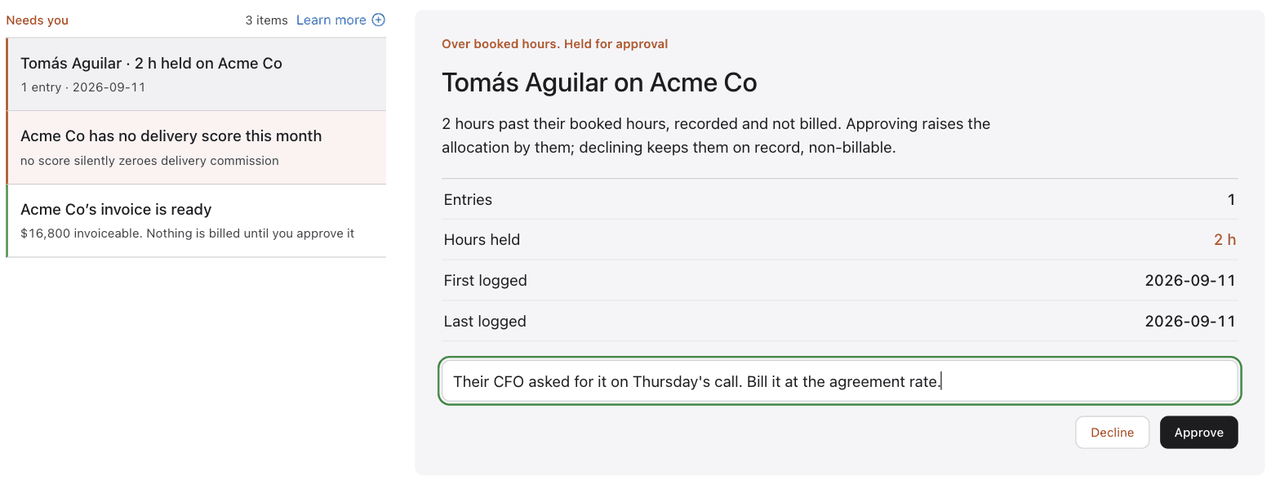
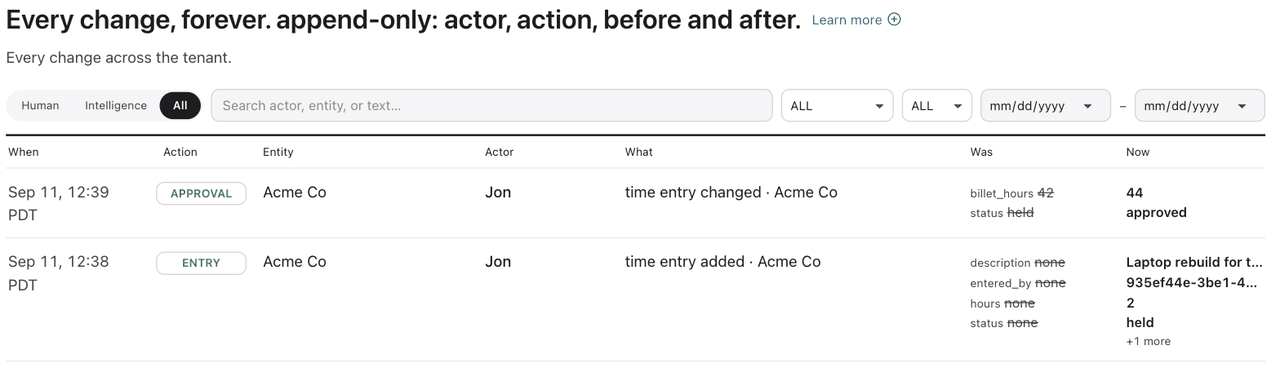
There is a quieter benefit. The system takes the question, so the account lead does not have to. Over-servicing is mostly people-pleasing at the account level, a yes said to be liked. A hold turns that yes into a decision made by the person whose margin it is, on the record, with the hours in front of them.
What the person logging sees.
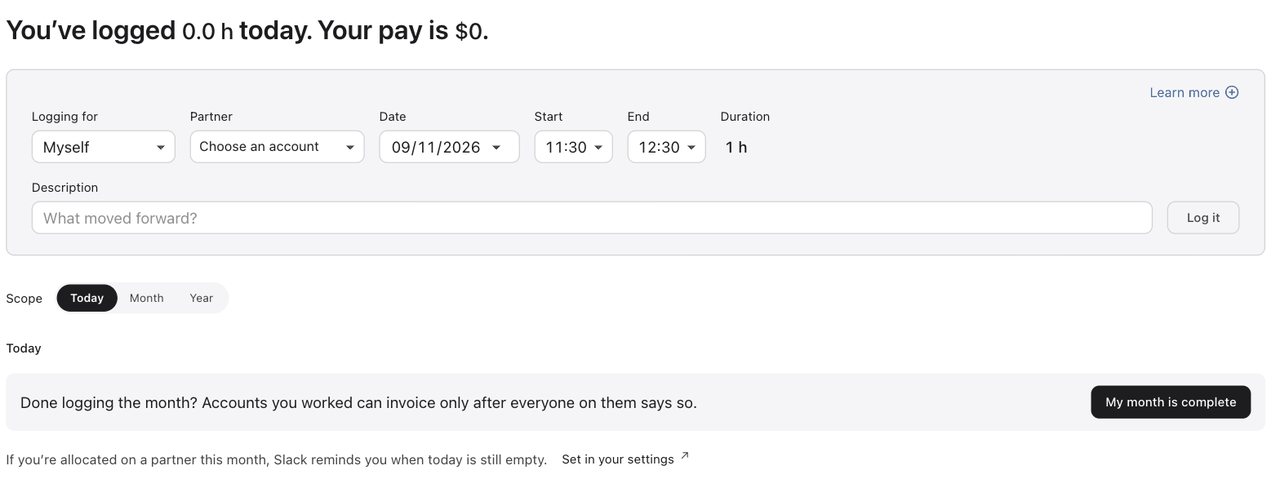
One message a day. No timers, no screenshots, no wall.
Harbor & Vine · 0 h
Northline Health · 12.5 h
Copperfield Tools · 31.0 h
Log yesterday’s hours.
The hold is framed as the client’s budget in question, never as the person’s hour. Everyone sees their own hours. The person who logged the two hours on the nineteenth knows at once that they are held, and knows by that afternoon whether the client is paying for them. Nothing they did is lost.
The threads on the other side of the timesheet are about walls and screenshots, not about hours. In August 2025 an engineer told r/ExperiencedDevs about a profitable startup that suddenly required everyone to log everything, then announced a loss three months later, a thread that reached 800 points and 179 comments. Two of the replies are the two designs in this post. One, at 127 points: “I work for a consultancy, here we track time to invoice our customers.” Another, at 54: “Honestly, this is better for the engineer. Lost 2 hours in a meeting? It now shows.” When the hour is counted for the client’s budget and the person’s own record, it protects the person. When it is counted to watch them, it does the other thing.
In May 2026 someone at a managed services provider asked r/sysadmin about tracking non-billable time in five-minute increments, 195 points and 157 comments. The top reply, at 287: “Make sure to add at least 30 minutes a day on the time sheet card for time spent updating time sheets.” Another, at 153: “all this leads to is employees padding their time.” The same month, one salaried remote worker’s answer to a new timesheet policy was liked 39,000 times.
I’m a salaried employee. But, I work remotely. My job asked us can we start using timesheets to monitor our time. Cause people don’t be working frfr. So I submitted my timesheet and it had 68 hours for one work week. I sent it to my manager and asked could I be paid overtime.
Sixty-eight hours is the record the manager did not want. It is also true, and the only design that survives contact with a true record is one in which the hours are the person’s and the decision is the firm’s. Basecamp drew that line in its own terms of service in 2020, when it barred third parties from using its interface for anything that “remotely records, monitors, or reports” a user’s activity, with one exception.
New Basecamp policy: “Third parties may not access and employ the API if the functionality is part of an application that remotely records, monitors, or reports a Service user’s activity other than time tracking, both inside and outside the applications”
Monitoring is the other design.
The hold is sometimes mistaken for surveillance, so it is worth saying what surveillance is. In August 2022 The New York Times reported that eight of the ten largest private employers in the United States track the productivity of individual workers, many in real time, where a pause can cost pay and, at one large insurer, low keyboard activity can cut a bonus. Jodi Kantor, who reported it with Arya Sundaram, explained it on CBS the next morning and on The Daily ten days later.
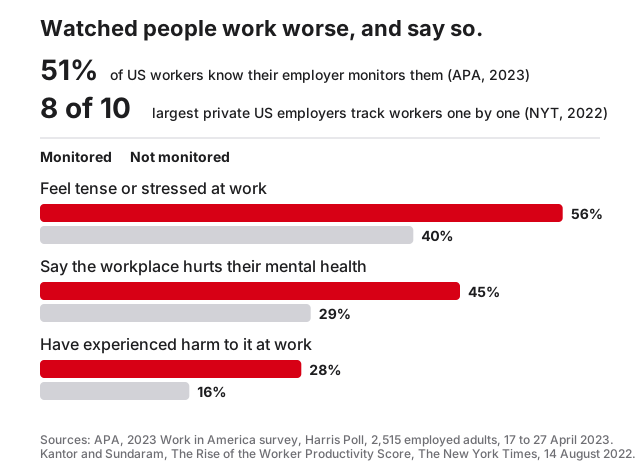
The American Psychological Association measured what that does to the people being watched. In its 2023 Work in America survey of 2,515 employed adults, 51% knew their employer monitored them. Of those, 56% said they typically felt tense or stressed at work, against 40% of the unmonitored, and 28% said they had experienced harm to their mental health at work, against 16%. Tara Behrend of Michigan State University, then president of the Society for Industrial and Organizational Psychology, said the data showed the tools do not make people work better: “They are counterproductive for the organizations that use them.”
Cory Doctorow, reading the same Times story, named the mechanism in a thread that August.
This is yet more proof that “you treasure what you measure,” or, more formally, “any target becomes a measurement” (AKA #GoodhartsLaw).
The decline of worker productivity in pursuit of metrics is an inescapable failure mode of bossware.
Bloomberg had filmed the industry two years earlier, twelve minutes on the software that watches while you work, and CBS returned to it in 2025 with the numbers larger. A hold measures none of that. It does not know when the person was at the keyboard, what they typed or whether they were idle. It knows one thing: that an hour, logged by the person who worked it, would take a client past the budget the client bought, and that someone with authority should say yes or no before the invoice does.
Closed means closed.
The last thing a hold gives you is a month you can close. Every hour was either within budget, approved past it, or declined past it, by a named person, on a dated record. When the month closes, the invoices, the statements and the margin are frozen and nothing in them changes after. That is a record a buyer, a lender or your own bookkeeper can read without asking what really happened, because what really happened is what it says.
What the books say.
Six books on trust, rules and records, none of them about time tracking, all of them about why a hold works and a wall does not.
- The Speed of TrustStephen M. R. Covey, 2006. Trust as an economic quantity, and why a firm that checks everything moves slower than one that checks the right thing once.
- DriveDaniel H. Pink, 2009. Autonomy, mastery and purpose, and what happens to all three when people are watched.
- It Doesn’t Have to Be Crazy at WorkJason Fried and David Heinemeier Hansson, 2018. The Basecamp position on time, attention and not watching people, from the people who wrote the policy quoted above.
- NudgeRichard H. Thaler and Cass R. Sunstein, final edition 2021. Choice architecture, which is what a hold is: the default keeps the hour, and the decision is made by the person whose margin it is.
- The Checklist ManifestoAtul Gawande, 2009. Why a rule enforced at the moment it applies beats a rule everyone knows and nobody checks.
- Measure What MattersJohn Doerr, 2018. What to measure and what not to, from the man who brought objectives and key results to Google. A held hour is a measure. A screenshot is not.
The firm behind Ceed also hosts The Security Podcast of Silicon Valley, 100 conversations since 2021 with the people who build and run security. Three of them are about walls, signals and who owns a decision.
- 95Pranava Adduri and George Gerchow of Bedrock DataMay 2026 · Stop saying no. Security leaders who put in guardrails instead of walls, which is the hold in another trade.
- 84Jack Cable, co-founder and CEO of CorridorDecember 2025 · What gets missed when nobody reviews the code, and why a signal beats a wall of alerts. The hour has the same problem.
- 91Neatsun Ziv on why asking developers to fix everything is a bad ideaMarch 2026 · Who should own a decision, and what happens when it lands on the person nearest the keyboard instead.
Two other shows have the long version. The Soul of Enterprise spent its 109th episode, in 2016, on trashing the timesheet. The Daily spent 24 August 2022 on the rise of workplace surveillance, with Jodi Kantor. Listen to both and the hold sits exactly between them: a record without a wall, a rule without a watcher.
Where the time trackers, the suites and the agreement-billing tools stand on this, row by row and dated, is on the comparison page. It credits them where they are ahead, which is real, and it names the one thing that happens here and nowhere else. The month that made us build it, with the numbers behind it, is in The invoice told us last. Why we built Ceed. The held hour as the stop loss against late payment is in The client paid late. The invoice was later., and as the change order at the hour in The agreement said 40 hours. The month said 47.
Sign upOr write to hello@ceed.so.
Questions.
What is the difference between a budget alert and a held hour?
Timing and authority. A budget alert is sent after the hours are in the month, usually by email, to whoever is subscribed, and changes nothing about the record. A held hour is stopped at the moment it is logged, before it reaches the invoice, and waits for a named person, the account leader or an owner, to approve or decline it. The alert reports. The hold decides, and keeps the hour either way.
Is holding an hour a form of employee monitoring?
No. Monitoring software records activity: keystrokes, screenshots, idle time, location. A hold records one fact the person entered themselves, that an hour of work would take a client past the budget the client bought, and routes the decision to the person whose margin it is. The person who logged the hour sees their own hours and the outcome the same day. Nothing about how they worked is captured, and nothing they logged is lost.
Who decides on a held hour?
The account leader for that client or an owner of the firm, by name. The decision is recorded with the reason and the time, and both are frozen when the month closes. The person who logged the hour does not decide, which is the point: over-servicing is usually a yes said at the account level to be liked, and the hold moves that yes to the person who pays for it.
What happens to a declined hour?
It stays on the record and off the invoice. The firm sees exactly what it chose to give away, when, to which client and on whose decision. The client’s budget holds, and the invoice matches the agreement.
 Jon McLachlan is a co-founder of Ceed and of YSecurity, whose team logs its hours on the page pictured above. Published 4 August 2026, updated 11 September 2026. Corrections to hello@ceed.so, and they are dated when made.
Sources
- Hacker News comment by AgentConundrum, 9 November 2010. https://news.ycombinator.com/item?id=1887816 (read 11 September 2026).
- Thomas Ptacek, Hacker News, 10 August 2024. https://news.ycombinator.com/item?id=41211933 (read 11 September 2026).
- David C. Baker and Blair Enns, “Transcending Timesheets”, 2Bobs, 7 October 2020. https://2bobs.com/podcast/transcending-timesheets (read 11 September 2026).
- “Time Tracking and Trust: What Today’s Employees Really Think”, Buddy Punch, n=534, fielded 30 June to 10 July 2025. https://buddypunch.com/research-insights/time-tracking-and-trust-what-todays-employees-really-think/ (read 11 September 2026).
- Ron Baker and Ed Kless, “Trashing the Timesheet”, The Soul of Enterprise, episode 109, 20 September 2016. https://www.thesoulofenterprise.com/tsoe/timesheets. Ron Baker with Tom Hood, “Ron Baker on Black Swans, Trashing Timesheets + Value Pricing”, YouTube, 25 January 2011. https://www.youtube.com/watch?v=B7B4vTalN5I (both read 11 September 2026).
- IDC, “The Cost of Inaction: The Business Impact of Not Using Professional Services Automation”, white paper sponsored by Kantata, February 2026, 100 professional services organizations, as summarized in Kantata’s release of 17 March 2026. https://finance.yahoo.com/news/study-finds-professional-services-firms-120000176.html (read 11 September 2026).
- u/six_trails, “I did not realize timesheets would be one of the worst parts of my jobs before working in public accounting”, r/Accounting, 16 November 2021, 1,578 points, 171 comments. https://www.reddit.com/r/Accounting/comments/qvlfqw/. “Everything they said about billable hours is true.”, r/Accounting, 18 July 2021, 1,109 points. https://www.reddit.com/r/Accounting/comments/omulvo/. u/rom_romeo, “Cautionary tale: Do not ignore an introduction of time tracking”, r/ExperiencedDevs, 18 August 2025, 800 points. https://www.reddit.com/r/ExperiencedDevs/comments/1mth51s/. u/AniBMagal, “Non billable time tracking”, r/sysadmin, 19 May 2026, 195 points. https://www.reddit.com/r/sysadmin/comments/1ti48lp/ (all read 11 September 2026).
- Posts on X: @blairenns (Blair Enns), 4 June 2019, https://x.com/blairenns/status/1135984785879212032. @Hearts0faKing, 12 May 2026, https://x.com/Hearts0faKing/status/2054248180808577296. @dhh (David Heinemeier Hansson), 4 May 2020, https://x.com/dhh/status/1257380983265005570. @doctorow (Cory Doctorow), 21 August 2022, https://x.com/doctorow/status/1561417509273731073. Like counts as read 11 September 2026.
- Jodi Kantor and Arya Sundaram, “The Rise of the Worker Productivity Score”, The New York Times, 14 August 2022. https://www.nytimes.com/interactive/2022/08/14/business/worker-productivity-tracking.html. “The Rise of Workplace Surveillance”, The Daily, 24 August 2022. https://www.nytimes.com/2022/08/24/podcasts/the-daily/workplace-surveillance-productivity-tracking.html. CBS Mornings, “New York Times’ Jodi Kantor on the rise of employee surveillance”, 15 August 2022. https://www.youtube.com/watch?v=4n8XbiXSDe0 (all read 11 September 2026).
- Michele Lerner, “Electronically monitoring your employees? It’s impacting their mental health”, American Psychological Association, 7 September 2023, on the 2023 Work in America survey, Harris Poll, 2,515 employed adults, 17 to 27 April 2023. https://www.apa.org/topics/healthy-workplaces/employee-electronic-monitoring (read 11 September 2026).
- Bloomberg Originals, “How Bossware is Watching While You Work”, 11 December 2020. https://www.youtube.com/watch?v=rLjZ6mbodcE. CBS News, “Your boss may be using surveillance software to monitor you”, 26 February 2025. https://www.youtube.com/watch?v=-FBmHm30vUo. Jonathan Stark, “You Can’t Buy An Hour”, 10 February 2022. https://www.youtube.com/watch?v=QGOdlFgQSWg. View counts as read 11 September 2026.
- The Security Podcast of Silicon Valley, a YSecurity production: episode 95 with Pranava Adduri and George Gerchow, 19 May 2026, https://ysecurity.io/podcast/95-stop-saying-no-how-security-leaders-enable-ai-instead-of-it/. Episode 84 with Jack Cable, 16 December 2025, https://ysecurity.io/podcast/84-what-gets-missed-when-nobody-reviews-the-code/. Episode 91 with Neatsun Ziv, 24 March 2026, https://ysecurity.io/podcast/91-why-asking-developers-to-fix-everything-is-a-bad-idea/.
- Product pictures are of Ceed’s staging environment on 11 September 2026, showing a demo account with invented names and figures.