Blog · 1 October 2026 · Jon McLachlan
Bill rate. Pay rate.
At a small firm the margin is the gap between what the client pays for an hour and what the person who worked it is paid, and in 2026 more of those hours are a contractor’s. This post is about that gap: where the senior contractors came from, the arithmetic of markup and margin, what a salaried consultant costs per billed hour, the cash chain between a client who pays late and a contractor the law says is due in thirty days, the rules that change today in New Jersey and the ones that changed in January, and the file a buyer, an auditor or a state will ask for. With twelve recordings, four posts from X, the Hacker News threads, six figures, pictures of the product, six books and three episodes of The Security Podcast of Silicon Valley. None of it is legal or tax advice.
Today, 1 October 2026, New Jersey’s new rules on who counts as an independent contractor become operative. For most firms that sell their team’s time the date lands on a change that already happened, quietly, one hire at a time. The second person to log an hour to a client is often not an employee. Gusto counted in April that more than four in ten solopreneurs paid at least one contractor in 2025, about $72.3 billion between them, and our own home page says Ceed is for a firm “from the day a second person logs an hour to your client.” This post is about that day, and about the two numbers it creates.
The first is the bill rate, what the client pays for the hour. The second is the pay rate, what the person who worked the hour is paid for it. The gap between them is the firm’s margin, and in 2026 it has to cover more than it used to: a client who pays in forty days, a contractor the law says must be paid in thirty, a set of rules that decide whether the contractor is a contractor at all, and a file that a buyer, an auditor or a state agency will one day ask to see. We run a security consultancy, YSecurity, which describes itself as more than 45 operators who ran security at Apple, Robinhood and the NSA, and the question of how each person who logs an hour is paid, from which hours and at what rate, is the question Ceed was built to answer for us first.
One line before the rest, because it matters: none of this is legal or tax advice. The rules differ by state and change often, and the right person to ask before you change how you pay anyone is your accountant or your attorney.
The partner left. The firm called.
Start with where the senior contractors came from, because in 2026 the answer is the top of the profession. On 24 April KPMG cut about 10% of its US audit partners, about 100 of some 1,400 partners and managing directors, after an early retirement programme fell short, Accounting Today reported after the Wall Street Journal. The firm’s statement: “Our audit business is strong, and this action reflects our ongoing commitment to sustaining audit quality and leading the profession into the future.” In May it cut about 400 advisory jobs as a “strategic realignment to ensure skills and capabilities are aligned with future demand”.
FT Exclusive: KPMG is cutting about 10% of its audit partnership in the US, after years of failed attempts to urge the least productive partners to retire early.
The reaction was not about KPMG. Robert Sterling’s post the same evening reached 485,000 views, and the line people passed around was about seniority.
KPMG is laying off 10% of their audit partners…
I’ll be blunt: If you work in front of a computer, your job isn’t safe.
It doesn’t matter how senior you are (KPMG’s partners literally own the company).
In London the same thinning happened at the promotion line. City AM reported on 27 April that EY UK made “only 34 promotions in 2025, a drop of nearly 70 per cent since 2022,” and Deloitte made “60 promotions last year, down from 124 at its peak three years earlier.” James Ransome of the recruiter Patrick Morgan told the paper he was “seeing a clear shift away from the traditional ‘job-for-life’ equity partnership model”, and a Companies House analysis in the same piece counted 346 equity partners among KPMG’s 833 and 606 among Deloitte’s 1,356. The Financial Times reported that KPMG and EY had moved some UK equity partners into salaried roles. Amanda Goodall, who tracks layoffs for a large audience, added the UK detail from KPMG’s internal announcement on 27 March: “440 roles in audit with the majority being assistant managers.”
The consulting firms thinned their middle too. McKinsey went from about 45,100 people at the end of 2023 to about 40,000 by May 2025, and Bob Sternfels explained the shape in January: “We can grow in this part, the client-facing side, and we can shrink in this part and have aggregate growth.” Accenture booked about $865 million of business optimization costs in fiscal 2025, which it said “includes severance”, and Julie Sweet described the logic plainly: “where we don’t have a viable path for skilling, sort of exiting people so we can get more of the skills in we need.” Accenture reports its fiscal 2026 results today. TheStreet reported in April that Deloitte had cut paid time off by five to ten days, frozen its pension after 2026 and halved paid family leave from sixteen weeks to eight.
Where the people went is the other half. MBO Partners published its State of Independence study on 28 September, three days ago, from a survey of 4,557 US adults in April, 2,063 of them independent: “The U.S. independent workforce reached a record 74.9 million people in 2026.” Full-time independents are up 114% since 2020 and are now 22% of all full-time US workers. “An estimated 5.8 million independent professionals now earn more than $100,000 annually, nearly double the number in 2020,” and “78% plan to remain independent or build a larger business.” Upwork’s index in July put the share of US skilled knowledge workers who freelance at 38%, up from 28%, and found 58% of full-time employees considering it, up from 36%.

The demand grew with the supply. Fractional Jobs reported on 18 August “a 149% year-over-year growth” in fractional hiring and “approximately 150,000 fractional professionals currently working in the US”, and its own report found 83% of them at director level or above, 87% with more than ten years of experience, an average of $223 an hour and a median of 21 client-facing hours a week. Taylor Crane, who runs it: “The fractional executive market has graduated from an interesting talent experiment into a full-fledged, measurable layer of the senior labor market.” Heidrick & Struggles, which owns Business Talent Group, counted “a 151% increase in C-suite engagements since 2021.” And Chad Oakley of the search firm Charles Aris said on Umbrex Unleashed that “It is now a candidate-driven market.”
Two caveats. The pyramid is not dying at the giants, which are rebuilding its base while they cut its middle: McKinsey planned about 12% more hires in North America for 2026, according to Storyboard18, and Bain told Poets&Quants its coming summer class was its “second largest summer associate class ever”. PwC’s own paper on the workforce of the future describes “a small leadership team, a strong middle layer, and a narrow base of new talent,” because “AI agents can take on many entry-level tasks.” And independence does not pay better on average. Upwork’s own figures have skilled full-time employees earning more than skilled freelancers in 2025, $109,000 against $101,000. What changed is not that everyone wants to be a contractor. It is that a boutique of eight can now find a former Big Four manager, a McKinsey alumna or a former CISO who will work two days a week, and the partners and managers the large firms shed have become the senior bench of the small ones.
Not so solo.
The firms buying that bench are small, and most of them start with one person. Gusto’s “Not So Solo” report, from its own payroll data, found that “More than four in ten solopreneurs (43.5%) paid at least one contractor during 2025”, 61% of those engaged two or more, contractors typically took about a tenth of revenue, and about a quarter of these businesses spent more than a quarter of revenue on them. The median relationship lasted five months. A year earlier Gusto had found that 34% of new solopreneurs hired a contractor in their first year. The second person at a consultancy, a fractional CFO practice, a security boutique or an agency is very often a 1099.
At the senior end the contract has a standard shape, and it is usually a flat monthly fee sized in hours only the firm knows. Fractional Jobs’ own guidance says that “Almost all fractional contracts are versions of Independent Contractor agreements (1099s)”, “usually month-to-month, with clearly defined hours (e.g. 10 per week), a monthly retainer or hourly rate,” and a notice period of fifteen to thirty days. Taylor Crane set the benchmark in February: “The gold standard for a fractional executive is a retainer for $10,000 per month for approximately 10 hours per week of work.” And Upwork’s figures say that “63% of freelancers typically work with several organizations at once,” which is exactly what makes them contractors in the eyes of most tests.
“A Fractional exec that charges a $10,000 monthly retainer would cost about $25,000 / month if you hired them full-time.”
“We don’t take a markup on their rates.”
Taylor Crane, founder of Fractional Jobs, on LinkedIn, 16 February 2026, 295 reactions.
That post also said the quiet part about why the arrangement exists: with a fractional executive “you don’t pay payroll taxes, health benefits, bonuses, etc.” The contractor prices that in. James Shore, the author and consultant, gave the rule most independents use in a Hacker News thread on Crane’s launch in August 2025: “General rule of thumb for independent contracting is that you should take the annual salary you would normally make and chop off the zeroes to get the hourly rate. So 150K/yr becomes $150/hr.” His reason: “That’s about double the yearly salary and pays for your increased costs (payroll tax, healthcare, retirement, vacation) as well as your bench time between jobs.” In the same thread the-alchemist was less impressed with the market’s side of it: “They don’t pay much. $5k-$6k/mo for half time.”
From the other side, the market for subcontracting through a firm is well understood by the people in it. natbennett, in the Hacker News thread “A layoff fundamentally changed how I perceive work”, which reached 1,041 points in January 2025, gave the route: “The easiest way is to reach out to consulting companies and ask if they take subcontractors. Second easiest is to ask companies that want to hire you if they’ll take you as a contractor instead.” baobabKoodaa described how consultancies use them: “they try to fill positions from their bench, and when they are unable, they subcontract to other consultancies or freelancers.” That is the shape of a staff augmentation firm, an IT consultancy or a software shop in 2026: a principal or two, a few employees, and senior contractors who come and go with the work.
Markup is not margin.
The bill rate and the pay rate make one spread, and people describe it two ways. Markup is the spread divided by the pay rate. Margin is the spread divided by the bill rate. A contractor paid $150 and billed at $250 is a 67% markup and a 40% margin, and the difference matters because owners price in markup and live on margin. The Economist’s question in October 2024, whether McKinsey and its rivals had got too big, drew 179 comments on Hacker News, and the employees of the big firms described their own multiple. candiddevmike: “The economics of consulting are pretty raw: they basically arbitrage the hourly rate of folks. They pay you X and then bill you for X*1.3 (minimum).” whatever1: “More likely they pay you X and they charge 3X, but yes I agree.” jncfhnb: “I’m pretty sure my average multiple is 6x.” FredPret: “3x is standard, you should push for a 2x raise.”

For a firm that places contractors, the practitioners’ numbers cluster. Liz Steblay, who coaches independent consultants, wrote in January 2025 that “Traditional agencies and boutique firms typically take 30-50% of your billings (the average is 35%)” and that “Online platforms usually charge 20-30%.” David Zhao of Codastrat put the consulting networks at 20% to 30% “or more”. Victor Valentine Romo’s worked example in February: “You charge client: $200/hour. You pay subcontractor: $80-$100/hour. Your gross margin: $100-$120/hour (50-60%)”, and he advises against anything below 30%. Staffing firms work on thinner spreads because they carry the payroll: the Staffing Industry Analysts median gross margin for US IT temporary staffing reached 25.6% in 2021, and LevelCFO’s benchmark is the one every owner should keep in view, “A 50% markup is roughly 24-27% burdened gross margin, NOT the ~33% the unburdened spread implies.” On a contractor there is no payroll burden, so the same 50% is a 33% margin. On a W-2 temp it is a quarter.
The spread is not profit, and Umbrex, a network of former McKinsey, Bain and BCG consultants, says why in one sentence: “The difference is not automatically profit because the rate must cover the full cost of employment, firm operations, and commercial risk.” For a salaried consultant the full cost of employment is larger than the salary, and it runs through the weeks nobody bills. The Bureau of Labor Statistics’ employer cost survey for June 2026 put the total cost of a management or professional worker in private industry at $78.88 an hour worked, of which $54.06 was wages and $24.82, or 31.5%, was benefits, about 46 cents of benefits for every wage dollar. SPI Research found that “Billable utilization fell to 66.4% in 2025, the lowest in SPI Research’s survey history and well below the 75% target.”
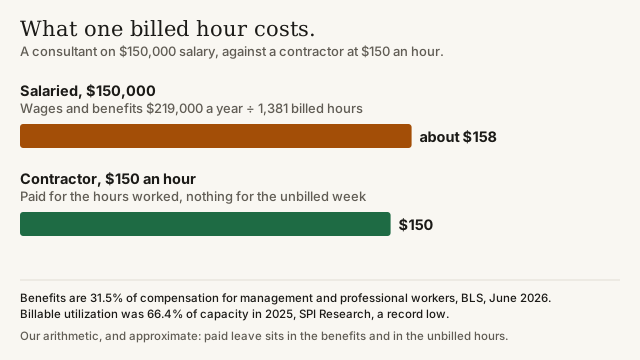
Put the two together and a consultant on a $150,000 salary costs the firm about $219,000 a year and bills about 1,381 hours of 2,080, about $158 of cost for every hour the client pays for. A contractor who prices by James Shore’s rule, $150 an hour for a $150,000 salary, costs $150 per billed hour and nothing in the weeks between clients. The rates look almost the same. The difference is who carries the bench, and for a defense contractor or an engineering firm billing a government client, who carries the audit of those hours too. Rob Black, who built Fractional CISO, wrote down the lesson every firm of eight learns once: hiring ahead of the work, when the firm is missing its revenue plan, “does NOT work”. That is why the second person is so often a contractor, and why the third and fourth are too, until the work is steady enough to carry a salary through a slow month.
David Maister’s ratio of juniors to partners explains the other half, the part a contractor-heavy firm gives up. Matt Alexander of Collective 54 summarized it in December: “The more junior professionals a partner could supervise and bill, the greater the profit per partner.” A boutique of principals and senior 1099s has little of that ratio, since every senior hour costs close to what it bills, and its margin comes from the spread on each hour rather than from a pyramid of juniors. Alexander’s argument is that the tools are becoming the new juniors: “Where human leverage scaled linearly with headcount, AI leverage scales exponentially with data.” Will Hinde, formerly of West Monroe and Accenture, told Consulting Success in August that “the winners have to show up differently and be architected differently, not just find efficiencies but revamp delivery itself.”
In Ceed’s demo account the numbers are simple on purpose. Acme Co is billed at $400 an hour, Tomás is paid $150, and forty approved hours in September make a $16,000 invoice, $6,000 of people cost and a 62.5% cash margin. That is a 167% markup, above the big firms’ “3X” and below jncfhnb’s six. The point is not the level. It is that both numbers come from the same forty hours, and the margin is known before the month ends, which we wrote about in margin per client, this morning.
Paid in thirty days. By law.
The spread has a second job that no price list shows: it has to carry the time between paying the contractor and being paid by the client. Intuit QuickBooks’ 2026 late payments report, from about 5,000 owners a quarter and a December survey of 1,305, found that “Nearly 3 in 5 businesses (59%) have invoices overdue by 30+ days, up from 47% last year”, that businesses with unpaid invoices are owed $17,700 on average, that “42% say outside pressures delayed payments they owed to their own contractors, suppliers, or vendors,” and that “39% say one late payment made it hard to cover payroll or bills in the past year.” Xero’s data had US small businesses waiting 29.3 days to be paid in the June quarter, up from 28.6, and paid 8.5 days late.

Dean Kaplan, who runs a collection agency, named the squeeze in April. At the top, he wrote of agencies, large clients push terms of 60 to 120 days and routinely pay late, and it applies to any firm that sells time. His next sentence is the one that has changed in the last three years: “At the bottom, they increasingly face 30-day legal obligations to pay contractors and risk double-damage penalties if they do not.” What firms do in the gap is not a secret either: “agencies slow payment to vendors and freelancers where they can.”
On Hacker News in April, an owner asked how others handle clients who do not pay on time, and the answers were the cash chain from the inside. Dustin Getz, the founder of Hyperfiddle: “If payments are slowing down and tardiness is increasing, they are not being forgetful, THEY ARE RUNNING OUT OF MONEY,” or “their customer is delinquent and they are aligning payments to transfer that risk to you.” michaelt: “If your contact can’t get a $500 invoice paid, then you’re not talking to someone with the authority to spend $500,000.” SteveStavros: “Switched to requiring 50% upfront for any new client work. Lost a couple of prospects but completely eliminated late payment issues.” And a consultant of twenty years, apercu, described the client every firm has: “there’s a hardcore 10% that will stretch you and stretch you because they can (I’m talking about paying NET 60/90 when the contractual agreement is NET 30).”
The law now sits under the contractor’s side of that chain in four large places. New York State’s Freelance Isn’t Free Act, in force since 28 August 2024, covers a freelancer hired for $800 or more, “Either by itself or when aggregated with all contracts for services between the same hiring party and freelance worker during the immediately preceding one hundred twenty days.” It requires payment on the date in the contract or, if the contract names none, “no later than thirty days after the completion of the freelance worker’s services”, forbids making timely payment conditional on the freelancer accepting less, requires the hiring party to keep the contract “for a period of no less than six years”, and entitles the freelancer to “double damages”. New York City has had its own law since 2017, with “the right to a written contract, the right to be paid timely and in full, and the right to be free of retaliation.” Illinois’ Freelance Worker Protection Act, since 1 July 2024, covers work of $500 or more over 120 days on the same thirty-day default, and its labor department received 24 complaints in the first year, 15 of them alleging late or no payment. California’s law, since 1 January 2025, covers professional services of $250 or more, with a thirty-day default, four years of record keeping and “recovery of up to twice the unpaid amount”. Los Angeles’ ordinance, since 24 April 2023, covers $600 or more in a calendar year, “no later than 30 calendar days after services are rendered,” with damages “up to twice the amount that remains unpaid.”

The obvious defense is a clause that pays the contractor when the client pays the firm. In construction, where these clauses were argued out, New York’s highest court held in 1995 that “Pay-when-paid provisions are void and unenforceable as contrary to public policy,” as Phillips Lytle summarizes West-Fair Electric v. Aetna, and California’s Supreme Court voided pay-if-paid clauses in 1997 in Wm. R. Clarke Corp. v. Safeco, calling them “contrary to the public policy of this state”. Siteline lists California, Delaware, Massachusetts, New York, North Carolina, South Carolina, Virginia and Wisconsin as states that void pay-if-paid. That is construction law, tied to lien rights, and how far it reaches a consulting subcontract is unsettled. What is settled is New York’s freelance statute, which requires the contract to state “the date on which the hiring party must pay” or “the mechanism by which such date will be determined”. Whether a clause keyed to the client’s payment meets that is a question for your attorney. The safer design is not to need one: bill the client from the same approved hours the contractor is paid from, on the same day, so the firm’s float is as short as the client allows. Catalant, the consulting marketplace, advertises the version it can offer, paying consultants “from the date of the client’s approval”.
We wrote in August that the invoice was late first, and for a firm with contractors the point is sharper. Every day between the end of the work and the invoice is a day the firm finances its contractor out of its own cash, with a thirty-day clock running in four jurisdictions and a contract clause the law may not honor. The invoice that goes out on the first of the month, from hours already approved, is the cheapest working capital a small firm has.
Today, in New Jersey.
New Jersey’s Department of Labor adopted its rules on the ABC test on 5 May 2026, and “The new rules will be operative on October 1, 2026.” They apply to the state’s Unemployment Compensation Law, its Wage and Hour Law and its Wage Payment Law, and Blank Rome noted on LinkedIn that the test also governs the state’s earned sick leave and temporary disability benefits laws, “a practical reach far broader than similar regulations in most other states.” The sentence that decides most cases is the one about who proves what: “To be classified as an independent contractor under New Jersey law, the putative employer has the burden of proof to meet all three prongs of the ABC test.”
The Department’s own page puts the test the other way round, with employment as the default: a worker “should be considered an employee unless all the following circumstances apply.” Prong A, the worker “has been and will continue to be free from control or direction over the performance of work performed, both under contract of service and in fact.” Prong B, “The work is either outside the usual course of the business for which such service is performed, or the work is performed outside of all the places of business of the enterprise.” Prong C, the worker “is customarily engaged in an independently established trade, occupation, profession or business.” Its guidance lists what is not enough on its own: registering a business, carrying insurance, holding a professional license, having other clients. Morgan Lewis read it the same way in May: “holding a professional license, having multiple employers, registering a business entity, receiving a 1099 tax form, or carrying insurance are not individually sufficient.”

For a consultancy, prong B is the hard one. A consultant hired to deliver consulting is inside the usual course of a consulting firm’s business, which Saul Ewing described in June as including “activities that the putative employer regularly engages in to generate revenue or develop, produce, sell, market, or provide goods or services.” The other route through prong B is that the work is done outside all of the firm’s places of business, which Ogletree read as “locations where the enterprise has a physical plant or conducts an integral part of its business,” adding that a remote worker’s “personal residence where they perform remote work…shall not be considered among the putative employer’s places of business.” That helps a contractor who works from home. It helps less a contractor who works at the client’s site beside the firm’s own people, and it does nothing for the first route. Douglas Nelson, an attorney, put the result in a sentence on 12 September: “A delivery business cannot easily treat drivers as contractors, and a consulting firm cannot easily do so with consultants.”
The penalties are real enough to plan around. The Department lists “Up to 5 percent of the worker’s gross earnings over the past 12 months as a penalty,” along with a “Stop work order, the suspension or revocation of any one or more licenses held by the employer.” Porter Thomas Grabell & Baumwoll summarized the per-worker penalties in August as “up to $250 per misclassified worker for a first violation and up to $1,000 per worker for subsequent violations,” in a piece on the state’s July settlement with STG Logistics, $2.775 million in all. Duane Morris told employers on 25 September to audit their contractor relationships before today, and Richard Reibstein, who writes a blog on independent contractor compliance, called the final version “one of the most business-unfriendly tests for IC status in the country.”
“Codification of this rule by the NJ Department of Labor will continue to make NJ an unfriendly place for businesses to call home.”
John L. Shahdanian II, an employment attorney, on LinkedIn, 27 May 2026.
The other side has its say. The acting labor commissioner, Kevin D. Jarvis, said of the final rule, “We heard from New Jersey’s business community and workers,” and a law firm headlined its summary “A Measured Retreat, Not a Reset.” The final text changed from the 2025 proposal after the comments, the Department says. It kept the burden on the firm. NJ Spotlight News asked in August 2025 whether the state’s gig workers would be hurt by it, and the arguments in that report are the same ones a consultancy will hear from its own contractors this autumn.
The rest of the map.
New Jersey is the news today, and it is not alone. California’s ABC test has a business-to-business exemption with twelve conditions, and the third is the one a consultancy that places a contractor with its client runs into: the provider must provide services “directly to the hiring entity rather [than] to its customers”, in the Labor Commissioner’s words. The professional services exemption lists fields such as marketing, graphic design and grant writing, and management consulting is not on it. Consulting appears in the referral agency exemption. Licensed attorneys, architects, engineers, private investigators and accountants are exempt on their own terms, which matters to law firms and accounting practices, and where an exemption applies the older Borello test decides. Massachusetts reads its second prong strictly: “A worker whose services form a regular and continuing part of the employer’s business should be found to be an employee,” in the Attorney General’s advisory, which also notes that the statute “authorizes the Attorney General to impose substantial civil and criminal penalties.”
The federal test is loosening, and it is still a proposal. The Department of Labor announced its proposed rule on 26 February 2026, the comment period closed on 28 April, and on 28 September a Federal Register search returned only the proposal. It rests on two core factors, “the nature and degree of the worker’s control over the work” and “the worker’s opportunity for profit or loss based on initiative and/or investment”, and the SBA’s Office of Advocacy estimated it would save small businesses $2.31 billion over ten years. Eighteen states wrote in April that under it “more employers would classify workers as independent contractors.” And the Department’s own answer to the question every New Jersey firm will ask: the rule “has no effect on those state wage-and-hour laws that use a more restrictive test, such as the ‘ABC’ test applied in California and New Jersey.” The strictest test that applies to a worker is the one that applies.
The tax side changed in January. “For payments made in 2026, the reporting threshold is $2,000,” where it had been $600, and the Internal Revenue Service will adjust it for inflation from 2027. Backup withholding moved to the same threshold. The forms for 2026 are due by 31 January, which in 2027 is a Sunday, so the due date is Monday, 1 February 2027. Payments to a corporation, including an LLC taxed as a C or S corporation, generally still need no form, with exceptions such as attorneys’ fees. None of it changes three things: the W-9 you collect before the first payment, the fact that the income is taxable whether or not a form is filed, and the IRS’s own test of who is a contractor, which asks about behavioral control, financial control and the relationship, and which a firm or a worker can ask the IRS to decide with Form SS-8. Form 1099-K, for payments through card processors and payment apps, is back to its old threshold, payments to a payee above $20,000 in more than 200 transactions.
Across the Atlantic, the United Kingdom’s off-payroll rules follow the client’s size, and the new small-company thresholds of more than £15 million of turnover and £7.5 million of balance sheet first change a client’s status in the 2027 to 2028 tax year, by HMRC’s own manual. A small client in the private sector does not decide a contractor’s status at all. A global consulting firm with contractors in both countries lives under both calendars.
The file they will ask for.
Every one of these rules ends in the same request, from a buyer, an auditor or a state, and it is for a file. CT Acquisitions, which advises consulting firms on their sale, tells owners that buyers look for sub-consultant capacity “under 15% of delivery hours done by 1099”, with a “documented classification rationale”, and warns that owners “find out 90 days into diligence that their adjusted EBITDA is 25% to 50% lower than what their tax returns show”. The Defense Contract Audit Agency’s guidance to contractors says why hours need a record of their own: “Unlike other costs, labor is not supported by external documentation or physical evidence to provide an independent check or balance.” New York wants the freelance contract kept six years, California and Los Angeles four, and New Jersey leaves the burden of proof with the firm, which in practice means the file.
The file is not long. The signed contract, with the payment date or the mechanism for it. The W-9. The contractor’s invoices or payout statements. The hours, tied to the client work they were for, with a description a stranger could read. Proof of payment and its date. And a short written rationale for the classification, prong by prong where a state uses the ABC test. The operators who check contractor hours for a living want the same thing in their own words. Shawn Jahromi, who runs a management consulting firm, told Clockify: “When an invoice arrives, we check alignment between story, tickets, and calendar, not minutes.” Guillermo Triana, who runs a professional employer organization, halved his review time by asking contractors to replace a vague “marketing” with entries like “2.3 hrs → wrote 800-word email series → launch 12/4”. And the contractors want to see it too. In Buddy Punch’s 2025 survey of 534 workers, 47% wanted “access to their own time tracking records”, and 30% said time tracking “feels like surveillance”.
The other side of the invoice.
The contractor has a case against all of this, and the strongest version of it comes from the Economic Policy Institute, which wrote in April that “Workers misclassified as independent contractors also must assume the full financial cost of Social Security and Medicare contributions, rather than split it evenly with their employer,” and lose unemployment insurance and workers’ compensation with it. Put bluntly, part of a firm’s margin on a 1099 can be the worker’s lost benefits. That is true, and it is the point of New Jersey’s rule. A contractor who works like staff, on the firm’s core service, under the firm’s direction, is what New Jersey, Massachusetts and California treat as an employee, and a firm that builds its margin on that arrangement has built it on a liability.
How America Built a 1099 System Designed to Exploit Drivers
The problem is the massive gray zone between W-2 employees and legitimate independent contractors, where carriers have created classification schemes designed to evade employment law while maintaining complete control over drivers.
The senior independents in this post mostly chose the life, and they price the bench in themselves. MBO found 78% planning to stay independent or build a larger business, and James Shore’s rule doubles the salary for a reason. The firm’s spread has to pay for something the contractor could not get alone, and when it does not, the contractor notices. On Hacker News in February ethbr1 said what many subcontractors think of the firm in the middle, “Often agencies are just skimming their percentage without adding real value to the project,” and then, in the same comment, what the client is actually buying: “This is actually what most VPs are paying for: being able to pick up a phone and chew IBM GCS, TCS, CG, etc. out when the schedule slips.” Liz Steblay calls subcontracting “a stepping stone rather than a long-term strategy”. The spread pays for the client, the sale, the accountability and, under the thirty-day laws, the float.
Fractional work has its critics among buyers too. In an August thread on hiring a fractional team, kypro wrote that “issues which could be resolved in hours by a team that’s full-time tend to drag on for days with a fractional workforce,” and make_it_sure that the fractional hires they tried “performed much much worse than a dedicated full time hire.” A fractional CFO in the same thread, desktopentree, drew the line that matches our experience: “Fractional service works for functions that are judgment-dense and cadence-light.” A principal with senior contractors fits advisory work and short, expert engagements, the shape of most professional advisors and data and AI consultancies. It does not fit every kind of delivery, and the record of hours and margin per client is how a firm finds out which kind it is doing.
One set of hours. Two rates.
Everything above turns on one fact about a firm with contractors. The same hour appears twice, once on the client’s invoice at the bill rate and once on the contractor’s statement at the pay rate. When the two are computed from different records, a timesheet here and a spreadsheet there, the firm has two versions of the month and a reconciliation to do before anyone is paid. This is the part of a firm Ceed keeps.
A person logs an hour once, against the client’s budget, from one Slack reminder a day, and the invoice, the payouts, the margin and the close all come from that entry. The client’s invoice is computed from the agreement at the client’s rate by tier. The contractor’s statement is computed from the same approved entries at the contractor’s own rate. There is no second record to reconcile against, because there is no second record.
Both lines from the same forty approved hours. The client sees the first, Tomás sees the second, and the owners see all three.
A contractor who works for two clients gets one statement from the hours both invoices used. This is the card on our home page, from the demo account, and it is the whole idea in four lines.
The same 100.5 hours the two invoices used. Your payment rail moves the money.
Each person sees their own record. The contractor logging an hour in Ceed sees their own hours and their own pay for the day, the thing 47% of Buddy Punch’s respondents asked for, and nothing about anyone else’s. Rates and margin are visible only to the owners and the people they name, enforced on the server, and the client sees what the agreement puts on the invoice, as the home page says under the client sees the fee.
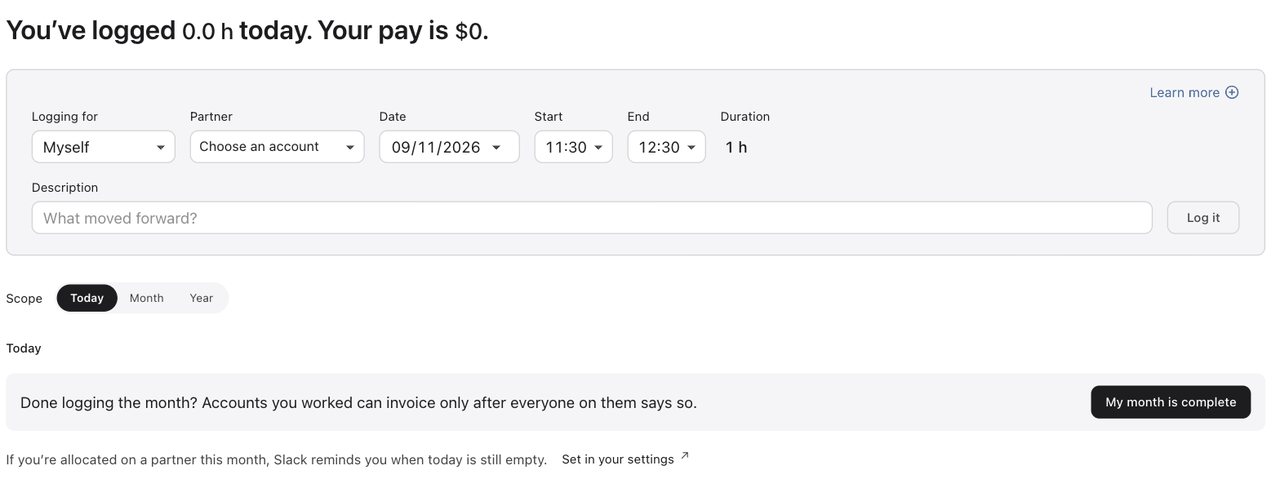
The cash chain gets shorter. The month cannot invoice until everyone who worked on an account has marked their month complete, the invoice waits as a draft until an owner approves it, and then it freezes. The hours approved in September can be on September’s invoice on the first of October and on the contractor’s statement the same day, so the float between paying the contractor and being paid by the client starts at the client’s terms and not at the firm’s paperwork. And the hour that would push a client past its budget waits for a person’s yes or no, so the question of who pays for it is answered on the day, with a name on it, and not at the invoice.
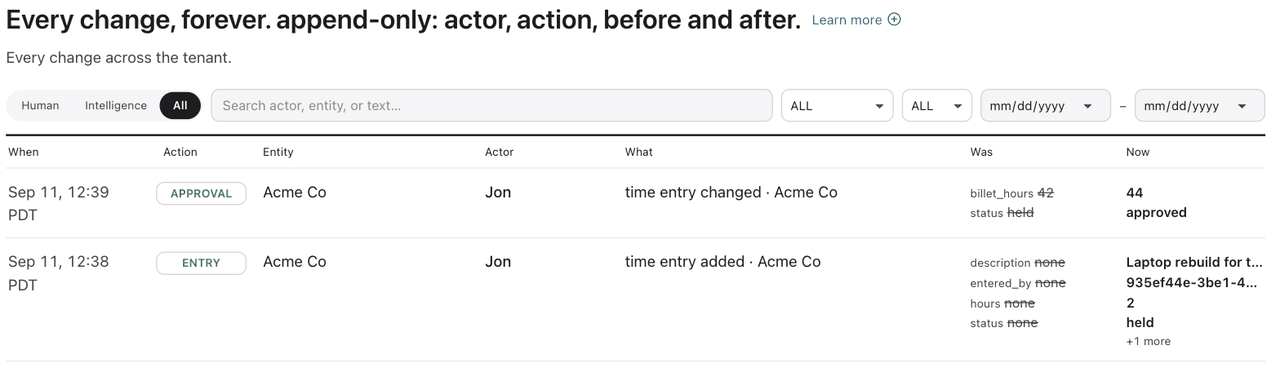
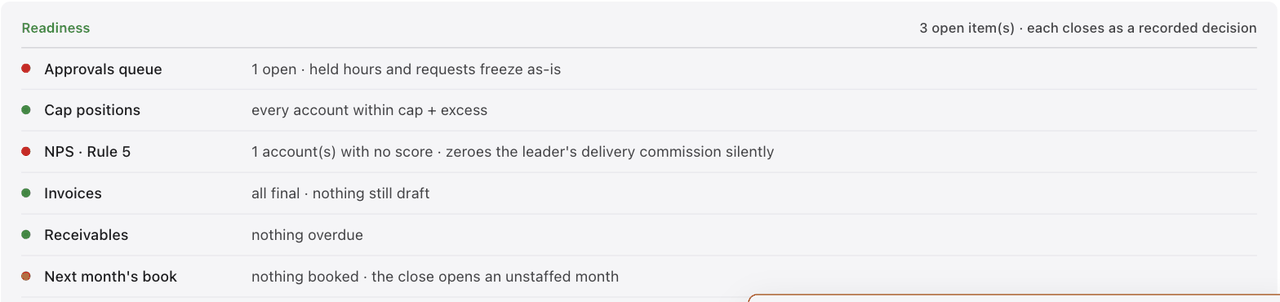
The file keeps itself. Every change is on an append-only trail with the actor, the action and the value before and after, closed months do not change, and the dated work beneath each invoice is the record of hours tied to client work that a buyer, an auditor or a state will ask for. The month close lists what is still open, held hours included, before it records the month as final.
Bringing the people in is a reading, not a data entry job. Ceed Intelligence reads a firm’s people list, its W-2s and 1099s, its client list and the agreements it signed, and proposes the people, the contractors, the clients and the budgets it found. The firm confirms them all at once or row by row, every record it added says so, and the rates and other money terms wait for a yes one by one.
The money moves where it moves today. Your bank and your payroll provider pay your people, and Ceed never touches the money. And the second person costs nothing to add. Ceed is 0.1% of what you invoice, with no seats and no minimum, so person number two and person number nine log their first hour on the same terms. Where Ceed stands beside the time trackers and the suites is on the comparison page, and we went through the row on payouts and commissions in Ten rows. One engagement.
What the books say.
Six books, two on the economics of a firm of experts, three from the independent’s side, and one on the cash between them.
- Managing the Professional Service FirmDavid H. Maister, 1993. The economics of a firm of experts, including the ratio of juniors to partners, which a boutique of principals and senior contractors turns inside out.
- The Gig EconomyDiane Mulcahy, 2016. The independent’s own arithmetic: the bench, the benefits, and the rate that has to pay for both.
- Free Agent NationDaniel H. Pink, 2001. The first account of the free agent as a class, twenty-five years before MBO counted 74.9 million of them.
- The Freelancer’s BibleSara Horowitz with Toni Sciarra Poynter, 2012. The Freelancers Union founder’s manual for the contractor’s side, contracts and getting paid included, and the lineage of the laws in this post.
- Humans as a ServiceJeremias Prassl, 2018. The legal case for treating much contract work as employment, the strongest book against the arrangement this post describes.
- Profit FirstMike Michalowicz, 2017. Cash management for small firms, which is the cash chain seen from the owner’s bank account.
Three conversations about who does the work.
The firm behind Ceed also hosts The Security Podcast of Silicon Valley, 104 conversations since 2021 with the people who build and run security. Three of them are about the people who do the work and how they come to do it: a recruiter, a CISO building a team, and a CISO by the fraction.
- 46
Polina Morozov, security recruiter at GrammarlyJune 2024 · From Robinhood to Grammarly, and what connects senior talent with the work.
- 2
Andrew Gontarczyk, CISO of Pure StorageMay 2021 · When a company should build a security team and what kinds there are, the hire or contract question at a larger scale.
- 7
Michael Brooks, vCISO at TravaAugust 2021 · The virtual CISO, the senior contractor model that security consultancies sell.
Ceed is for firms that sell their team’s time: fractional CFO, CISO, CMO and CTO practices, security and IT boutiques, staff augmentation and healthcare staffing firms, engineering firms, consultancies and agencies up to fifty people. If your second person is a contractor, sign up and pay them from the same hours you bill. Nothing to pay until your first invoice.
Sign upOr write to hello@ceed.so.
Questions.
Do I need to send a 1099 if I paid a contractor less than $2,000 in 2026?
Not a federal Form 1099-NEC. For payments made in 2026 the Internal Revenue Service threshold is $2,000, up from $600, and it will be adjusted for inflation from 2027. Keep collecting a W-9 before the first payment and keep a running total for each payee, because the threshold is per year and the income is taxable either way. States can have their own rules, so check with your accountant. Forms for 2026 payments are due by Monday, 1 February 2027, because 31 January is a Sunday. This is not tax advice.
Do I need to send a 1099 to an LLC?
It depends on how the LLC is taxed. Payments to a corporation, including an LLC taxed as a C or S corporation, generally need no Form 1099-NEC, with exceptions such as payments to attorneys. An LLC taxed as a sole proprietorship or a partnership generally does. The W-9 you collect before the first payment tells you which, which is one more reason to collect it then. Ask your accountant about your own case.
Can a consulting firm pay consultants as 1099 contractors in New Jersey?
Only if it can prove all three prongs of the ABC test, and from 1 October 2026 the Department of Labor’s rules say so in writing. Prong B is the hard one for a consultancy, because consulting is the firm’s usual course of business, so the firm has to show the work is done outside all of its places of business. A professional license, a registered business, a 1099 or insurance is not enough on its own. Ask an employment attorney before you rely on it.
What percentage of the bill rate should a subcontractor get?
There is no rule, only conventions. Boutiques and agencies typically keep 30% to 50% of a subcontractor’s billings, 35% on average by one coach’s count, and consulting networks keep 20% to 30% or more. Keeping 35% means paying the contractor 65%, a 54% markup. The right split pays for what the firm adds, the client, the sale, the accountability and the time between paying the contractor and being paid, and leaves a margin you can see per client.
Can I pay my contractor only after my client pays me?
Be careful. New York State, New York City, Illinois, California and Los Angeles give freelancers the payment date in the contract, or thirty days after the work if none is set, with double damages in several of them, and New York forbids making timely payment conditional on accepting less. In construction several states void pay-if-paid clauses, and how far that reaches consulting is unsettled. Ask your attorney, and shorten the gap instead: invoice the client from the same approved hours the contractor is paid from, on the same day.
Does Ceed pay our contractors?
No. Ceed computes each contractor’s payout statement from the same approved hours as the client’s invoice, at the contractor’s own rate, and your bank or payroll provider moves the money. The owners see the bill rate, the pay rate and the margin per client every morning, the contractor sees their own hours and pay, and the client sees what the agreement puts on the invoice. Ceed costs 0.1% of what you invoice, with no seats, so adding a contractor costs nothing.
 Jon McLachlan is a co-founder of Ceed and of YSecurity, where the person who logs an hour and the client who pays for it see the same record from two sides. Published 1 October 2026. Corrections to hello@ceed.so, and they are dated when made.
Sources
- New Jersey Department of Labor and Workforce Development, press release on the ABC test rules, 5 May 2026, https://www.nj.gov/labor/lwdhome/press/2026/20260505_ABC.shtml. Its page on independent contractors, https://www.nj.gov/labor/myworkrights/worker-protections/independent_contractors/, and its guidance on the application of the ABC test, https://nj.gov/labor/assets/PDFs/Legal%20Notices/Application%20of%20the%20ABC%20Test.pdf. The adopted rule, N.J.A.C. 12:11, 58 N.J.R. 1587(a), https://nj.gov/labor/assets/PDFs/Legal%20Notices/Rule%20Adoptions/58%20N.J.R.%201587_a_.pdf. Every source below was read on 28 September 2026 unless another date is given.
- Gusto, “Not So Solo”, 28 April 2026, https://gusto.com/resources/gusto-insights/72b-solopreneur-economy-2026 (read 27 September 2026), and its 2025 report on new solopreneurs, 31 July 2025, https://gusto.com/resources/gusto-insights/new-business-formation-solopreneurs-2025.
- Accounting Today, “KPMG lays off 10% of US audit partners”, 24 April 2026, https://www.accountingtoday.com/news/kpmg-lays-off-10-of-us-audit-partners (read 27 September 2026). On KPMG’s advisory cuts, 4 May 2026, via Yahoo Finance, https://finance.yahoo.com/economy/policy/articles/big-four-firm-cuts-100s-024700163.html.
- Maria Ward-Brennan and Rosie Harris-Davison, City AM, 27 April 2026, https://www.cityam.com/golden-partnership-perks-not-anymore-say-the-big-four/, and City AM, 24 April 2026, https://www.cityam.com/big-four-giant-kpmg-downgrades-equity-partners/.
- McKinsey’s size: Fortune, 29 May 2025, https://fortune.com/2025/05/29/mckinsey-headcount-down-more-than-10-percent, and Business Insider via Yahoo Finance, 7 January 2026, https://finance.yahoo.com/news/mckinseys-ceo-breaks-down-ai-100301404.html. Accenture, fourth quarter and full year fiscal 2025 results, https://newsroom.accenture.com/content/4q-full-fy25-earnings/accenture-reports-fourth-quarter-and-full-year-fiscal-2025-results.pdf, The Register, 26 September 2025, https://www.theregister.com/2025/09/26/accenture_ai_jobs/, and the date of its fiscal 2026 results, https://www.businesswire.com/news/home/20260915357288/en/Accenture-to-Announce-Fourth-Quarter-and-Full-Year-Fiscal-2026-Results. TheStreet on Deloitte’s benefits, 24 April 2026, https://www.thestreet.com/markets/big-four-accounting-faces-reckoning-theyre-choosing-ai-over-humans-cutting-benefits-and-hiring.
- MBO Partners, State of Independence 2026, 28 September 2026, https://www.prnewswire.com/news-releases/mbo-partners-by-beeline-us-independent-workforce-reaches-record-74-9-million-as-full-time-independence-accelerates-302890957.html. Upwork, Future Workforce Index 2026, 14 July 2026, https://www.globenewswire.com/news-release/2026/07/14/3326964/0/en/Upwork-s-Future-Workforce-Index-2026-How-AI-is-Redefining-the-Value-of-Work-as-Skilled-Freelancing-Accelerates.html, and its freelancing statistics, https://www.upwork.com/resources/freelancing-stats.
- Fractional Jobs, “Fractional hiring surges 149%”, 18 August 2026, https://www.prweb.com/releases/fractional-hiring-surges-149-as-businesses-rethink-the-full-time-standard-report-302852670.html, The Fractional Work Report, https://www.fractionaljobs.io/the-fractional-work-report, its FAQ, https://www.fractionaljobs.io/faq (read 12 September 2026), and Taylor Crane on retainers, 24 February 2026, https://www.fractionaljobs.io/help/should-i-charge-an-hourly-rate-a-monthly-retainer-or-something-else. Heidrick & Struggles, 2026 on-demand talent report, https://www.heidrick.com/en/perspectives/on-demand-talent/2026-talent-report.
- Umbrex Unleashed, episode 651 with Chad Oakley, https://umbrex.com/unleashed/651-current-state-of-the-consulting-market-in-2026/ (read 27 September 2026). Umbrex, “Bill Rates, Margins, and Value”, https://umbrex.com/resources/the-consulting-career-guide/bill-rates-margins-and-value-capture/. Storyboard18 on McKinsey’s hiring, https://www.storyboard18.com/brand-marketing/mckinsey-counters-ai-job-fears-with-12-graduate-hiring-boost-in-2026-80845.htm. Poets&Quants, 1 July 2026, https://poetsandquants.com/2026/07/01/the-mbb-arent-hiring-fewer-mbas-theyre-hiring-different-ones/. PwC, on agentic AI and workforce redesign, 29 January 2026, https://www.pwc.com/us/en/tech-effect/ai-analytics/agentic-ai-workforce-redesign.html.
- Hacker News: “Have McKinsey and its consulting rivals got too big?”, 19 October 2024, 168 points and 179 comments, https://news.ycombinator.com/item?id=41888061, with candiddevmike, https://news.ycombinator.com/item?id=41888801, whatever1, https://news.ycombinator.com/item?id=41888842, jncfhnb, https://news.ycombinator.com/item?id=41888918, and FredPret, https://news.ycombinator.com/item?id=41890052. “Show HN: Fractional jobs”, 18 August 2025, https://news.ycombinator.com/item?id=44945379, with jdlshore, https://news.ycombinator.com/item?id=44947751, and the-alchemist, https://news.ycombinator.com/item?id=44957656. “A layoff fundamentally changed how I perceive work”, 27 January 2025, https://news.ycombinator.com/item?id=42838700, with natbennett, https://news.ycombinator.com/item?id=42847475. “Show HN: Software Freelancers Contract Template”, 22 September 2025, https://news.ycombinator.com/item?id=45330198, with baobabKoodaa, https://news.ycombinator.com/item?id=45331471.
- Hacker News: “Ask HN: How do you handle clients who don’t pay on time?”, 4 April 2026, https://news.ycombinator.com/item?id=47638685, with dustingetz, https://news.ycombinator.com/item?id=47638781, michaelt, https://news.ycombinator.com/item?id=47639699, and SteveStavros, https://news.ycombinator.com/item?id=47639650. “No Pay, No Work; Early Career Lessons”, 10 April 2025, https://news.ycombinator.com/item?id=43639871, with apercu, https://news.ycombinator.com/item?id=43642734. The Wall Street Journal on white-collar recruiting, 9 February 2026, https://news.ycombinator.com/item?id=46941850, with ethbr1, https://news.ycombinator.com/item?id=46945419. “Ask HN: What is a good advice for someone looking to fractional hire a team?”, 7 August 2026, https://news.ycombinator.com/item?id=49208975, with kypro, https://news.ycombinator.com/item?id=49209815, make_it_sure, https://news.ycombinator.com/item?id=49212460, and desktopentree, https://news.ycombinator.com/item?id=49222778.
- Liz Steblay, Successful Independent Consulting, 28 January 2025, https://www.successfulindependentconsulting.com/blog/your-guide-to-subcontracting-as-an-independent-consultant. Victor Valentine Romo, 8 February 2026, https://victorvalentineromo.com/articles/subcontracting-consulting-practice/. David Zhao, Codastrat, 29 March 2022, https://codastrat.com/how-to-navigate-life-in-the-independent-consulting-networks/. LevelCFO, staffing benchmarks, April 2026, https://levelcfo.com/benchmarks/staffing/. Staffing Industry Analysts, Sharon Thomas, 18 July 2022, https://www.staffingindustry.com/editorial/staffing-industry-review/gross-margins.
- Bureau of Labor Statistics, Employer Costs for Employee Compensation, June 2026, released 9 September 2026, https://www.bls.gov/news.release/ecec.nr0.htm, and its Table 4, https://www.bls.gov/news.release/ecec.t04.htm. SPI Research’s 2026 benchmark as summarized by Deltek, 30 July 2026, https://www.deltek.com/resources/articles/professional-services-benchmarks/. Rob Black, Fractional CISO, 29 November 2023, https://fractionalciso.com/77-months-in-what-i-learned-starting-a-cybersecurity-company/. Matt Alexander, Collective 54, 8 December 2025, https://www.collective54.com/blogs/ai-and-the-new-leverage-model-for-professional-services/. Consulting Success, podcast 386 with Will Hinde, 17 August 2026, https://www.consultingsuccess.com/building-a-consulting-model-to-stay-competitive-in-the-ai-era-with-will-hinde-podcast-386.
- Intuit QuickBooks, 2026 Small Business Late Payments Report, 7 July 2026, https://quickbooks.intuit.com/r/small-business-data/small-business-late-payments-report-2026/. Xero, invoice payment times, 20 August 2026, https://www.xero.com/us/guides/invoice-payment-times/, and Small Business Insights, June quarter 2026, https://www.xero.com/us/resources/small-business-insights/latest-united-states/. Dean Kaplan, The Kaplan Group, 13 April 2026, https://www.kaplancollectionagency.com/business-advice/trickle-down-debt-how-late-client-payments-to-agencies-cascade-onto-freelancers/.
- New York State, Freelance Isn’t Free Act, General Business Law Article 44-A, bill S5026 of 2023, https://www.nysenate.gov/legislation/bills/2023/S5026, and the Department of Labor’s page, https://dol.ny.gov/freelance-isnt-free-act. New York City’s Freelance Isn’t Free Act, https://www.nyc.gov/site/dca/businesses/freelance-isnt-free-act.page. Illinois Department of Labor, Freelance Worker Protection Act FAQ, https://labor.illinois.gov/faqs/freelance-worker-protection-act.html, and its first annual report, 1 July 2025, https://labor.illinois.gov/content/dam/soi/en/web/idol/laws-rules/legal/documents/freelance-worker-protection-act/Freelance%20Worker%20Protection%20Act%20Report%20-%20July%201%202025.pdf. Gunderson Dettmer on California’s Freelance Worker Protection Act, 19 December 2024, https://www.gunder.com/en/news-insights/insights/client-insight-californias-freelance-worker-protection-act-takes-effect-on-january-1-2025. City of Los Angeles, Freelance Worker Protections Ordinance, https://wagesla.lacity.gov/sites/g/files/wph1941/files/2025-03/Freelance%20Worker%20Protections%20Ordinance.pdf.
- Erin C. Borek, Phillips Lytle, 18 October 2022, https://phillipslytle.com/borek-pay-when-paid-provisions-still-unenforceable-in-nys/. Levelset on California’s pay-if-paid rule, https://www.levelset.com/blog/pay-when-paid-and-pay-if-paid-clauses-in-california/. Siteline, updated 23 July 2026, https://www.siteline.com/blog/pay-if-paid-vs-pay-when-paid-what-you-need-to-know. Catalant, for independent consultants, https://catalant.com/for-independent-consultants/.
- On New Jersey’s rule: Ogletree, 4 June 2026, https://ogletree.com/insights-resources/blog-posts/new-jersey-issues-controversial-final-regulations-on-abc-test-for-independent-contractor-status/. Saul Ewing, 3 June 2026, https://www.saul.com/insights/blog/njdol-abc-test. Morgan Lewis, May 2026, https://www.morganlewis.com/pubs/2026/05/new-jersey-adopts-final-independent-contractor-regulations. Douglas Nelson, 12 September 2026, https://www.mnlawllc.com/post/new-jersey-s-abc-test-was-always-this-strict-now-it-is-written-down. Duane Morris via Mondaq, 25 September 2026, https://www.mondaq.com/unitedstates/employee-benefits-compensation/1847104/new-jersey-employers-should-prepare-now-for-the-independent-contractor-rule-effective-october-1-2026. Richard Reibstein, 22 September 2026, https://www.independentcontractorcompliance.com/2026/09/22/dont-overlook-the-nationwide-implications-of-the-upcoming-independent-contractor-regulation-in-new-jersey/, quoted from the blog’s index page. Porter Thomas Grabell & Baumwoll, 27 August 2026, https://www.ptgb-law.com/2026/08/27/new-jerseys-crackdown-on-independent-contractor-misclassification-what-employers-need-to-know/. JDSupra’s listing of commentary on the rule, https://www.jdsupra.com/topics/misclassification/new-jersey.
- California Labor Commissioner, independent contractor FAQ, June 2026, https://www.dir.ca.gov/dlse/faq_independentcontractor.htm. Massachusetts Attorney General, Advisory 2008/1 on the independent contractor law, https://www.mass.gov/doc/attorney-generals-advisory-on-the-independent-contractor-law/download.
- US Department of Labor, 2026 rulemaking on employee or independent contractor status, https://www.dol.gov/agencies/whd/flsa/misclassification/2026rulemaking, and its FAQ, https://www.dol.gov/agencies/whd/flsa/misclassification/2026rulemaking/faqs. The proposal in the Federal Register, 27 February 2026, https://www.federalregister.gov/documents/2026/02/27/2026-03962/employee-or-independent-contractor-status-under-the-fair-labor-standards-act-family-and-medical. SBA Office of Advocacy, 3 March 2026, https://advocacy.sba.gov/2026/03/03/dol-proposes-new-independent-contractor-rule/. The joint comment of eighteen states, 27 April 2026, https://www.pa.gov/content/dam/copapwp-pagov/en/dli/documents/laws-regs/laws/documents/updated%20comment%20coalition%20April%2029%202026.pdf.
- Internal Revenue Service: “Am I required to file a Form 1099 or other information return?”, https://www.irs.gov/businesses/small-businesses-self-employed/am-i-required-to-file-a-form-1099-or-other-information-return. Instructions for Forms 1099-MISC and 1099-NEC, https://www.irs.gov/instructions/i1099mec. The Form 1099-K threshold, 23 October 2025, https://www.irs.gov/newsroom/irs-issues-faqs-on-form-1099-k-threshold-under-the-one-big-beautiful-bill-dollar-limit-reverts-to-20000. Independent contractor or employee, https://www.irs.gov/businesses/small-businesses-self-employed/independent-contractor-self-employed-or-employee, and the instructions for Form SS-8, https://www.irs.gov/pub/irs-pdf/iss8.pdf. The 1 February 2027 due date is our reading of the rule for weekends.
- HM Revenue & Customs, Employment Status Manual ESM10006A, updated 22 July 2026, https://www.gov.uk/hmrc-internal-manuals/employment-status-manual/esm10006a, and off-payroll working for clients, https://www.gov.uk/guidance/off-payroll-working-for-clients.
- CT Acquisitions, on preparing a consulting firm for sale, https://ctacquisitions.com/prepare-your-business-for-sale/consulting-firm-exit/ (read 27 September 2026). Defense Contract Audit Agency, Information for Contractors, 14 November 2023, https://www.dcaa.mil/Portals/88/Documents/Guidance/CAM/Information%20For%20Contractors%20DCAAM%207641_90.pdf. Clockify, “Track Contractor Hours With Clockify”, 16 December 2025, https://clockify.me/blog/tracking-time/track-contractor-hours/. Buddy Punch, time tracking and trust, 2025, https://buddypunch.com/research-insights/time-tracking-and-trust-what-todays-employees-really-think/ (both read 12 September 2026).
- Economic Policy Institute, Ismael Cid-Martinez, Nina Mast, Margaret Poydock and Valerie Wilson, 15 April 2026, https://www.epi.org/publication/misclassifying-workers-as-independent-contractors-is-costly-for-workers-and-social-insurance-systems/.
- Posts on LinkedIn, read in a browser on 28 September 2026: Taylor Crane, 16 February 2026, https://www.linkedin.com/posts/taylorcrane_how-much-fractional-executives-actually-cost-activity-7429201119370698753-sF-W. Blank Rome, 12 May 2026, https://www.linkedin.com/posts/blank-rome-llp_newjersey-employmentlaw-employers-activity-7460044248214618113-KtIH. John L. Shahdanian II, 27 May 2026, https://www.linkedin.com/posts/john-l-shahdanian-ii-esq-7ba4506_the-abc-test-for-independent-contractors-activity-7465390180934283264-OTpQ.
- Posts on X, read in a browser on 28 September 2026, dates in UTC: Financial Times, 23 April 2026, https://x.com/FT/status/2047347949118615893. Robert Sterling, 23 April 2026, https://x.com/RobertMSterling/status/2047401016794972672. Amanda Goodall, 23 April 2026, https://x.com/Amanda_Goodall/status/2047367049891238259. Rob Carpenter, 2 February 2026, https://x.com/RobCarpenter/status/2018376592494354466.
- Recordings on YouTube, with view counts as read on 28 September 2026: Hidden Ledger, 18 July 2026, https://www.youtube.com/watch?v=HU8el3qsiVU. The Accounting Podcast, episode 485, 29 April 2026, https://www.youtube.com/watch?v=EBjX65XN620. The CFO Report, 9 December 2025, https://www.youtube.com/watch?v=LxlV9_lVx48. Consulting Success, 11 November 2020, https://www.youtube.com/watch?v=T26F1W7m-jM. Contractor Growth Network, 14 April 2022, https://www.youtube.com/watch?v=UsFT-YO0edY. Worksome with Rafael Espinal, 2 August 2024, https://www.youtube.com/watch?v=i_6D2WUXqc4. Talbert Law Office, 2 October 2024, https://www.youtube.com/watch?v=VSnesCiQ6vY. NJ Spotlight News, 6 August 2025, https://www.youtube.com/watch?v=ghHoAm1hohQ. The Legal Lineup with Anthony Zaller, 17 May 2018, https://www.youtube.com/watch?v=nP17qb4M8cc. Jamie Trull, 14 January 2026, https://www.youtube.com/watch?v=K6vb8yPpp4Y. Ginny Silver, 23 January 2022, https://www.youtube.com/watch?v=IiGI8YSmoJ4. Sherman, My CPA Coach, 1 April 2024, https://www.youtube.com/watch?v=EW-lnxIZ6qg.
- Product pictures are of Ceed’s staging environment in September 2026, showing a demo account with invented names and figures. The two drawn cards use the same demo account, and the second is the one on the Ceed home page.
- The Security Podcast of Silicon Valley, a YSecurity production: episode 46 with Polina Morozov, 6 June 2024, https://ysecurity.io/podcast/46-polina-morozov-security-recruiter-at-grammarly-on-navigating-and/. Episode 2 with Andrew Gontarczyk, 17 May 2021, https://ysecurity.io/podcast/2-andrew-gontarczyk-ciso-of-pure-storage-building-a-security-team/. Episode 7 with Michael Brooks, 10 August 2021, https://ysecurity.io/podcast/7-michael-brooks-vciso-and-director-of-cyber-risk-services-at/. YSecurity’s description of itself, https://ysecurity.io/.