Blog · 29 September 2026 · Sasha Sinkevich
Fewer hours. Same margin.
The email has a name in 2026. The client read that AI makes the work faster and would like a share of the saving. This post answers it from the firm’s own numbers: who is asking and how often, what the saving is and is not, who owns an hour a tool saved, the new line on the cost side, and one client’s month worked through four ways, with the arithmetic. With twelve recordings, five posts from X, the Hacker News threads, seven figures, pictures of the product, eight books and three episodes of The Security Podcast of Silicon Valley. Correct as far as we know on 28 September 2026.
The email is polite. It tends to arrive in the autumn, when next year’s budgets are set, and it usually comes from someone who has just read the article you read. The work is faster now, it says, because of AI, and some of that saving should come back to us. It rarely names a number. It does not have to, because the owner who reads it already knows her own number, roughly, and is doing the arithmetic before she has finished the second paragraph.
On 31 August 2026 the Financial Times reported that consultants were heading for a showdown with their own clients. Greg Meyers, the chief digital and technology officer of Bristol Myers Squibb, told the paper that “in our cyber security area, we used to pay a lot of third parties to monitor things on our behalf. Now AI is doing a lot of that monitoring and those contracts are going away.” He did not object to the firms making money from the tools. “I’m totally fine for this to be margin-expanding for them as long as we get to participate in the downside.” For a managed security provider that first sentence is the whole email. In the same piece UniCredit reported a 24 per cent drop in its spending on external consultants and Société Générale a 9 per cent decline, and Mark Barrocas of SharkNinja said, “We are definitely spending less with consultants.”
The biggest firms are on the receiving end too. In February the same paper reported that KPMG had pressed its own auditor, Grant Thornton UK, to cut the fee by about 14%, from $416,000 to $357,000, on the grounds that AI was making the audit cheaper to do. Grant Thornton’s reply is the most useful sentence in the first half of this post: “our fees reflect both the cost of our people and the cost of the technology that supports them.” In August, Reuters reported that the clients of Persistent Systems, one of India’s large service firms, were demanding the same work for 25% to 30% less while expecting faster delivery, according to its chief executive.
It is not only consulting. At the start of September the Financial Times reported that Wall Street banks were pressing their law firms to pass the savings on. Adam Meshel, Citigroup’s global head of legal, as Point Blank and eDiscovery Today quoted him: “If the number of hours they’re working on a matter has come down because of AI… our expectation is for costs to come down significantly per transaction.” Modern Counsel’s account of the same reporting had Citigroup asking the firms competing for its work to explain how much money they are saving through AI, Morgan Stanley planning more competitive bidding and more fixed fees, and Goldman Sachs examining how the savings should be reflected in legal bills. On 26 September the New York Times DealBook newsletter put the question in a headline, “As A.I. makes law firms more efficient, clients ask: ‘Where’s my discount?’”, and by the evening of 28 September the Hacker News thread about it had passed 140 points and 150 comments.
We are on both sides of this email. YSecurity, the security consultancy Ceed was built to run, uses AI in its work and bills in fifteen-minute increments against a monthly cap, so this is a question our own clients can put to us, and one we answer with our own numbers. That is the argument of this post. The request is fair more often than owners like and smaller than clients think, and the answer is a decision made with four numbers the firm should already have: the hours the work took before and after, what the tools now cost, what happened to the quality, and what the client’s money buys now. The answer can be a share of the saving, the same fee with more work in it, a smaller scope, or, sometimes, a raise. It should not be a reflex in either direction. Near the end the same client’s month is worked through four ways, and the last section shows where those four numbers live in Ceed.
Who is asking. And how often.
Start with the size of the wave, because it is smaller than the headlines and larger than zero. The Agency Management Institute asked 579 agency leaders and 400 of their clients for its Agency Core study, published on 11 August 2026, and the clients’ answer fits on one line: “29% want a discount when AI gets involved. The rest want better thinking.” The study’s reading of the rest was sharper than any vendor’s: “Clients aren’t replacing agencies with AI. They’re replacing the agencies that act like AI could.” And 42% of the clients planned to reduce an agency relationship within twelve months.
Productive, which sells software to agencies, surveyed more than 180 of them in November 2025: “Around a third of agencies in our survey have already faced this question, while nearly half expect to hear it soon.” Then it asked again. Its pulse survey of 174 agencies and consultancies, fielded in the second half of March and published on 11 June 2026, found what the headlines had not: “Clients haven’t increased the rate of asking for discounts. If anything, the ‘not yet but we expect it’ group grew slightly, suggesting the feared wave of discount requests still hasn’t arrived.” It also found “no consensus on what’s the best pricing model in the age of AI.” Promethean Research, which benchmarks agency finances, saw the pressure in the margins before it saw it in the email: “Some of the recent margin compression appears to be due to pricing pressure from clients expecting cheaper services due to AI advancements.”
The large buyers are further along, and they have a finance function in the room. Thomson Reuters’ Future of Professionals report for 2026, a survey of 1,816 professionals across law, tax, audit, accounting, compliance, risk and trade in March and April, found that “78% of corporate clients now consider AI-enabled quality improvements very important or essential, yet just 6% say most of their providers deliver it.” Within twelve months, 32% will be reconsidering provider relationships, and the report put about $143 billion of US legal and accounting revenue “under active reconsideration based on AI delivery.” Axiom’s survey of 510 in-house legal leaders and finance chiefs, published on 8 September, found the other half of the story: “Fifty-nine percent of legal leaders say their law firms raised fees while positioning AI as a value-add, roughly double last year’s share.” And in G2’s survey of 1,038 business software buyers, the preference for outcome-based pricing “more than doubled from 11% to 23% in a single year” while the finance function’s part in a purchase grew from 31% to 46%. Buyers, G2 wrote, “are rejecting pricing they cannot predict, defend, or connect to business value”.

So the email arrives first from clients with a procurement team and a copy of the Financial Times, and later, and more softly, at the small end. A boutique of eight with three enterprise accounts should expect it this quarter. A fractional CFO practice whose clients are founders may not see it until a founder reads the same article, and a security consultancy selling monitoring to a pharmaceutical company has, in effect, already had it, in the Financial Times, from Bristol Myers Squibb.
“AI has created a strange problem for Professional Services firms: the better the technology gets, the fewer hours they have to sell.”
“Watch leverage ratios and associate intake before you watch hourly rates.”
James O’Dowd of Patrick Morgan, a recruiter for professional services firms, on LinkedIn, 20 August 2026, 86 reactions and 27 comments.
The fundamental unit of value these companies sell, the billable human hour, is being automated away in real time.
Rob Sinfield wrote the complaint every buyer’s email is really making, on LinkedIn on 19 August: “Eighteen months of announcements about work getting faster, and not one published figure on what happens to the fee when it does.” The rest of this post is about producing that figure for one firm.
Faster work. Smaller invoice.
Before any client asks, hourly billing has already answered. Clio, which sells practice software to law firms, put it in one sentence this year: “If AI helps you finish a five-hour task in an hour, and you bill by the hour, you’ve just given your client an 80% discount.” Its worked example is an estate planning matter that took 30 hours at $250 and billed $7,500. “If AI saves 40% of the time on that kind of work, the same matter takes 18 hours and bills at $4,500.” Nobody sent an email. Nobody agreed to $3,000 off. It happened in the timesheet. And most firms have not changed anything: in Clio’s 2026 report on solo and small firms, “86% of solo firms and 78% of small firms haven’t changed their pricing at all since they started using AI,” where 51% of mid-market and 46% of enterprise firms had adjusted theirs, and fewer than a third of the solo and small firms had grown revenue with the tools.

The consultant Jeff Sauer made an eleven-minute video about the same arithmetic in May, and its title is the whole argument. In the description he gives the numbers: “A client audit used to take me 40 hours. With AI it takes 4. Under hourly billing, that means I cut my own revenue by 90% for doing better work.”
“Last year, one of my consultants delivered in two days what used to take three people two weeks.”
“We built a model where getting faster makes you poorer.”
Mathilde Henry, a former professional services delivery lead at Adobe, on LinkedIn, 20 August 2026.
Michael Zipursky of Consulting Success wrote the rule for anyone who sells hours in July: “The more efficient you become, the faster you solve problems, and the less you earn.” Ikum Kandola, who led generative AI work at PwC before founding a company that sells to consultancies, gave the size of the only fix inside the model: “If delivery time is halved, the value and margin of an engagement fall with it unless firms can realistically double their rates.” Few firms can double a rate in a year. We wrote in September that eating hours is a price cut made by the wrong person. An hour a tool saved and billed by the hour is a price cut made by nobody.
In billable hours, AI productivity means more output per hour, more revenue per consultant. In outcomes-based pricing, AI productivity means same outcome delivered faster, less revenue per project.
Aakash Gupta’s post has a second line that matters more for small firms: “Now every efficiency gain flows to the client instead of the firm.” It is true of every hourly contract the day it is signed. It is also why the trap has a twin. Small US law firms billed 3% to 7% more hours per case as they adopted AI, according to 8am’s MyCase data as reported in July. The tools had not made the matters shorter. Either the work grew into the hours, or the hours stopped measuring the work, and a client who reads that statistic beside Clio’s will ask which.
There is a floor under the trap, and it is ethical, not commercial. When OpenAI announced Astra for Law on 17 September, with Sullivan & Cromwell, Ropes & Gray, Cooley and other firms named, the Hacker News thread passed 570 points and 670 comments, and the top joke wrote itself. WarmWash: “Cool, now you can pay an attorney $500/hr for them to prompt Astra for 30 minutes, and bill you like they spent the normal 8 hours on the case.” The reply from stockresearcher was the rule: “That is an ethics violation. Even in the pre-AI era, getting caught billing for hours not worked was seriously punished.” The American Bar Association’s Formal Opinion 512, as the Bar Examiner quoted it, says that “when lawyers are billing hourly, they must only bill for their actual time.” Outside the law the rule is the contract, and the contract says the same thing. An hour that was not worked cannot be billed as one. So under an hourly agreement the saving belongs to the client from the first minute, and the only open questions are whether the firm should still be selling that work by the hour, and what the saving really was.
Faster inside. Worse outside.
The client’s email assumes the saving is real and even. The best evidence says it is real, uneven, and in places imaginary. In 2023 Fabrizio Dell’Acqua and eight coauthors, Ethan Mollick and Karim Lakhani among them, ran an experiment with consultants at Boston Consulting Group and published it as a Harvard Business School working paper. On tasks inside what they called the jagged technological frontier, the consultants with the tool “completed 12.2% more tasks on average, and completed task 25.1% more quickly”, with “more than 40% higher quality”. On a task chosen to sit outside it, they “were 19 percentage points less likely to produce correct solutions” than the consultants without it. Faster and better where the tool is good, confidently wrong where it is not, and the frontier is not marked on the work.

Mollick’s talk on the study at the Stanford Digital Economy Lab went up a month after the paper, and the hour is worth it for anyone about to promise a client a number. The same shape runs through the studies since. Erik Brynjolfsson, Danielle Li and Lindsey Raymond, studying 5,172 customer support agents, found a 15% gain on average, 36% for the least skilled, and no gain for the most skilled. METR’s trial with sixteen experienced open-source developers across 246 tasks in 2025 found they took 19% longer with the tools than without them. A study of entrepreneurs in Kenya found no average effect and the weakest performers nearly 10% worse. The gains are largest on repeatable work done by people still learning it, which is the work a firm used to give its juniors.
The savings the firms report are real where the work repeats. Current, the accounting group formerly called Crete Professionals Alliance, said in June that its tax tools processed 7,000 returns in 2025 with about 31% less preparation time. Bob Sternfels said McKinsey had saved “1.5 million hours in search and synthesis work last year”. They are also smaller than the vendors’ claims. When SAP suggested AI could cut the cost of consultants by up to half, Capgemini’s chief executive, Aiman Ezzat, told the Financial Times: “We don’t see 50 per cent.” And Jonathan Stark, who has argued against hourly billing for a decade, wrote on 5 September that after hours with a model on a talk outline he went back to pen and paper: “I’m starting to think the ability to slow down might be a new superpower.”
Two writers put the result in words a firm can use with a client. Mark Wilson, in July: “AI compresses effort. It doesn’t compress experience.” And “The customer wasn’t buying ten days. They were buying clarity.” Luis Garicano, the economist, pointed out why consultants may end up busier rather than idle, because cheaper analysis means more proposals to argue over: “less analytical effort per decision, but more contested proposals to be considered and authorized, and so more work for consultants and managers.” For the email the lesson is narrower. A saving measured on one kind of task, by one person, in one month, is not a saving on the engagement. The owner who answers from a feeling will guess high or low. The owner who answers from the hours knows which of this client’s work sits inside the frontier and which does not.
What the giants did. Out loud.
The largest firms have been answering this email in public for a year, and their answers are worth reading for what they concede. McKinsey has moved furthest from the hour, by its own account. Michael Birshan told Business Insider in November 2025 that about a quarter of its global fees were outcome-based: “We’re doing more performance-based arrangements with our clients.” Bob Sternfels told Harvard Business Review in January: “We’re moving away from an advisory model. Today about a third of our revenue comes from underwriting outcomes.” In June the Wall Street Journal put it at more than 30%, citing a senior partner, Shelley Stewart III. The three figures are the firm’s own and unaudited, and they describe a firm large enough to underwrite a client’s result.
PwC’s chief AI officer in the United States, Dan Priest, told Bloomberg in June 2025 what happened when the firm talked about its tools: “Clients would hear us talking about using AI and say, ‘We want our fair share of those efficiencies.’” Bloomberg reported that PwC had cut prices. In March 2026 The Logic reported the US firm’s plan to offer AI tax and consulting tools by subscription, without going through a consultant billing by the hour. In the same month Bloomberg Tax asked the accounting firms how they would price the saving, and Sergio de la Fe of RSM US asked the question of this post in a partner’s own words: “Is that all margin for me or is that all price reduction for our client?” PwC’s US tax leader, Krishnan Chandrasekhar, said “Time’s becoming less and less of relevance,” and put the test as a question to the client: “Would this fee be a fair price for us executing this transaction for you?”
Accenture’s chief financial officer, Angie Park, defined the word on the March earnings call: “pricing, which is the margin on the work that we sell.” Julie Sweet said revenue and the number of people had not moved in step for a decade: “we really have not had a linear relationship since around 2015 when RPA, when automation really came in.” Accenture reports its full year on Thursday, 1 October, two days after this post. Cognizant’s chief financial officer, Jatin Dalal, told a Citi conference on 8 September that “There is no specific pressure on rate card”, that the pressure is on the total cost of ownership, and that the firm now prices effort and machine work as two quantities: “you have Q1 and Q2, where Q1 is the effort, which was classic human effort, and you have Q2, which is the inference, and you are pricing both.”
India’s IT service firms are where the contracts have moved most, and Reuters’ August report is the best map of the terms. At Tata Consultancy Services, “About 80% of the company’s contracts within its finance, human resources and other business services segment are now based on outcome performance measures,” double the share of late 2023. HCLTech’s contract with E.ON paid nothing in the first year, with later payments tied to efficiency and outcomes. Cognizant’s contract with Daimler Truck “stipulated AI-related cost savings would be split between the vendor and the client”. Infosys told analysts it had walked away from contracts that were no longer economically viable. Jimit Arora of Everest Group: “It’s a desperate market for the service providers. The odds are very much in favour of clients.” Mohit Joshi of Tech Mahindra said that “our competition at times is doing irrational things”, and Reuters reported rivals pricing in productivity gains of 70% to 80% over five to seven years and guaranteeing the prices.
Deloitte reported $74.5 billion of revenue for its fiscal 2026 on 24 September, up 3.8%, with its technology and transformation business up 2.5%. Earlier, according to the Wall Street Journal as The Decoder reported it, the leader of its US public sector consulting practice told a town hall that the traditional billed work, “even though still a significant part in 2035, will only be a part of the overall picture”. One consultant’s summary of the meeting, in the same report: “They heavily implied our model is toast.”
Outcome fees move the problem rather than solve it. A Hacker News commenter, alberth, described a McKinsey pitch to his company in which the firm would earn 10% of any incremental revenue, and the difficulty it made on the client’s side: “finance teams struggle to plan or allocate budgets because the final amount could range widely”, from $200,000 to $20 million depending on the results. Anshuman Vedi, the founder of Techspire Consulting, wrote in August that outcome pricing needs a person who owns the result on the client’s side: “Without that person, outcome-based pricing is simply a new fee model attached to the same old delivery problem.” And a three-minute video from Willingness to Pay makes the pricing consultant’s version of the same objection.
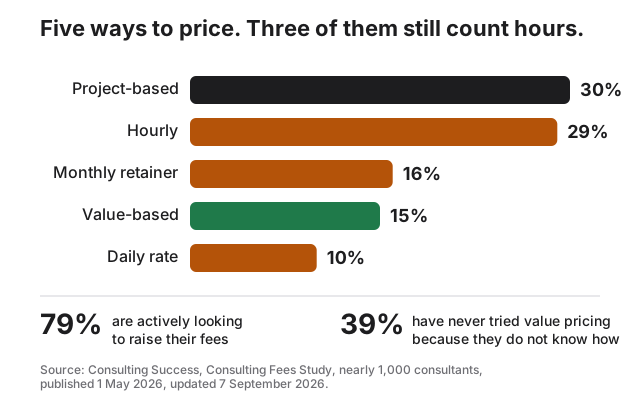
Where the readers of this blog live, among fractional executives, boutique consultancies and professional advisors, the hour is still the unit. Go Fractional’s June 2026 study of its job board found that “hourly pricing remains the dominant model” and that outcome-based deals, “while growing in conversation, are still ramping up in practice”, at an average of $153 an hour. One of its respondents asked the question this post is about, how to reprice “when AI is increasing your efficiency and decreasing hours”. The Consulting Success fees study of nearly 1,000 consultants in more than 75 countries, published in May and updated on 7 September, found project fees the most common primary model at 30%, hourly at 29%, monthly retainers at 16%, value-based fees at 15% and daily rates at 10%. And the largest buyer in the world made the fixed price its default this year. An executive order of 30 April 2026 requires that “Any non-fixed-price contract must be justified in writing by the contracting officer to the agency head,” and the proposed rewrite of the federal acquisition rules for contract types, published on 18 September, takes comments until 19 October. For a defense contractor the discount question arrives as a contract type, and the saving is the firm’s only if it knows its own cost.
Whose hour is it. Read the contract.
Under the email sits a question the client does not ask out loud: who owns an hour that a tool saved. It has three answers, and the contract already chose one of them before anyone opened a model.
Under time and materials, the saved hour is the client’s. The firm sold hours, the hours fell, and the invoice falls with them. The bar’s rule for lawyers is the plain version of every hourly contract: “A fee charged for which little or no work was performed is an unreasonable fee,” in the Bar Examiner’s quotation of Opinion 512. Greg Meyers’s “participate in the downside” is a fair demand here, and the firm that resists it is arguing with its own agreement. The honest move on an hourly contract is not to refuse the saving but to ask whether the work should still be sold by the hour, which is the next two answers.
Under a fixed fee or a retainer, the saved hour is the firm’s, because the firm carried the risk that the work would run long. The client bought a result at a price and got it. Here the email is really about resentment, and Blair Enns, who with David C. Baker has argued against labor-based pricing for years on the 2Bobs podcast, explained in May why it arrives in the middle of a contract rather than at the start of one: “Resentment only arises in your existing client relationships. You don’t lose deals because of pricing resentment.” The lesson he drew: “I should have structured the deal so that my pay was highest when my value was.” Baker added the part that explains a retainer in its second year: “Your highest value was at the beginning, and you’re continuing to get paid the same way even though the value you’re creating is dropping.”
In that episode Enns went further than anyone quoted in this post. AI, he said, was “the last great forcing function that will ultimately kill labor-based pricing in 90% of the businesses out there, including almost all professional services firms.” He also said, “I don’t think you go to hell for selling time,” and his reading of the buyers is worth a small firm’s attention: “If you look at what the leaders in marketing procurement are writing, they’re all saying, ‘Listen, agencies, we’re ready to go past hourly rates.’” Baker’s version was shorter: “Labor-based pricing is dead.”
Under an outcome or a value price, the saving was never on the table, because the price was set on what the result is worth. Ron Baker, who has argued it for decades at VeraSage, told Jetpack Workflow in September that “The billable hour’s been dead for decades. We just haven’t had the funeral yet. AI is delivering the funeral,” and that “Value is not a number. Value’s a feeling.” Asked whether a firm still needs timesheets once it stops billing hourly, he answered in one word: “No.” Jonathan Stark wrote in August that a firm which moves to fixed prices and still builds them from hours has changed its model and not its mind: “You’re forcing the client to evaluate you as labor because you’re only giving them labor to evaluate,” and “Until you know the answers to questions like these, you’re just sneaking hours into the proposal.” Brad Blickstein, who runs the Blickstein Group, put it to The Geek in Review in August: “The amount of time it takes to do the work is not the same as the value of the work,” and, of clients who ask for the hours under a fixed fee, “Either you feel you’re getting fair value or you don’t. But the hours aren’t your business.”
You can’t partner with clients while you bill them hourly. Hourly billing is an adversarial structure. You profit when things take longer. They profit when things go faster. That’s not a partnership. That’s a conflict of interest.
The Hacker News thread on the DealBook piece argued the same three answers with better jokes. otterley retold the old story of the plumber’s bill, with its two lines, “Pipe tapping: $5” and “Knowing where to tap: $495”. neya: “AI is just a tool like everything else. Are you also going to ask me for a discount because I used a powered screw driver?” springtimesun wrote that “you often aren’t really paying for the hours, you’re paying the structural tax that has been established by the system,” and thayne pointed out the asymmetry nobody in the industry mentions: “if AI is making software developers so much more productive, those developers are not getting paid substantially more, or having to work fewer hours.” That last one is the fourth owner of the saved hour, the person who did the work. Inside a firm the saving often goes to the worker first, as a shorter day or a free afternoon, and nobody tells the client or the owner.
Every company is full of secret cyborgs. When I give talks, people always come up afterwards to confess they have automated their work and don’t want to tell anyone.
Whatever the contract says, the market will take some of the saving in the end. Three McKinsey authors wrote in April that “competition tends to erode productivity gains, benefiting customers more than the companies that implement them,” and that the firms which capture the gains ahead of rivals “can temporarily expand margins”. Benjamin Verschuere and Angus Cameron of Liminal Capital wrote in ProMarket in July that “as rival firms adopt the same tools and engage in competition, the productivity gains convert from profits to lower prices, and the surplus passes to consumers.” The word that matters in both is time. The firm that answers the email this quarter from its numbers keeps the gain longer than the firm that answers in two years because a competitor quoted less.
Here is where we land, and it is not quite where the value pricing school lands. On a fixed fee the hours are not the client’s business. They are the owner’s. Accenture’s chief financial officer defined pricing as the margin on the work, and margin is a number nobody can know without the cost of the work, which for a firm that sells its team’s time is mostly hours. Toggl, which sells time tracking and argues for leaving hourly billing, says it in so many words: “If you run retainers, track your time on them anyway. Not to bill it, but to see what your retainer actually costs to deliver each month.” And the large buyers will read the inputs whatever the seller prefers.
enterprise buyers aren’t idiots. they break down input costs and then negotiate. selling them on value is orthogonal to selling billable hours.
So keep the hours as private evidence and talk about the outcome in public. We wrote in July, in why we built Ceed, that whatever a firm charges, the hours are still its cost, and later that month that the number only you know is the budget in hours behind a flat fee. The discount email is where that number earns its keep. A firm that stopped keeping timesheets has nothing to answer a procurement team with except a feeling, and a firm that bills every hour it keeps has already given the saving away.
A new line. On the cost side.
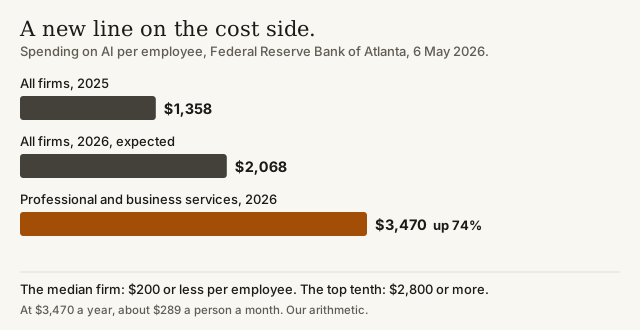
The email counts the saving and forgets the bill. The Federal Reserve Bank of Atlanta asked firms in March what they spend on AI and published the answers on 6 May: $1,358 per employee in 2025 and $2,068 expected in 2026 across firms, and in professional and business services “$3,470 per employee in 2026, a 74 percent increase from 2025”. The spread is wide. The median firm expected to spend no more than $200 a person, and the top tenth at least $2,800. For a firm of ten at the sector’s figure, that is about $34,700 a year, or $289 a person a month. Small beside the people. Not zero, rising fast, and priced by someone else’s list.
Grant Thornton made the point to KPMG in February, and an unnamed former KPMG partner made it more bluntly to The Finance Story: “We’ve invested millions in AI over the last five years. Are you factoring that into the fee, or just expecting the benefits for free?” On our own show, a week ago, Yash Kosaraju, the chief information security officer of a16z, described the bill that comes with speed: “There is one way of finishing the same task in 10 minutes that might cost you $250. Or it could take you 15 minutes and cost you only $50.” The fastest way to do a task is not always the cheapest, and a firm that bills a client ten quick minutes may have paid $250 for them.
The meter is also hard to read. DISCO surveyed 53 law firms and 51 in-house teams and published on 23 September. One respondent: “The token/credit costs seem to be changing as the definition of a task evolves.” DISCO’s own James Park: “Pricing transparency has become a bigger constraint on adoption than output.” Thomson Reuters found in February that “Only 18% of respondents said they knew their organization was tracking return-on-investment (ROI) of AI tools in some manner,” and that 40% of firms had received instructions both to use AI on matters and not to use it, from different clients. Forrester reported in June that 61% of agencies still classify AI as “a ‘cost of business,’ with limited direct monetization.” Paweł Huryn, who writes about product management, closed a post in June with a line about who keeps the saving in the long run: “The savings were never yours. They’re rent, paid up to whoever owns the model.”
Whether the firm can pass the tool cost to the client is a question the law has thought about hardest, and its answers are a good default elsewhere. Carolyn Elefant, in a column the Illinois State Bar Association republished in July: “Subscriptions, platform licenses, and tools that equip the practice generally are overhead,” and “A lawyer may charge a client for metered AI usage, but only when the charges are attributable to the client’s specific matter, billed at actual cost without markup.” Her rule for the rest: “A lawyer whose ordinary AI costs rise should raise rates or adopt flat fees rather than itemize tokens.” Oregon’s bar said in 2025 that lawyers must tell clients, preferably in writing, if they intend to charge the actual cost of AI. Clients are writing their own rules into the time entry. Fulkerson Advisors read 1,054 sets of outside counsel guidelines as of 16 September and found that 20 mention AI: 12 require disclosure, two refuse to pay for time spent using or learning the tools, two refuse to pay for subscriptions, and three expect the savings passed on as fewer hours. Zscaler’s guidelines are the clearest: “If a timekeeper uses generative AI for a discrete task, they should note that in their time entry,” and “Any time and cost associated with AI-generated work product shall not be passed on to Zscaler.”
Small firms improvise. A planning assistant at a seven-person consultancy told Productive what hers did: “Day rates of employees decreased due to the workflow automation enabled by AI, and the AI subscription was added as expenses claim.” That is one answer. The better one, for most firms, is to treat the tools as a cost of the work, count them next to the people on each client, and let the price absorb them the way it absorbs rent. Either way the number has to exist before the email does.
Some hours fall. Some rise.
The clients are not wrong that the price of some work is falling. They are wrong that it is falling for all of it. Upwork’s Future Workforce Index, published on 14 July from a survey of 2,400 US skilled workers and its own marketplace data, is the clearest picture of the split. Earnings for “AI-based execution tasks” fell 28% in a year. For generative and creative production, contract starts grew 90% while earnings per contract fell 13%. Meanwhile “AI-augmented professional services grew 72% year over year and saw earnings rise 22%,” and freelancers doing more complex work with AI saw their earnings rise 45% in the first quarter of 2026. Across every category, freelancers doing AI work earned 34% more per hour than those who did not. Nick Bloom, the Stanford economist, gave the reading in Upwork’s release. The value is not arriving evenly, he said, and is “concentrated in more complex work where people are applying expertise, judgment, and business context on top of AI.”

Rates for judgment are rising. The Thomson Reuters Institute’s law firm index for the second quarter of 2026 found that “Worked rates climbed 7.1%, a pace that would have been almost unthinkable before the last few years,” with technology spending up 11.6%, and warned that “Sustained increases could trigger a pushback, a move toward alternative fee arrangements, or other competitive pressures.” Axiom’s 2025 survey had found that “Only 6% of law firms are charging less for AI-assisted work” and that 34% were charging more. Among independent consultants, 54% raised their rates in the past two years and the North American median is $290 an hour, according to a survey by Reinvention Academy in August. Among agencies the pressure shows: Promethean Research counted 28% raising rates in 2025 and 20% in 2026, with 29% charging between $175 and $199 an hour. Fractional executives quote $153 an hour on average on Go Fractional’s board and $223 at vice president level and above in Fractional Jobs’ report, which are different populations, not a trend. And Cognizant, for all the pressure on its contracts, said revenue per person rose 5% in the first half of 2026.
“Selling time-and-materials directly penalizes efficiency.”
Charley Grant, head of consulting at Andersen, on LinkedIn, 9 September 2026.
Marcel Petitpas and Kristen Kelly of Parakeeto, who run the numbers for agencies, said it best in their episode of 9 September: “AI hasn’t made agency work worse, it has made parts of it replicable,” and “Pricing pressure is usually a mismatch signal: what your firm values isn’t what this client values.” The honest answer to the email splits the work the same way. On the replicable part, the drafts, the first pass, the formatting, the triage, the client is often right and a share is owed. On the judgment, the review, the decision and the name on the result, the price may deserve to rise, and a firm can only say which part is which if it knows where its hours went.
One email. Four answers.
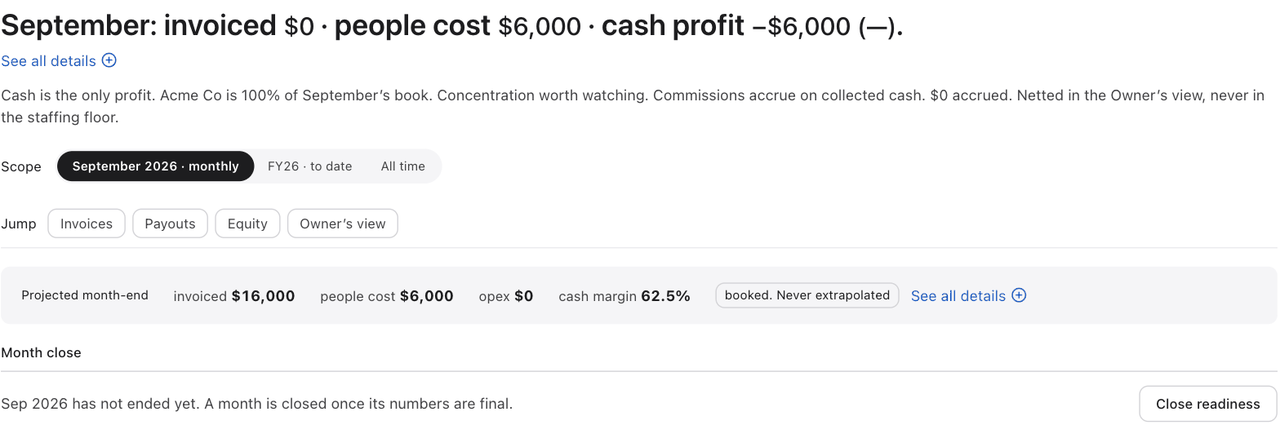
Take one client and one month, with the numbers from Ceed’s demo account, which uses invented names. Acme Co is billed $400 an hour, capped at $16,000 a month, and the consultant on it, Tomás, is paid $150 an hour. In the spring the work took 40 hours a month: $16,000 invoiced, $6,000 of people cost, $10,000 of margin, 62.5%. In September, with the tools, the same work takes 30 hours, and the tools cost $300 a month for this client. Then the email arrives. Here are four answers, with what each does to the month.

The first answer is to say nothing and bill the hours as they fall. The invoice is $12,000 and the margin $7,200. The client has had 25% off, and nobody decided it. It is where 86% of solo law firms are, by Clio’s count, and it is the only answer that gives the client more than the email asked for.
The second is the share. Move the client from hours to a fixed monthly fee for the same scope and give part of the saving back. At $14,800 a month the client pays 7.5% less and the firm keeps $10,000, exactly what it made in the spring. This is the answer in the title: fewer hours, the same margin in dollars, and a price the client can see went down. It is also where the largest contracts are going, as in Cognizant’s agreement with Daimler Truck to split the savings.
The third is the hold, with more. Keep the fee and put the ten hours back into work the client wanted and never had the budget for: the quarterly test, the second review, the report nobody had time to write. The margin is $9,700, and the client pays the same for ten more hours of work a month than the old scope needed. Gini Dietrich, who runs the agency Spin Sucks, wrote the reply for this one: “AI made the mechanics faster,” and the efficiency shows up as speed, scope and reliability. It is the right answer when the client’s real complaint is value, which by the Agency Management Institute’s count is the other 71%.
The fourth is the re-scope. If the client wants cheaper, change what they buy. Take the monthly report out of the agreement, price the rest at $12,000 fixed, and do it in 22 hours. The client pays 25% less and gets less, the firm keeps $8,400 at 70%, and the change is written down. Dietrich again: “If you want cheaper, we adjust scope or service levels.” We wrote about how a scope changes in writing, in the change notice, in September.
There is a fifth answer, the raise, for the client whose work moved the other way. If the tools made the review deeper and the result better, and the work sits in Upwork’s rising categories, the firm can say so and price it. A raise needs the same evidence as a cut. The general counsel in Thomson Reuters’ August survey of stand-out lawyers was asking exactly that: “Are we actually seeing the benefit of that, or are we just seeing increased partner rates to offset efficiencies gained from AI for less associate billing?” We wrote about a rate that never moved while the client grew, and how a firm raises one.
The words matter as much as the arithmetic. Thomson Reuters’ survey of 2,527 lawyers nominated by their clients boiled the conversation down to three questions: “What changed about the work? What changed for the client? What value did that create?” And it added that “The client does not need a tour of the firm’s AI stack.” What the client needs to know, it went on, is “what work will be done faster, clearer, safer, more predictably, and become more useful because of AI.” Jonathan Stark’s questions for the start of any price are the same ones pointed at value: “What is the buyer trying to make happen?” and “What changes if this is a home run?” A buyer on Hacker News said what he had actually been looking for from a contractor: “the rate was never what i was looking at. it was whether the person could tell me what something would cost before they built it.” Prabhash Nayak, on LinkedIn in August, told buyers what to ask: “Not how many people are on the account. Ask what happens to the fee when that number goes down.” The firm that has the answer before the question is asked is the one that keeps the client.
Here are the three replies, in the words we would use. They are drafts, not quotes, and the numbers are the firm’s to fill in.
The share: “You’re right that parts of this got faster. The research and first drafts on your account took about 40 hours a month in the spring and about 30 now. Some of that saving should be yours, so from 1 November the monthly fee is $14,800. What stays the same is the review, the judgment and who signs off.”
The hold: “The hours on drafting fell, and we put them back into the quarterly testing you asked about in June rather than cut the invoice. If you would rather have a lower fee, we can take the monthly report out. Either way you will see the dated work each month.”
The re-scope: “The fee was set for an outcome, not for hours. What changed is the risk on our side, not the result on yours. If the scope should change, let’s change the scope, and the fee with it.”
The hours stay. The price is yours.
Everything above comes down to four numbers for each client: the hours before, the hours now, what the tools cost, and the margin that is left. None of them is on the client’s invoice under a flat fee, and all of them are the owner’s to keep. This is the part of a firm Ceed keeps.
The hours stay, whatever the invoice says. In Ceed the team logs its hours against each client’s budget, from one Slack reminder a day, whether the agreement bills them or not. A flat retainer invoices as a flat retainer, one line, and the hours behind it, with the budget the owner sized the fee from, stay with the firm, as the home page says under the client sees the fee. That record is the answer to the email: forty hours in April and thirty in September on the same work, dated, in the words of the person who did it.
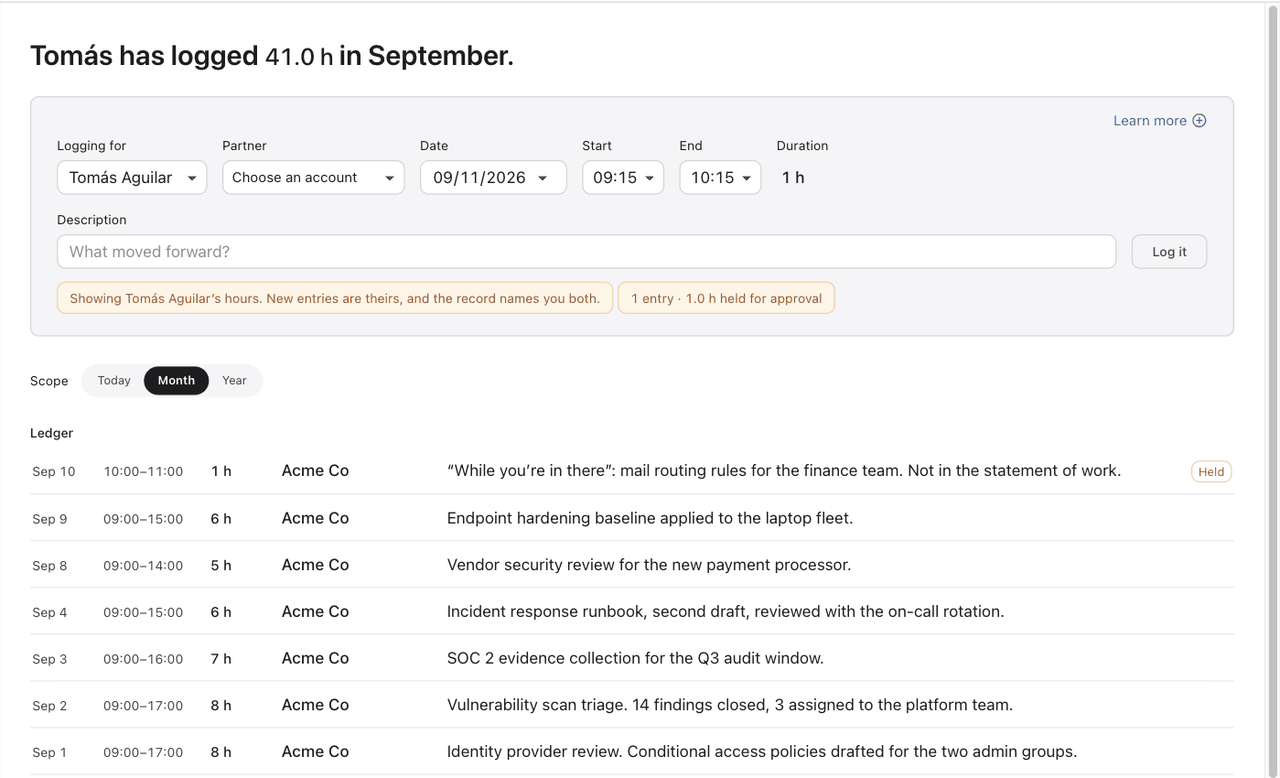
The margin is there before the email. Revenue, cost and margin for every client are in Ceed every morning, from the hours as they are logged, and visible to the owners and whoever they name. An owner who sees 62.5% on Acme Co today knows what 7.5% off would leave, and what 25% off would, before she writes back, and the month reads invoiced, people cost, operating cost and cash margin side by side. We wrote in September about margin per client, this morning, and it is this post’s answer too.
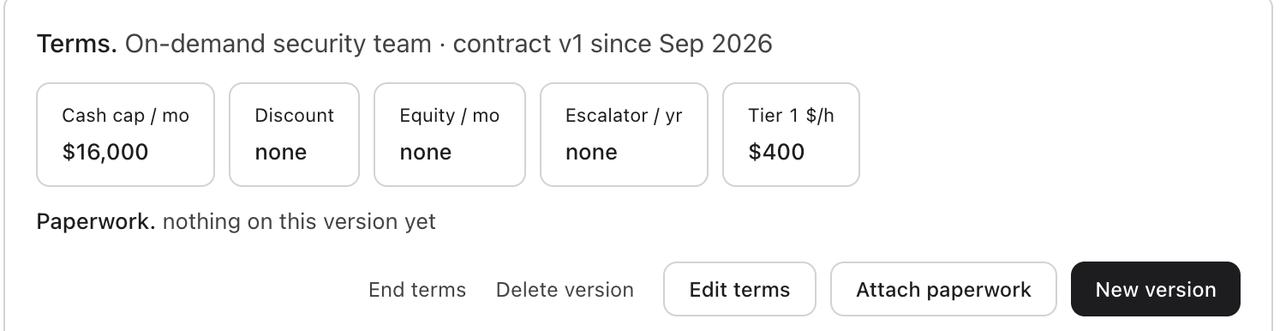
The answer becomes a term. The agreement in Ceed is a terms card: the monthly cap, the rate by tier, the discount, the yearly escalator and any equity taken as payment, versioned, with the signed paperwork attached to the version. A share of the saving is a new version with a discount on it, or a new fee, dated, and every invoice after it is computed from the version in force. The escalator is on the same card, for the client whose work moved the other way. Nothing about the price depends on someone remembering what was agreed in an email in October.
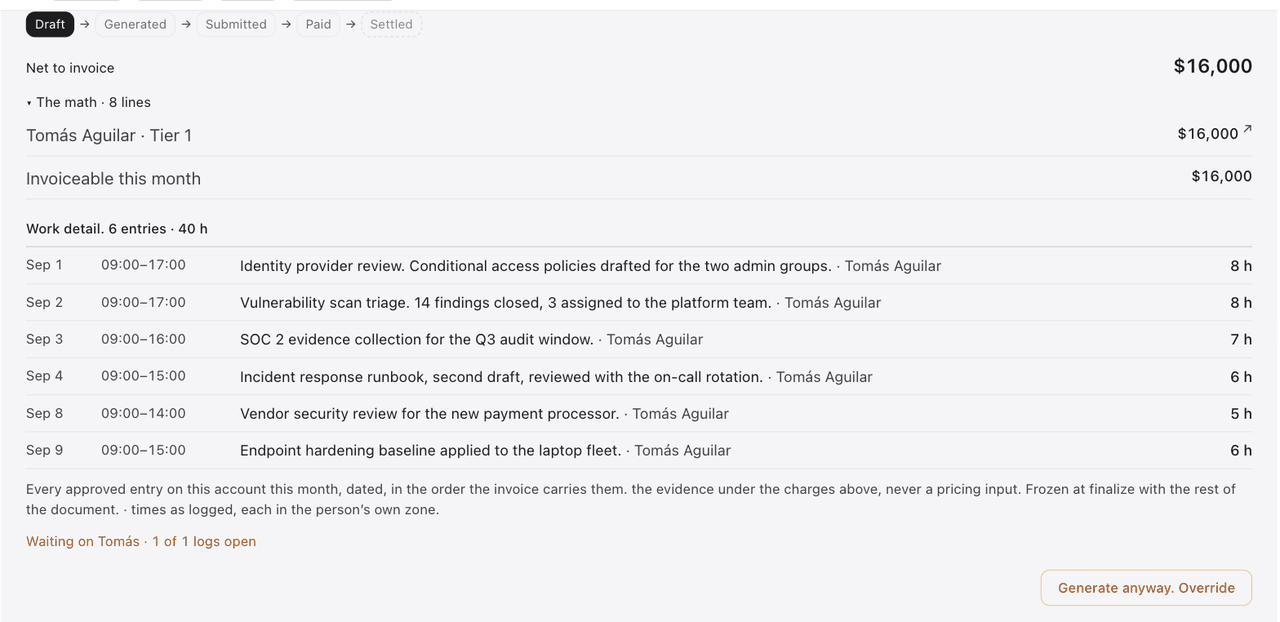
The invoice shows what the money bought. The invoice comes from the agreement, with the approved entries beneath the charges, dated, in the order the invoice carries them. When a procurement team asks what changed, the work detail is the answer, and the agreement decides how much of it the client sees. And when a client asks for more for less, the hour that would push past the budget waits for a person’s yes, so the hold with more is a decision made on the day and not a leak found at the invoice, as we wrote in Held. Not hidden.
Ceed uses AI, and it shows the bill. Ceed Intelligence reads a firm’s people list, W-2s and 1099s, client list and signed agreements into the record, turns a sentence into the act and answers with the firm’s own numbers. Every act shows its price before the firm confirms it, the model’s cost is its own line on the statement, and every number on an invoice is still computed from the agreement and the record, the same way every time. That is the practice this post argues for, applied to ourselves: the tool’s cost is visible for each act, and the price is set by the agreement, not by the minutes the machine saved.
And Ceed’s own price takes part in the downside. It is 0.1% of what the firm invoices, with no seats, no tiers and no minimum, and a month you invoice nothing costs nothing. If a share of the saving takes $1,200 off a client’s month, Ceed’s bill for that month falls by $1.20. Ceed never touches the money. Your bank moves it, and your ledger, your project tool and your payroll provider stay where they are. Where Ceed stands beside the time trackers and the suites is on the comparison page, row by row, dated.
What the books say.
Eight books, four on pricing the work instead of the hours, two on what the tools do to expertise, and two on the economics underneath.
- Implementing Value PricingRonald J. Baker, 2010. The case for pricing the customer rather than the hour, and for dropping the timesheet, which is the view this post argues with most.
- Pricing CreativityBlair Enns, 2018. Pricing rules for firms that sell ideas, options and anchors included, from one of the two voices of the 2Bobs.
- The Business of ExpertiseDavid C. Baker, 2017. The other 2Bob on selling expertise rather than labor, and on positioning a firm so the discount conversation happens less.
- Value-Based FeesAlan Weiss, third edition, 2021. The consultant’s handbook for fees set on the client’s outcome, with the conversations that get there.
- Hourly Billing Is NutsJonathan Stark, 2017. Short essays on the incentive problem in its plainest form, sold as an ebook from his site.
- The Future of the ProfessionsRichard Susskind and Daniel Susskind, updated edition, 2022. The long view of what professionals sell when technology makes expertise cheap.
- Co-IntelligenceEthan Mollick, 2024. By a coauthor of the jagged frontier study, on where the tools help and where they mislead.
- Prediction MachinesAjay Agrawal, Joshua Gans and Avi Goldfarb, 2018. When prediction gets cheap, judgment becomes the scarce input, which is the economics under the whole email.
Three conversations about what speed costs.
The firm behind Ceed also hosts The Security Podcast of Silicon Valley, 104 conversations since 2021 with the people who build and run security. Three of them are about the price of going faster, from the buyer’s side of the table.
- 104
Yash Kosaraju, chief information security officer at a16zSeptember 2026 · Why he does not trust the approve button, and the same task done in ten minutes for $250 or in fifteen for $50.
- 79
Veronica Moturi, Brinks HomeOctober 2025 · Lower costs and better support: AI takes the first line and people keep the judgment, a buyer’s view of the saving.
- 73
Michael Moore, vice president and head of legal at GleanJuly 2025 · How free AI tools become expensive mistakes, the cost line seen from the buyer’s legal department.
Ceed is for firms that sell their team’s time: fractional CFO, CISO, CMO and CTO practices, security, IT and engineering boutiques, data and AI consultancies, management consultancies, law firms and agencies up to fifty people, and nineteen kinds of firm in all. If a client has asked for a share of what AI saved, sign up and answer from your own hours. Nothing to pay until your first invoice.
Sign upOr write to hello@ceed.so.
Questions.
Should a consultancy charge less when it uses AI?
Sometimes, and by a number the firm can work out. On an hourly agreement the client already pays less when the hours fall, because an hour that was not worked cannot be billed. On a fixed fee or a retainer the saving is the firm’s, which carried the risk, and a share is a decision rather than a debt. Make it with four numbers: the hours before and after on the same work, what the tools cost for that client, what happened to the quality, and what the fee now buys. In our worked example a client whose work fell from 40 hours to 30 could have 7.5% off and the firm would keep the same margin in dollars.
If AI makes the work faster, why does it cost the same?
Because the client pays for the result and the risk, not the minutes, and because the saving is uneven. In the Harvard Business School experiment with Boston Consulting Group consultants, the tool made work 25.1% faster inside its frontier and made people 19 percentage points less likely to be right outside it, so the review and judgment around the tool did not get cheaper. The tools are also a new cost, about $3,470 per employee in professional and business services in 2026 by the Atlanta Fed’s count. When the price stays, say what the saving bought instead: more work, faster turnaround or a deeper review.
Is the time AI saves margin for the firm or a price cut for the client?
The contract decides. Under time and materials it is the client’s from the first minute. Under a fixed fee or a retainer it is the firm’s, and competition takes some of it back over time, as three McKinsey authors wrote in April 2026. Under an outcome price it was never on the table. Most firms have a mix, so the useful answer is per client: which work sits inside the frontier, what share of the hours it was, and what the margin on that client is this morning. RSM’s Sergio de la Fe asked the same question in March, and it has no answer without the hours.
Can a firm pass its AI tool costs on to clients?
Usually inside the price, not as a line. The law has written the clearest rules: subscriptions that equip the practice are overhead, metered usage for one client’s matter can be billed at actual cost without markup, and clients should be told in advance, as commentators summarize the American Bar Association’s Opinion 512 and Oregon’s 2025 opinion. Some clients now refuse outright. Of 1,054 outside counsel guidelines read by Fulkerson Advisors, two refuse to pay for AI subscriptions, and Zscaler’s refuse any AI cost at all. Count the tools against each client as a cost of the work and set the price with them in it.
What should I say when a client asks for an AI discount?
Say what changed, with numbers, and offer a choice. Thomson Reuters’ three questions are a good frame: what changed about the work, what changed for the client, and what value that created. Then offer the share, a lower fixed fee that still keeps your margin, the hold, the same fee with the saved hours put back into work the client wants, or the re-scope, a smaller fee for a named, smaller scope. Keep the review, the judgment and who signs off the same, and put whatever you agree in the agreement, dated.
If we price on value, do we still need to track hours?
Yes, for yourself. Value pricing takes the hours off the invoice, not out of the business. The hours are the cost of the work, and without them a firm cannot know its margin per client or answer a procurement team that asks what changed. Toggl, which sells time tracking, gives the same advice for retainers: track the time anyway, to see what each one costs to deliver. In Ceed a flat retainer invoices as one line, and the hours behind it, with the budget the fee was sized from and the margin it leaves, stay with the firm.
 Sasha Sinkevich is a co-founder of Ceed and of YSecurity, where the hours behind every client’s fee are still counted, including the ones a tool saved. Published 29 September 2026. Corrections to hello@ceed.so, and they are dated when made.
Sources
- Financial Times, reprinted by The Irish Times, “Consultants head for a showdown with their own clients”, 31 August 2026. https://www.irishtimes.com/business/2026/08/31/consultants-head-for-a-showdown-with-their-own-clients/. Every source below was read on 28 September 2026 unless another date is given.
- Financial Times, reprinted by The Irish Times, “KPMG pressed its auditor to pass on AI cost savings”, 6 February 2026. https://www.irishtimes.com/business/2026/02/06/kpmg-pressed-its-auditor-to-pass-on-ai-cost-savings/. The Finance Story, 12 February 2026, for the unnamed former KPMG partner. https://thefinancestory.com/kpmg-forced-auditor-for-a-14-ai-discount-will-the-billable-hour-die.
- Reuters, Sai Ishwarbharath B, Abhirami G and Haripriya Suresh, “AI reshapes India’s IT services sector contracts as clients demand more for less”, 20 August 2026, via Yahoo Finance. https://finance.yahoo.com/technology/ai/articles/ai-reshapes-indias-services-sector-230207528.html.
- On the banks and their law firms, as reported from the Financial Times: Point Blank, 1 September 2026, https://www.pointblank.law/p/clients-are-coming-for-the-billable-hour-and-wall-street-is-leading-the-charge. Doug Austin, eDiscovery Today, 9 September 2026, https://ediscoverytoday.com/2026/09/09/wall-street-banks-challenge-the-billable-hour-model-artificial-intelligence-trends/. Modern Counsel, 3 September 2026, https://modern-counsel.com/2026/wall-street-wants-its-share-of-big-laws-ai-savings/.
- The New York Times, DealBook, “As A.I. makes law firms more efficient, clients ask: ‘Where’s my discount?’”, 26 September 2026, cited by its headline. https://www.nytimes.com/2026/09/26/business/dealbook/ai-law-discount-billable-hour.html. The Hacker News thread, 28 September 2026, 140 points and 154 comments when read. https://news.ycombinator.com/item?id=49872522, with the comments by otterley, https://news.ycombinator.com/item?id=49873852, neya, https://news.ycombinator.com/item?id=49873352, springtimesun, https://news.ycombinator.com/item?id=49873757, and thayne, https://news.ycombinator.com/item?id=49873827.
- Agency Management Institute, Agency Core 2026, 579 agency leaders and 400 clients, 11 August 2026. https://www.agencycore.org/agency-core-2026/. Productive, “Agencies in the AI Era”, 21 November 2025, https://productive.io/blog/agencies-in-the-ai-era/, and the pulse report, 174 agencies and consultancies, 11 June 2026, https://productive.io/reports/agencies-in-the-ai-era-pulse-report/. Promethean Research, Digital Agency Industry Report 2026. https://prometheanresearch.com/digital-agency-industry-report/.
- Thomson Reuters, Future of Professionals 2026, press release, 22 June 2026. https://www.thomsonreuters.com/en/press-releases/2026/june/ai-is-ready-but-firms-are-not-how-falling-behind-on-ai-implementation-is-costing-clients-and-talent. Axiom, 2027 In-House Legal Budget Report, 8 September 2026, https://www.prnewswire.com/news-releases/bigger-budgets-less-relief-83-of-in-house-teams-expect-legal-budgets-to-increase-in-2027-yet-55-still-expect-workload-to-outpace-budget-302872397.html, and its 2025 Legal AI Report, https://www.axiomlaw.com/blog/law-firms-cash-in-while-clients-pay-more-the-ai-paradox-reshaping-legal-economics. G2, 2026 Buyer Behavior Report, 1,038 buyers, June 2026. https://sell.g2.com/2026-buyer-behavior-report.
- Clio, on small and solo law firm profitability, 2026, https://www.clio.com/blog/small-solo-law-firm-profitability/, and its 2026 report on solo and small firms, 4 May 2026, https://www.clio.com/about/press/2026-solo-small-firm-report/. Small law firms billing more hours per case, from 8am’s MyCase data, 10 July 2026. https://xira.com/p/2026/07/10/small-law-firms-billing-more-hours-per-case-the-opposite-of-what-ai-promised-but-at-least-theyre-getting-paid/.
- Michael Zipursky, “How to Set a Consulting Hourly Rate”, Consulting Success, 27 July 2026, updated 7 September 2026, https://www.consultingsuccess.com/consulting-hourly-rate. Ikum Kandola, Consultancy.uk, 13 January 2026, https://www.consultancy.uk/news/42718/is-ai-about-to-kill-the-billable-hour-consulting-model (read 12 September 2026).
- OpenAI, “Astra for Law”, 17 September 2026, https://openai.com/index/astra-for-law/. The Hacker News thread, 17 September 2026, 570 points and 671 comments, https://news.ycombinator.com/item?id=49745940, with the comments by WarmWash, https://news.ycombinator.com/item?id=49746392, and stockresearcher, https://news.ycombinator.com/item?id=49746587.
- American Bar Association, Formal Opinion 512, 29 July 2024, https://www.americanbar.org/content/dam/aba/administrative/professional_responsibility/ethics-opinions/aba-formal-opinion-512.pdf, quoted from The Bar Examiner, Fall 2024, https://thebarexaminer.ncbex.org/article/fall-2024/generative-artificial-intelligence-tools/, and summarized by Michele Carney, Law Practice Today, December 2024, https://www.americanbar.org/groups/law_practice/resources/law-practice-today/2024/december-2024/the-reasonableness-of-fees-when-using-ai/. Oregon State Bar, Formal Opinion 2025-205, February 2025, https://www.osbar.org/_docs/ethics/2025-205.pdf. Carolyn Elefant, “The One About Passing AI Costs Through to Clients”, Illinois State Bar Association, 10 July 2026, https://www.isba.org/sections/rural/newsletter/2026/07/theoneaboutpassingaicoststhroughtoclients.
- Fabrizio Dell’Acqua and coauthors, “Navigating the Jagged Technological Frontier: Field Experimental Evidence of the Effects of AI on Knowledge Worker Productivity and Quality”, Harvard Business School working paper 24-013, 18 September 2023. https://papers.ssrn.com/sol3/papers.cfm?abstract_id=4573321. The studies by Brynjolfsson, Li and Raymond, by METR and by Otis and coauthors, as summarized by Digital Applied, 23 September 2026, https://www.digitalapplied.com/blog/ai-productivity-same-task-half-the-time-pay-time-tracking.
- Current, formerly Crete Professionals Alliance, Business Wire, 2 June 2026, https://www.businesswire.com/news/home/20260602293257/en/Crete-Professionals-Alliance-Rebrands-as-Current-to-Equip-Independent-Accounting-Firms-to-Compete-at-Enterprise-Scale. Business Insider on McKinsey’s saved hours, via Yahoo Finance, 7 January 2026, https://finance.yahoo.com/news/mckinseys-ceo-breaks-down-ai-100301404.html.
- Jonathan Stark, “Is AI really more efficient?”, 5 September 2026, https://jonathanstark.com/daily/20260905-2359-is-ai-really-more-efficient, and “Trojan Hours”, 5 August 2026, https://jonathanstark.com/daily/20260805-2359-trojan-hours. Mark Wilson, 16 July 2026, https://www.markwilson.co.uk/thoughts/2026/07/16/ai-isnt-killing-consulting-its-killing-time-as-a-proxy-for-value/. Luis Garicano, “What do consultants get paid for?”, Silicon Continent, 30 July 2026, https://www.siliconcontinent.com/p/what-do-consultants-get-paid-for.
- McKinsey’s outcome share, in the firm’s own words: Business Insider via Yahoo Finance, 17 November 2025, https://finance.yahoo.com/news/ai-reshaping-mckinsey-makes-money-195132745.html. Harvard Business Review, January 2026, https://hbr.org/2026/01/we-want-to-make-ourselves-better. The Wall Street Journal, 29 June 2026, as reported by The Decoder, https://the-decoder.com/deloitte-tells-its-own-consultants-ai-is-coming-for-the-billable-hour/, which is also the source for Deloitte’s town hall.
- Bloomberg on PwC, 27 June 2025, as reported by Going Concern, 30 June 2025, https://www.goingconcern.com/big-4-firm-discovers-that-bragging-about-ai-efficiencies-leads-clients-to-expect-a-discount/. Anita Balakrishnan, The Logic, 19 March 2026, https://thelogic.co/briefing/u-s-pwc-will-move-away-from-hourly-billing-and-toward-ai-subscriptions-exec-says/. Jorja Siemons, “AI Efficiency Gains Push Accounting Firms to Reimagine Pricing”, Bloomberg Tax, 5 March 2026, https://news.bloombergtax.com/financial-accounting/ai-efficiency-gains-push-accounting-firms-to-reimagine-pricing.
- Accenture, second quarter fiscal 2026 conference call, 19 March 2026, https://investor.accenture.com/~/media/Files/A/accenture-v4/investors/earnings-reports/2026/second-quarter-fiscal-2026-conference-call-transcript.pdf, and the date of its fourth quarter results, Business Wire, 15 September 2026, https://www.businesswire.com/news/home/20260915357288/en/Accenture-to-Announce-Fourth-Quarter-and-Full-Year-Fiscal-2026-Results. Cognizant at the Citi Global TMT conference, 8 September 2026, transcript via Investing.com, https://www.investing.com/news/transcripts/cognizant-at-citi-tmt-conference-ai-push-lifts-outlook-93CH-4892007. Deloitte, fiscal 2026 global revenue, 24 September 2026, https://www.deloitte.com/global/en/about/press-room/global-revenue-announcement.html.
- alberth on Hacker News, 9 October 2025, https://news.ycombinator.com/item?id=45527529. Anshuman Vedi, Consultancy.uk, 27 August 2026, https://www.consultancy.uk/news/45467/what-it-takes-to-make-outcome-based-pricing-work-in-consulting. Go Fractional, the economics of fractional work, June 2026, https://www.gofractional.com/insights/economics. Consulting Success, Consulting Fees Study, published 1 May 2026 and updated 7 September 2026, https://www.consultingsuccess.com/consulting-fees.
- The executive order of 30 April 2026, as summarized by Holland & Knight, May 2026, https://www.hklaw.com/en/insights/publications/2026/05/fixed-price-first-choice-new-eo-pushes-agencies-further-away. Federal Register, proposed rule for Parts 16, 17 and 35 of the Federal Acquisition Regulation, 18 September 2026, https://www.federalregister.gov/documents/2026/09/18/2026-19160/federal-acquisition-regulation-revolutionary-federal-acquisition-regulation-overhaul-parts-16-17-and.
- 2Bobs, “Is AI Going to Kill Labor-based Pricing?”, 25 March 2026, https://2bobs.com/podcast/is-ai-going-to-kill-labor-based-pricing, and “Pricing Resentment”, 20 May 2026, https://2bobs.com/podcast/pricing-resentment, quoted from the transcripts on the episode pages. Jetpack Workflow on Ron Baker, 8 September 2026, https://jetpackworkflow.com/blog/value-pricing-for-accounting-firms-ron-baker-on-why-ai-is-killing-the-billable-hour/. The Geek In Review with Brad Blickstein, 3 August 2026, https://www.geeklawblog.com/2026/08/brad-blickstein-on-private-equity-thinking-ai-pricing-and-the-law-firm-business-model.html. Toggl, Elizabeth Thorn, consulting pricing models, 18 May 2026, updated 7 September 2026, https://toggl.com/blog/consulting-pricing-models (read 27 September 2026).
- Antoine Montard, Dago Diedrich and Tanguy Catlin, “Where AI will create value, and where it won’t”, McKinsey, 29 April 2026, https://www.mckinsey.com/capabilities/strategy-and-corporate-finance/our-insights/where-ai-will-create-value-and-where-it-wont. Benjamin Verschuere and Angus Cameron, ProMarket, 15 July 2026, https://www.promarket.org/2026/07/15/what-economists-are-missing-about-ai/.
- Federal Reserve Bank of Atlanta, Barrero, Bloom, Davis, Foster, Meyer, Mihaylov and Navarrete, “How Much Are Firms Spending on AI (and What Will Happen to Headcounts)?”, 6 May 2026. https://www.atlantafed.org/research-and-data/publications/policy-hub-macroblog/2026/05/06/how-much-firms-spending-on-ai-and-what-will-happen-to-headcounts.
- DISCO, survey of 53 law firms and 51 in-house teams, 23 September 2026, https://www.financialcontent.com/article/bizwire-2026-9-23-legal-ais-next-challenge-isnt-accuracy-its-the-bill. Thomson Reuters Institute, 2026 AI in Professional Services Report, 9 February 2026, https://www.thomsonreuters.com/en/institute/articles/ai-in-professional-services-report-2026. Forrester, 24 June 2026, https://investor.forrester.com/news-releases/news-release-details/forrester-nine-10-us-marketing-agencies-use-ai-cut-costs-expense. Fulkerson Advisors, AI in outside counsel guidelines, 1,054 guidelines as of 16 September 2026, https://www.fulkersonadvisors.com/research/ai-in-outside-counsel-guidelines (read 27 September 2026).
- Upwork, Future Workforce Index 2026, 14 July 2026, https://www.globenewswire.com/news-release/2026/07/14/3326964/0/en/Upwork-s-Future-Workforce-Index-2026-How-AI-is-Redefining-the-Value-of-Work-as-Skilled-Freelancing-Accelerates.html. Thomson Reuters Institute, Tomas Arvizu, Q2 2026 Law Firm Financial Index, 31 August 2026, https://www.thomsonreuters.com/en/institute/articles/q2-2026-lffi-analysis-rising-costs. Reinvention Academy, 4 August 2026, https://www.chiefreinventionofficer.com/blog-page/what-are-consultants-charging-in-2026. Fractional Jobs, The Fractional Work Report 2026, https://www.fractionaljobs.io/the-fractional-work-report.
- Gini Dietrich, “Handling the ‘AI Discount’ Question from Clients”, Spin Sucks, 28 October 2025, https://spinsucks.com/communication/ai-discount-client-question/. Thomson Reuters Institute, Stand-out Lawyers survey, 2,527 lawyers, 6 August 2026, https://www.thomsonreuters.com/en/institute/reports/turning-law-firm-ai-strategies-into-practice. Parakeeto, episode 232, 9 September 2026, https://www.parakeeto.com/blog/what-ai-is-doing-to-your-agency-margins-ep232/. launchseed on Hacker News, 23 May 2026, https://news.ycombinator.com/item?id=48251290.
- Posts on LinkedIn, read in a browser on 12 and 28 September 2026: James O’Dowd, 20 August 2026, https://www.linkedin.com/feed/update/urn:li:activity:7496115838916263936/. Mathilde Henry, 20 August 2026, https://www.linkedin.com/feed/update/urn:li:activity:7496099393931161600/. Rob Sinfield, 19 August 2026, https://www.linkedin.com/posts/robertsinfield_aithingserp-understandingai-erp-ugcPost-7495786292991926273-UHuG/. Charley Grant, 9 September 2026, https://www.linkedin.com/feed/update/urn:li:activity:7503386638925070336/. Prabhash Nayak, 18 August 2026, https://www.linkedin.com/posts/prabhash-nayak-017866233_nobody-wants-to-say-this-out-loud-so-i-will-share-7495449408306782208-_njH/.
- Posts on X, read in a browser on 28 September 2026, dates in UTC: Anish Moonka, 4 February 2026, https://x.com/anishmoonka/status/2018956887010824574. Aakash Gupta, 25 May 2026, https://x.com/aakashgupta/status/2058806284468814292. Jonathan Stark, 2 April 2026, https://x.com/jonathanstark/status/2039810856767181028. Ethan Mollick, 2 August 2024, https://x.com/emollick/status/1819240740985115127. Sidu Ponnappa, 12 June 2026, https://x.com/ponnappa/status/2065332462746542119. Paweł Huryn, 20 June 2026, https://x.com/PawelHuryn/status/2068246664452710581.
- Recordings on YouTube, with view counts as read on 28 September 2026: The Economist, “Is McKinsey losing its crown to AI?”, 11 August 2025, https://www.youtube.com/watch?v=QXAXNcRs7gQ. Jeff Sauer, “AI Consulting Made Me Faster. Hourly Billing Punished Me For It”, 7 May 2026, https://www.youtube.com/watch?v=cZlA2_iXVY8. Stanford Digital Economy Lab, Ethan Mollick, 24 October 2023, https://www.youtube.com/watch?v=dPJ6Bxsky0s. Harvard Business Review, “How McKinsey Plans to Survive AI (and Reinvent Consulting)”, 9 February 2026, https://www.youtube.com/watch?v=hSpem_oGAf0. AccountingWEB, “KPMG squeezes auditor for AI discounts”, 12 February 2026, https://www.youtube.com/watch?v=VtywLsAPiOE. Willingness to Pay, “Outcome-Based Pricing: Why It Sounds Better Than It Is”, 7 April 2026, https://www.youtube.com/watch?v=wwdg2HAkO00. 2Bobs, “Is AI Going to Kill Labor-based Pricing?”, 25 March 2026, https://www.youtube.com/watch?v=eyxcXo_By5U. Jetpack Workflow, “How AI Will Kill the Billable Hour in CPA Firms”, 6 September 2026, https://www.youtube.com/watch?v=MIw2p6Upy68. The Geek In Review, Brad Blickstein, 3 August 2026, https://www.youtube.com/watch?v=adgZ2x2_ez8. Parakeeto, episode 232, 9 September 2026, https://www.youtube.com/watch?v=WN4o7Hdxvyg. 2Bobs, “Pricing Resentment”, 20 May 2026, https://www.youtube.com/watch?v=991j7GkAhWc. Sakas & Company, “2030 agency predictions from industry expert Karl Sakas”, 9 April 2025, https://www.youtube.com/watch?v=NB57eJ4wm5o.
- Product pictures are of Ceed’s staging environment in September 2026, showing a demo account with invented names and figures. The worked example uses the same demo numbers, and its arithmetic is ours.
- The Security Podcast of Silicon Valley, a YSecurity production: episode 104 with Yashvier Kosaraju, 22 September 2026, https://ysecurity.io/podcast/104-why-a16zs-ciso-doesnt-trust-the-approve-button/, quoted from the transcript on the page at 28:36. Episode 79 with Veronica Moturi, 7 October 2025, https://ysecurity.io/podcast/79-ai-at-brinks-home-lower-costs-better-customer-support/. Episode 73 with Michael Moore, 15 July 2025, https://ysecurity.io/podcast/73-how-free-ai-tools-become-expensive-mistakes/.